30(b)(6) Deposition Transcription: Corporate Representatives, Technical Terms, and Exhibits
Contents
Quick answer: 30(b)(6) deposition transcription is the preparation of a deposition transcript involving one or more organizational designees testifying on specified topics on behalf of an organization. It should preserve the source, identify speakers carefully, mark uncertainty, and match the required legal format and status before use.
General information only: Court, agency, ethics, evidentiary, privacy, and recording rules vary by jurisdiction and matter. Confirm the governing requirements before filing or relying on a transcript as an official record.
What is this service? — Practical answer: 30(b)(6) deposition transcription is the preparation of a deposition transcript involving one or more organizational designees testifying on specified topics on behalf of an organization. | Why it matters: It converts a spoken legal record into searchable text while preserving the source for verification.
Who uses it? — Practical answer: commercial litigators, corporate counsel, paralegals, and technical subject-matter teams | Why it matters: The transcript supports review, drafting, issue spotting, evidence organization, or authorized record preparation.
Biggest caution — Practical answer: Do not assume a private transcript is the official record. | Why it matters: Official status is controlled by the court, agency, reporter, deposition officer, or governing rule.
What is 30(b)(6) deposition transcription and when is it used?
30(b)(6) deposition transcription is the preparation of a deposition transcript involving one or more organizational designees testifying on specified topics on behalf of an organization.
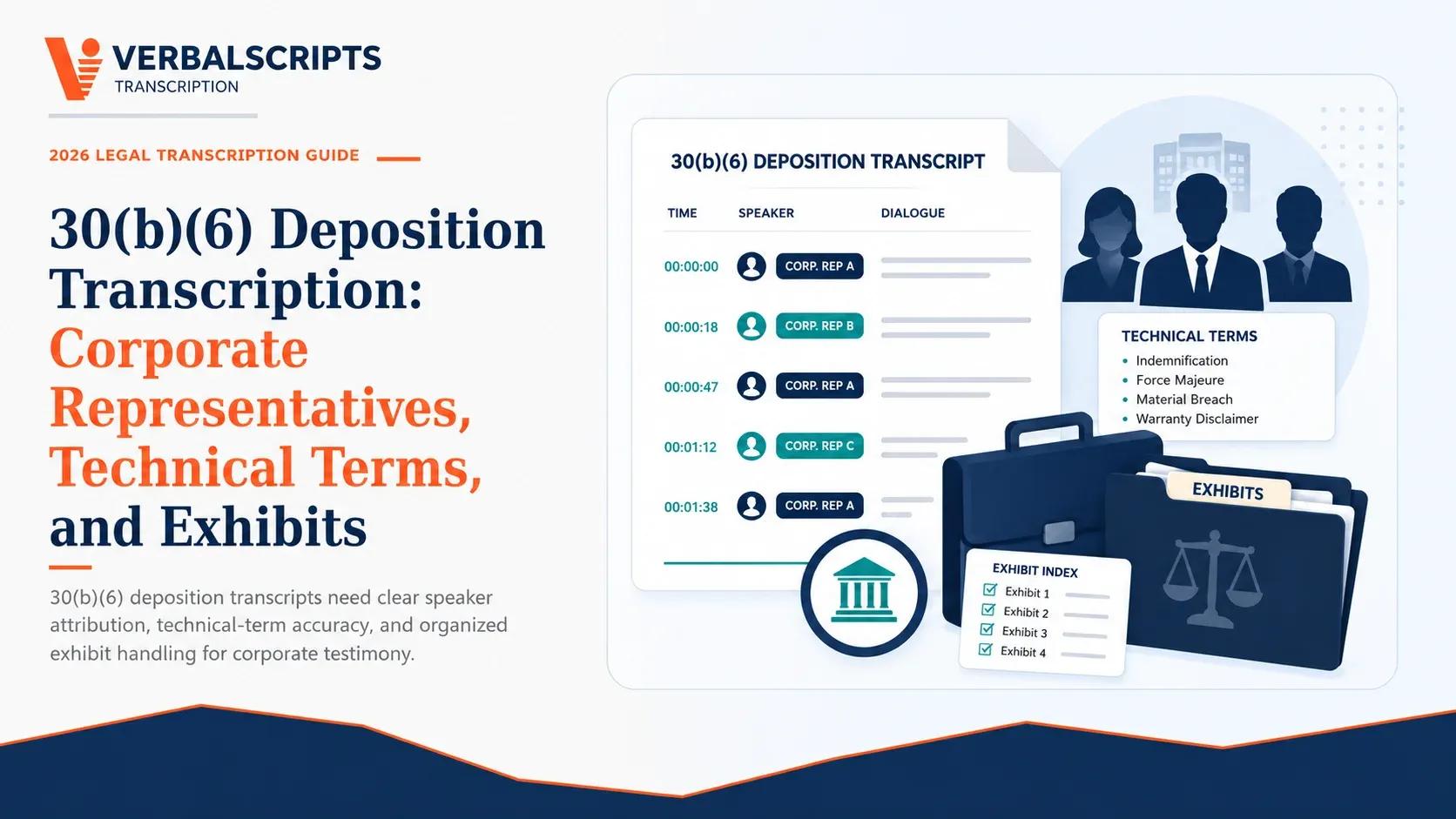
These depositions are terminology-heavy and structurally complex. The same corporate representative may address several noticed topics, multiple designees may testify, and exhibits often include policies, contracts, data, engineering records, or financial materials.
In practice, use the organization’s exact name and consistent labels for each designee rather than generic “witness” labels when multiple representatives appear. This distinction matters because the transcript should be designed around the decision the legal team actually needs to make, not around a generic transcription template.
For legal teams, a technical glossary should be built from the deposition notice, pleadings, product names, acronyms, systems, and exhibit list. A good provider should ask for enough case context to spell names and terms correctly without taking over the lawyer’s legal judgment.
Why does 30(b)(6) deposition transcription matter for legal review?
The practical value of 30(b)(6) deposition transcription is speed of review. Audio and video preserve tone and original context, but text allows a legal team to search names, phrases, dates, figures, objections, exhibit references, and recurring themes across a matter.
From a quality-control standpoint, exhibit references should preserve the numbers or letters used on the record; do not renumber exhibits for convenience. When the transcript is consistent, it becomes easier to compare testimony across witnesses and proceedings and to locate the exact source segment for verification.
During production, if a witness speaks about a topic outside personal knowledge or distinguishes personal knowledge from organizational knowledge, the wording should be preserved carefully. The transcript should therefore be treated as a structured review tool whose reliability depends on accurate transcription, careful uncertainty notation, and a clear link back to the source recording.
For commercial litigators, corporate counsel, paralegals, and technical subject-matter teams, that combination can reduce the time spent repeatedly replaying long recordings while preserving the ability to verify every material quotation against the original.
What should a high-quality 30(b)(6) deposition transcription include?
A legal transcript should make the spoken record easier to use without changing it. The exact format depends on the proceeding, but the strongest deliverables usually include the following elements:
• Clear speaker identification based on names or roles that can actually be supported by the recording and reference materials.
• Consistent treatment of interruptions, crosstalk, false starts, and inaudible passages.
• Timestamps when fast verification against audio or video matters.
• Accurate case names, proper nouns, dates, numbers, statutes, medical or technical terms, and exhibit references.
• A stable format that matches counsel’s workflow, such as Q-and-A, page-and-line, Word, searchable PDF, or timecoded text.
• A certification statement only when requested and only to the extent the preparer is authorized to make it.
For case preparation, corrections to names or technical terms should be verified from counsel-provided reference materials rather than guessed from the audio.
When the record is complex, for multi-day or multi-designee matters, one lead editor should normalize terminology and formatting across the transcript set.
Comparison at a glance
Individual deposition — Primary purpose: Witness testifies personally | Typical use: Personal knowledge focus | Key caution: Confirm governing rules and source status.
Rule 30(b)(6) deposition — Primary purpose: Designee testifies for organization on noticed matters | Typical use: Corporate knowledge and topic scope | Key caution: Confirm governing rules and source status.
Expert deposition — Primary purpose: Opinion testimony | Typical use: Qualifications, methodology, specialized terms | Key caution: Confirm governing rules and source status.
How does the 30(b)(6) deposition transcription workflow work?
A defensible production workflow is easier to manage when every handoff is explicit. A practical seven-step process is:
1. Preserve and identify the source. Keep the original recording unchanged and record where it came from, the proceeding date, and any file identifiers.
2. Define the intended use. Tell the provider whether the transcript is for internal review, deposition production, motion practice, an appeal, an agency record, or possible filing.
3. Send case context. Provide the case caption, speaker spellings, terminology, exhibit list, and formatting instructions that can reduce ambiguity.
4. Transcribe conservatively. Capture what is audible, label speakers carefully, and mark uncertainty rather than guessing.
5. Review against the source. Editing and review should focus on omissions, mishears, names, numbers, terminology, and speaker attribution.
6. Proofread and format. Apply the requested legal style, headings, timestamps, page-and-line format, indexes, or deliverable formats consistently.
7. Deliver securely and retain appropriately. Return the transcript through the agreed channel and follow the matter’s retention, deletion, or legal-hold instructions.
For high-stakes matters, rushing should compress scheduling rather than eliminate review. If the deadline is extremely short, it is better to agree on partial delivery or coordinated team production than to silently remove quality-control stages.
What legal and procedural issues should you check before using 30(b)(6) deposition transcription?
Federal Rule of Civil Procedure 30(b)(6) requires the organization to designate one or more persons to testify about information known or reasonably available to the organization. State analogues may differ.
A transcription provider should not decide admissibility, privilege, recording legality, or the official status of a court record. Those are legal or tribunal questions for counsel, the reporter, the clerk, or the agency. The provider’s job is to preserve the source faithfully, follow the requested format, and describe the deliverable accurately.
Authentication and chain of custody are also separate from transcription accuracy. A perfectly typed transcript does not prove who made the recording, whether it is complete, whether it was lawfully obtained, or whether it satisfies a jurisdiction’s evidentiary rules. Preserve the original and maintain the documentation counsel needs to establish foundation.
Where privacy-sensitive information is involved, send only the material the provider is authorized to receive and use a secure workflow with access restrictions, confidentiality agreements, and appropriate retention limits.
How should quality control be handled for 30(b)(6) deposition transcription?
For legal material, quality control should be separated into distinct checks rather than treated as a final spell-check. A practical four-part sequence is transcription/editing, substantive review against the recording, proofreading, and formatting verification.
The first pass should capture the spoken content and resolve obvious terminology from approved reference materials. The review pass should listen again to difficult passages and check speaker attribution, omissions, numbers, names, and material legal or technical terms. Proofreading then focuses on punctuation, consistency, internal contradictions, and typographical errors. Formatting review confirms page structure, timestamps, exhibit references, headers, indexes, and certificate language.
No reviewer should be rewarded for turning every unclear section into a confident sentence. Honest uncertainty notation is a quality feature. If speech cannot be established reliably after reasonable review, the transcript should say so and direct the legal team to the exact timestamp.
For long or multi-file matters, a shared style sheet is equally important. The style sheet should track party names, counsel, witnesses, acronyms, recurring exhibits, technical terms, preferred labels, and any case-specific formatting decisions.
What mistakes should legal teams avoid with 30(b)(6) deposition transcription?
Common failures are predictable: ordering the wrong type of transcript, assuming a private transcript is official, sending a low-quality derivative instead of the source, withholding speaker names and reference documents, choosing rush without stating a real deadline, and treating inaudible speech as an invitation to guess.
Another frequent mistake is changing the source during enhancement. If audio processing is needed, preserve the original evidence file and create a separate working copy. The transcript can then reference the working copy while the unaltered source remains available for authentication and evidentiary questions.
Finally, avoid over-certification. A certificate of accuracy can describe the transcription work, but it should not promise 'court admissibility' in every jurisdiction or imply the vendor is an official court reporter when it is not.
What should you send a provider for 30(b)(6) deposition transcription?
Send the best available source recording plus the minimum case context needed for accurate production: case caption, proceeding date, file list, speaker names and roles, terminology, exhibits, requested transcript style, output format, certification instructions, and exact due date with time zone.
If there are protective orders, HIPAA restrictions, student privacy concerns, immigration safety concerns, or special retention requirements, communicate them before upload. When the provider knows the constraints at intake, the project can be assigned, reviewed, and delivered within the correct security boundary.
Related VerbalScripts resources can help with specialized workflows, including legal transcription, deposition work, court-reporter support, turnaround planning, court-admissible formatting, and PDF delivery.
Conclusion: choosing the right 30(b)(6) deposition transcription workflow
The best 30(b)(6) deposition transcription workflow is the one that fits the proceeding, deadline, evidence status, and intended legal use without overstating what the transcript is. Preserve the source, give the transcription team accurate case context, require transparent handling of uncertainty, and verify the governing rules before filing or representing a transcript as official.
VerbalScripts supports law firms and legal teams with human legal transcription, secure file handling, speaker identification, timestamps, legal formatting, proofreading, and rush options. For a project-specific quote, send the recording duration, proceeding type, deadline, and required deliverables so the scope can be confirmed before work begins.
Related VerbalScripts resources
For related workflows, review deposition transcription services; transcription services for lawyers and attorneys; transcription support for court reporters; PDF transcription delivery; transcription turnaround-time guide; Legal transcription services.
Frequently asked questions
Is 30(b)(6) deposition transcription the same as an official court transcript?
Not necessarily. A transcript can be professionally prepared and accurate without being the official record. Official status depends on the court, agency, deposition officer, reporter, or other procedure that governs the proceeding. Before filing or citing a private transcript as official, confirm the applicable rule, order, or clerk instructions.
How accurate should 30(b)(6) deposition transcription be?
Legal transcription should aim for the highest practical accuracy the recording allows, with special attention to names, numbers, legal and technical terminology, speakers, and exhibits. Accuracy also means marking genuine uncertainty. A provider should not invent words simply to make the transcript read smoothly when the audio is unclear.
Should 30(b)(6) deposition transcription include timestamps?
Use timestamps when counsel needs to verify quotations, review video or audio evidence, locate inaudible sections, build trial clips, or work quickly through a long recording. For a traditional official page-and-line transcript, the governing format may prioritize page and line citations instead. The provider can deliver both when useful.
Can poor audio still be transcribed?
Often, yes, but the result depends on what the source actually captured. Low volume, background noise, echo, crosstalk, and compression can reduce intelligibility. Careful enhancement of a working copy may help, but missing or clipped speech cannot always be recovered. Unresolved passages should be marked with timestamps rather than guessed.
What is the best format for 30(b)(6) deposition transcription?
Word is useful for attorney editing and review, while searchable PDF provides a stable distribution copy. Page-and-line legal formatting, Q-and-A structure, timestamps, condensed copies, indexes, SRT/VTT captions, or other formats may be appropriate depending on the proceeding. Specify the intended use before production starts.
How fast can VerbalScripts deliver 30(b)(6) deposition transcription?
Turnaround depends on recording length, audio quality, speaker count, legal complexity, formatting, and the requested review level. Standard legal work is commonly scheduled over several business days, with 24-hour and same-day options available for suitable projects. The safest approach is to provide an exact deadline and request a written feasibility confirmation.
General information only: Court, agency, ethics, evidentiary, privacy, and recording rules vary by jurisdiction and matter. Confirm the governing requirements before filing or relying on a transcript as an official record.
Quick answer: 30(b)(6) deposition transcription is the preparation of a deposition transcript involving one or more organizational designees testifying on specified topics on behalf of an organization. It should preserve the source, identify speakers carefully, mark uncertainty, and match the required legal format and status before use.
General information only: Court, agency, ethics, evidentiary, privacy, and recording rules vary by jurisdiction and matter. Confirm the governing requirements before filing or relying on a transcript as an official record.
What is this service? — Practical answer: 30(b)(6) deposition transcription is the preparation of a deposition transcript involving one or more organizational designees testifying on specified topics on behalf of an organization. | Why it matters: It converts a spoken legal record into searchable text while preserving the source for verification.
Who uses it? — Practical answer: commercial litigators, corporate counsel, paralegals, and technical subject-matter teams | Why it matters: The transcript supports review, drafting, issue spotting, evidence organization, or authorized record preparation.
Biggest caution — Practical answer: Do not assume a private transcript is the official record. | Why it matters: Official status is controlled by the court, agency, reporter, deposition officer, or governing rule.
What is 30(b)(6) deposition transcription and when is it used?
30(b)(6) deposition transcription is the preparation of a deposition transcript involving one or more organizational designees testifying on specified topics on behalf of an organization.
These depositions are terminology-heavy and structurally complex. The same corporate representative may address several noticed topics, multiple designees may testify, and exhibits often include policies, contracts, data, engineering records, or financial materials.
In practice, use the organization’s exact name and consistent labels for each designee rather than generic “witness” labels when multiple representatives appear. This distinction matters because the transcript should be designed around the decision the legal team actually needs to make, not around a generic transcription template.
For legal teams, a technical glossary should be built from the deposition notice, pleadings, product names, acronyms, systems, and exhibit list. A good provider should ask for enough case context to spell names and terms correctly without taking over the lawyer’s legal judgment.
Why does 30(b)(6) deposition transcription matter for legal review?
The practical value of 30(b)(6) deposition transcription is speed of review. Audio and video preserve tone and original context, but text allows a legal team to search names, phrases, dates, figures, objections, exhibit references, and recurring themes across a matter.
From a quality-control standpoint, exhibit references should preserve the numbers or letters used on the record; do not renumber exhibits for convenience. When the transcript is consistent, it becomes easier to compare testimony across witnesses and proceedings and to locate the exact source segment for verification.
During production, if a witness speaks about a topic outside personal knowledge or distinguishes personal knowledge from organizational knowledge, the wording should be preserved carefully. The transcript should therefore be treated as a structured review tool whose reliability depends on accurate transcription, careful uncertainty notation, and a clear link back to the source recording.
For commercial litigators, corporate counsel, paralegals, and technical subject-matter teams, that combination can reduce the time spent repeatedly replaying long recordings while preserving the ability to verify every material quotation against the original.
What should a high-quality 30(b)(6) deposition transcription include?
A legal transcript should make the spoken record easier to use without changing it. The exact format depends on the proceeding, but the strongest deliverables usually include the following elements:
• Clear speaker identification based on names or roles that can actually be supported by the recording and reference materials.
• Consistent treatment of interruptions, crosstalk, false starts, and inaudible passages.
• Timestamps when fast verification against audio or video matters.
• Accurate case names, proper nouns, dates, numbers, statutes, medical or technical terms, and exhibit references.
• A stable format that matches counsel’s workflow, such as Q-and-A, page-and-line, Word, searchable PDF, or timecoded text.
• A certification statement only when requested and only to the extent the preparer is authorized to make it.
For case preparation, corrections to names or technical terms should be verified from counsel-provided reference materials rather than guessed from the audio.
When the record is complex, for multi-day or multi-designee matters, one lead editor should normalize terminology and formatting across the transcript set.
Comparison at a glance
Individual deposition — Primary purpose: Witness testifies personally | Typical use: Personal knowledge focus | Key caution: Confirm governing rules and source status.
Rule 30(b)(6) deposition — Primary purpose: Designee testifies for organization on noticed matters | Typical use: Corporate knowledge and topic scope | Key caution: Confirm governing rules and source status.
Expert deposition — Primary purpose: Opinion testimony | Typical use: Qualifications, methodology, specialized terms | Key caution: Confirm governing rules and source status.
How does the 30(b)(6) deposition transcription workflow work?
A defensible production workflow is easier to manage when every handoff is explicit. A practical seven-step process is:
1. Preserve and identify the source. Keep the original recording unchanged and record where it came from, the proceeding date, and any file identifiers.
2. Define the intended use. Tell the provider whether the transcript is for internal review, deposition production, motion practice, an appeal, an agency record, or possible filing.
3. Send case context. Provide the case caption, speaker spellings, terminology, exhibit list, and formatting instructions that can reduce ambiguity.
4. Transcribe conservatively. Capture what is audible, label speakers carefully, and mark uncertainty rather than guessing.
5. Review against the source. Editing and review should focus on omissions, mishears, names, numbers, terminology, and speaker attribution.
6. Proofread and format. Apply the requested legal style, headings, timestamps, page-and-line format, indexes, or deliverable formats consistently.
7. Deliver securely and retain appropriately. Return the transcript through the agreed channel and follow the matter’s retention, deletion, or legal-hold instructions.
For high-stakes matters, rushing should compress scheduling rather than eliminate review. If the deadline is extremely short, it is better to agree on partial delivery or coordinated team production than to silently remove quality-control stages.
What legal and procedural issues should you check before using 30(b)(6) deposition transcription?
Federal Rule of Civil Procedure 30(b)(6) requires the organization to designate one or more persons to testify about information known or reasonably available to the organization. State analogues may differ.
A transcription provider should not decide admissibility, privilege, recording legality, or the official status of a court record. Those are legal or tribunal questions for counsel, the reporter, the clerk, or the agency. The provider’s job is to preserve the source faithfully, follow the requested format, and describe the deliverable accurately.
Authentication and chain of custody are also separate from transcription accuracy. A perfectly typed transcript does not prove who made the recording, whether it is complete, whether it was lawfully obtained, or whether it satisfies a jurisdiction’s evidentiary rules. Preserve the original and maintain the documentation counsel needs to establish foundation.
Where privacy-sensitive information is involved, send only the material the provider is authorized to receive and use a secure workflow with access restrictions, confidentiality agreements, and appropriate retention limits.
How should quality control be handled for 30(b)(6) deposition transcription?
For legal material, quality control should be separated into distinct checks rather than treated as a final spell-check. A practical four-part sequence is transcription/editing, substantive review against the recording, proofreading, and formatting verification.
The first pass should capture the spoken content and resolve obvious terminology from approved reference materials. The review pass should listen again to difficult passages and check speaker attribution, omissions, numbers, names, and material legal or technical terms. Proofreading then focuses on punctuation, consistency, internal contradictions, and typographical errors. Formatting review confirms page structure, timestamps, exhibit references, headers, indexes, and certificate language.
No reviewer should be rewarded for turning every unclear section into a confident sentence. Honest uncertainty notation is a quality feature. If speech cannot be established reliably after reasonable review, the transcript should say so and direct the legal team to the exact timestamp.
For long or multi-file matters, a shared style sheet is equally important. The style sheet should track party names, counsel, witnesses, acronyms, recurring exhibits, technical terms, preferred labels, and any case-specific formatting decisions.
What mistakes should legal teams avoid with 30(b)(6) deposition transcription?
Common failures are predictable: ordering the wrong type of transcript, assuming a private transcript is official, sending a low-quality derivative instead of the source, withholding speaker names and reference documents, choosing rush without stating a real deadline, and treating inaudible speech as an invitation to guess.
Another frequent mistake is changing the source during enhancement. If audio processing is needed, preserve the original evidence file and create a separate working copy. The transcript can then reference the working copy while the unaltered source remains available for authentication and evidentiary questions.
Finally, avoid over-certification. A certificate of accuracy can describe the transcription work, but it should not promise 'court admissibility' in every jurisdiction or imply the vendor is an official court reporter when it is not.
What should you send a provider for 30(b)(6) deposition transcription?
Send the best available source recording plus the minimum case context needed for accurate production: case caption, proceeding date, file list, speaker names and roles, terminology, exhibits, requested transcript style, output format, certification instructions, and exact due date with time zone.
If there are protective orders, HIPAA restrictions, student privacy concerns, immigration safety concerns, or special retention requirements, communicate them before upload. When the provider knows the constraints at intake, the project can be assigned, reviewed, and delivered within the correct security boundary.
Related VerbalScripts resources can help with specialized workflows, including legal transcription, deposition work, court-reporter support, turnaround planning, court-admissible formatting, and PDF delivery.
Conclusion: choosing the right 30(b)(6) deposition transcription workflow
The best 30(b)(6) deposition transcription workflow is the one that fits the proceeding, deadline, evidence status, and intended legal use without overstating what the transcript is. Preserve the source, give the transcription team accurate case context, require transparent handling of uncertainty, and verify the governing rules before filing or representing a transcript as official.
VerbalScripts supports law firms and legal teams with human legal transcription, secure file handling, speaker identification, timestamps, legal formatting, proofreading, and rush options. For a project-specific quote, send the recording duration, proceeding type, deadline, and required deliverables so the scope can be confirmed before work begins.
Related VerbalScripts resources
For related workflows, review deposition transcription services; transcription services for lawyers and attorneys; transcription support for court reporters; PDF transcription delivery; transcription turnaround-time guide; Legal transcription services.
Frequently asked questions
Is 30(b)(6) deposition transcription the same as an official court transcript?
Not necessarily. A transcript can be professionally prepared and accurate without being the official record. Official status depends on the court, agency, deposition officer, reporter, or other procedure that governs the proceeding. Before filing or citing a private transcript as official, confirm the applicable rule, order, or clerk instructions.
How accurate should 30(b)(6) deposition transcription be?
Legal transcription should aim for the highest practical accuracy the recording allows, with special attention to names, numbers, legal and technical terminology, speakers, and exhibits. Accuracy also means marking genuine uncertainty. A provider should not invent words simply to make the transcript read smoothly when the audio is unclear.
Should 30(b)(6) deposition transcription include timestamps?
Use timestamps when counsel needs to verify quotations, review video or audio evidence, locate inaudible sections, build trial clips, or work quickly through a long recording. For a traditional official page-and-line transcript, the governing format may prioritize page and line citations instead. The provider can deliver both when useful.
Can poor audio still be transcribed?
Often, yes, but the result depends on what the source actually captured. Low volume, background noise, echo, crosstalk, and compression can reduce intelligibility. Careful enhancement of a working copy may help, but missing or clipped speech cannot always be recovered. Unresolved passages should be marked with timestamps rather than guessed.
What is the best format for 30(b)(6) deposition transcription?
Word is useful for attorney editing and review, while searchable PDF provides a stable distribution copy. Page-and-line legal formatting, Q-and-A structure, timestamps, condensed copies, indexes, SRT/VTT captions, or other formats may be appropriate depending on the proceeding. Specify the intended use before production starts.
How fast can VerbalScripts deliver 30(b)(6) deposition transcription?
Turnaround depends on recording length, audio quality, speaker count, legal complexity, formatting, and the requested review level. Standard legal work is commonly scheduled over several business days, with 24-hour and same-day options available for suitable projects. The safest approach is to provide an exact deadline and request a written feasibility confirmation.
General information only: Court, agency, ethics, evidentiary, privacy, and recording rules vary by jurisdiction and matter. Confirm the governing requirements before filing or relying on a transcript as an official record.
Subscribe to our newsletter.
Get latest updates for our Articles & Blogs. We post fresh content every week.
- Weekly articles
- Stay updated with our weekly articles covering various topics.
- No spam
- We respect your inbox. No spam, just valuable content.

Sign up for our monthly newsletter