
Discover how AI medical dictation innovations are transforming clinical documentation for faster, accurate healthcare
Jun 14, 2026
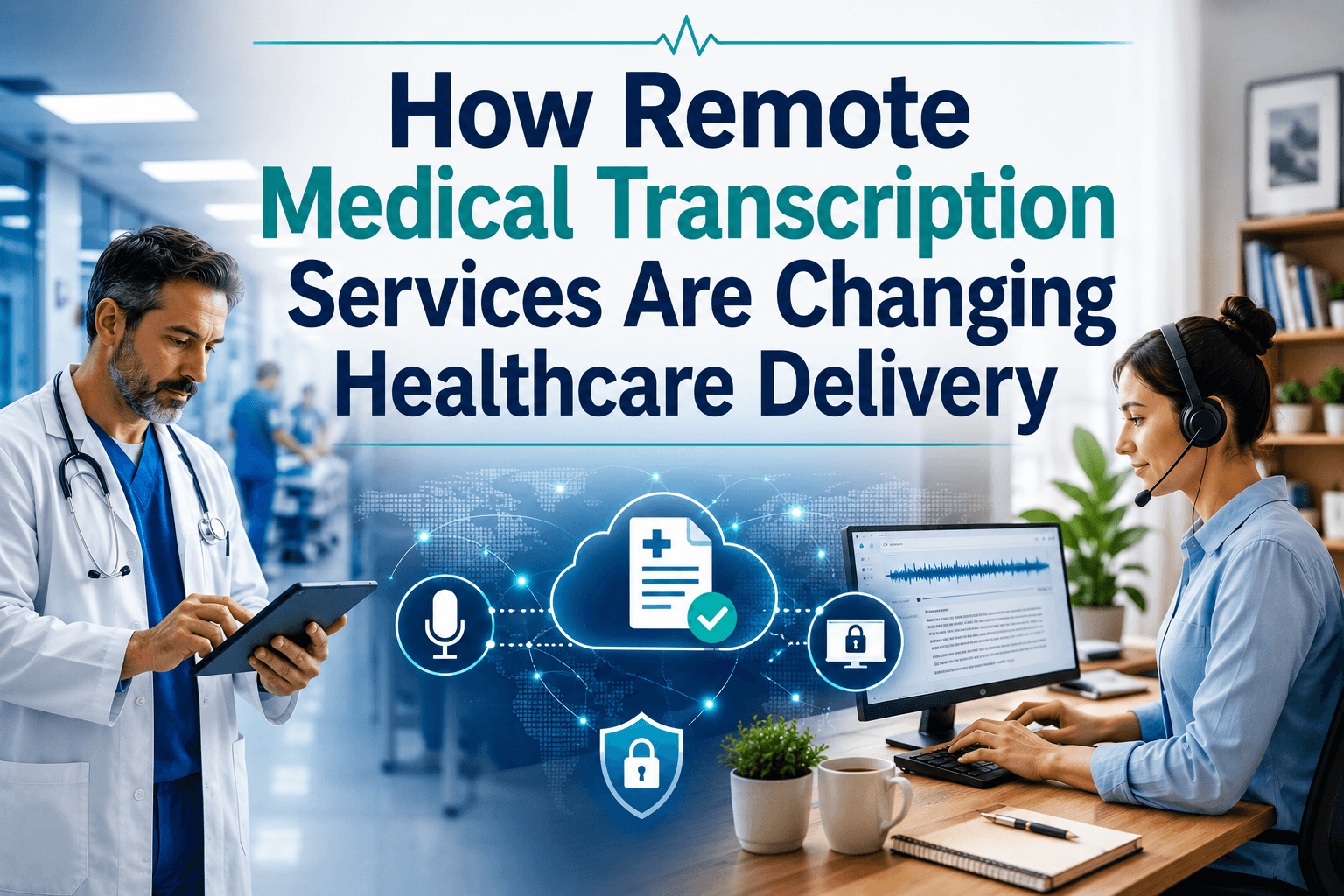
How Remote Medical Transcription Services Are Changing Healthcare Delivery
by Content Specialist—2 minute read
Contents
Doctors create patient notes between rounds in a hectic ER; nurses balance charts; specialists rush against time to keep records current. Now imagine a silent home office many miles away where, by a series of voice notes, a medical transcriptionist smoothly changes them into accurate digital records that can be searched. Beyond a vision for the future, this is the truth of remote medical transcription services, a quiet revolution changing how healthcare works.
Clunky tape recorders and internal transcription departments belong to days gone by. Cloud-based systems and AI-driven tools help physicians nowadays delegate documentation chores to experienced remote transcriptionists, therefore enabling their free time to concentrate on patient care. However, this change is not just about convenience—it is about solving important deficiencies in the accuracy, accessibility, and efficiency of healthcare. One keystroke at a time, let us explore how remote transcription is transforming the business.
What is remote medical transcription?
Voice-recorded reports—such as doctor's notes, diagnoses, or surgical summaries—that have been transcribed into written text for patient files define medical transcription. By using technology to outsource these tasks to off-site experts, remote medical transcription services go one rung beyond. Healthcare professionals upload audio files on secure internet platforms, which are subsequently transcribed, checked, and returned ready polished documents for electronic health records (EHRs).
This approach matches state-of-the-art technologies with human knowledge. Although artificial intelligence could take care of first drafts for quickness, skilled transcribers verify that medical jargon, drug names, and difficult vocabulary are exactly recorded. The outcome is a more efficient process under which doctors spend more time treating and less typing. I used although up there because not all transcription services use AI. Few companies like Verbalscripts understand the delicate manner of medical transcription and the importance of accuracy that AI services may not achieve, and they choose to depend on human transcribers for accuracy and security purposes.
Organizations that separate transcription from physical location benefit from access to a worldwide talent pool without concern for overhead expenses such as office space, equipment, or full-time wages. Service plans generally charge on a per-line or per-minute basis, thus transforming fixed internal costs into steady operational expenditures. When demand varies—such as during a public health crisis or flu season—remote services scale smoothly to add or reduce transcription capability without affecting speed or accuracy.
Recover Clinician Time and Improve Patient Relations
Busy doctors find great breather from remote medical transcription, one of its most appealing advantages. Many research shows that doctors may spend two hours on electronic health record documentation for each hour they devote to hands-on patient care. By outsourcing documentation, clinicians reclaim these lost hours, enabling them to focus on diagnosis, treatment planning, and patient engagement rather than typing notes.
Transcribed reports getting to doctors quickly—sometimes in just a few hours—cancel the well known "pajama time" where physicians log back into EHRs after clinic hours to complete notes. Almost instantly available clear, precise notes allow doctors to enter every appointment well-prepared with thorough patient history and latest test results. Improved diagnostic accuracy and a more robust therapeutic relationship follow from providers being able to focus their whole attention on listening and solving patient complaints.
Flexible scalability and major cost efficiency.
Running an in‑house transcription department comes with significant overhead: recruitment, training, IT infrastructure, workspace, tools, and benefits all add up. Moreover, remote transcription services change these fixed expenses into variable costs by charging only for the lines or minutes transcribed. After moving to outsourced methods, medical businesses often cite a 40%–60% reduction in transcription expenditures. Furthermore, billing is clear and consistent, simplifying budgeting and financial planning.
Handling volume variations is also a strong suit of remote services. Transcription needs can explode during peak times, such as seasonal sickness outbreaks; businesses can just increase remote capacity rather than trying to hire temporary workers or pay overtime. Conversely, they scale back during quieter periods, preventing idle personnel expenses. This flexibility gives organizational speed and financial flexibility, allowing medical organizations to distribute resources where they are most needed.
Elevating Accuracy by Means of AI Help and Professional Review
Given that even small transcription errors can lead to wrong medical diagnoses and billing disputes, accuracy in medical records cannot be negotiated. Remote transcription businesses address this by using several professional editing passes by specialists knowledgeable in anatomy, pharmacology, and medical terms. Speed in this can result in a hybrid approach that comes from artificial intelligence and human judgment to provide accuracy.
More advanced systems use machine‑learning algorithms to flag uncertain terms or potential contradictions, hence requesting review of records for editors. Remote services deliver reliable documents doctors can use for critical decision-making by combining human and technological expertise, while quality control usually entails peer reviews or random audits to maintain accuracy levels above 99%.
Perfect incorporation of telehealth and EHR products.
Though the rapid spread of telehealth has revolutionized patient care access, it has also created new paperwork problems. Remote medical transcription interfaces seamlessly with telehealth systems and EHR systems through secure APIs or encrypted data transfers. If video meetings or phone conversations are virtual, they are recorded, transcribed, and automatically placed into the electronic record of the patient.
End-to-end automation ensures that telemedicine appointments are documented as thoroughly as those conducted in person. Patients get continuous follow-up treatment as referral letters, laboratory requests, and discharge notes move seamlessly from one source to another, independent of the setting. Providers benefit from the same workflow continuity, with all notes and reports centralized in the EHR.
Assure legal compliance and data security.
Remote transcription companies with good reputation use end-to-end encryption, secure servers, vigorous data-security policies, and comply with laws like HIPAA for data-security measures as well as compliance with regulations. Legal agreements for company associates and regular security checks ensure all processes meet or exceed legal standards.
By maintaining extra certifications including SOC-2 and ISO 27001, some websites display their commitment to data security. Extensive audit trails and incident‑response plans reduce breach risks and enable fast response if an accident happens. These checks allow health organizations to securely delegate transcription without exposing patient information.
Real World Impact: A Hospital. Case Studies.
Struggling with transcription delays and increasing administrative costs, a mid‑sized community hospital shifted to a remote transcription contractor. Physicians said they gained one extra hour per day for direct patient care, therefore severely limiting after-hour charting. The hospital reduced turnaround times by 30% and transcription costs by 25% in three months.
Follow-up visits were speeded up by improved accessibility of discharge summaries and surgical notes, therefore reducing wait times for test results by 20%. Patient satisfaction rose and revenue cycle management improved since billing and coding departments got on-time documentation for claims processing. The hospital administration pointed to remote transcription for lower cost savings as well as improvements in the quality of care.
The AI‑Enabled Next Generation of Medical Translation.
With ambient‑listening "scribe" systems now able to pick up clinician‑patient talks in real time, investment in AI‑powered transcription tools has rapidly grown in recent years. Early pilots indicate that using these tools can cut documentation time in half, allowing doctors to concentrate solely on talking with patients. Smart summarization capabilities extract important medical data—such as changes in medication or vital signs—and populate organized templates within the EHR.
Though artificial intelligence alone cannot take the place of human oversight, experts urge caution even in the face of fast progress. Especially with various accents or background noise, speech-recognition engines still produce "hallucinations" or misinterpretations. The new model is a combination one: AI manages majority transcription, and professional proofreaders use discerning judgment to guarantee accuracy and context. This partnership offers efficiency without compromising the standard on which doctors rely.
Defeating obstacles and accepting change.
Changing to remote transcription demands careful preparation. Companies need to screen vendors for transparency, contractual agreements, and compliance credentials. Staff training and change management plans help medical professionals adjust to new processes and develop confidence in outsourced documentation. Before full deployment, pilot programs with specific performance metrics—such as turnaround time, error rates, and user satisfaction—offer information to refine processes.
Clear communication on security policies and quality‑assurance procedures relieves worries about artificial intelligence integration and outsourcing. Most organizations that negotiate these stages successfully have constant improvements in clinician well-being, operational efficiency, and patient results.
However, to protect you from the inaccuracies of AI, you can opt for fully human transcription services like Verbalscripts that guarantee an unmatched accuracy of 99%
Conclusion
By combining global knowledge with sophisticated technology, remote medical transcription services free clinicians from the monotony of charting, provide scalable cost savings, and keep strict accuracy and security criteria. Integration with telehealth and EHR systems guarantees that every patient interaction—virtual or in person—is seamlessly documented. The hybrid approach of machine transcription combined with human validation will help to speed up processes without sacrificing quality as AI technologies keep improving. A seminal innovation in a healthcare setting where patient-centered care and efficiency are top priorities, remote transcription lets physicians give their total attention to curing while guaranteeing every word is recorded and kept for the best care delivery.

Protect patient data with Verbalscripts’ reliable, HIPAA-compliant medical transcription services ensuring accuracy and privacy.

Medical transcription streamlines documentation, boosts accuracy, protects patient data, and helps doctors focus more on care instead of paperwork.

Fast, accurate transcription services helping San Francisco tech and media teams turn spoken content into clear, searchable, and actionable text.
Subscribe to our newsletter.
Get latest updates for our Articles & Blogs. We post fresh content every week.
- Weekly articles
- Stay updated with our weekly articles covering various topics.
- No spam
- We respect your inbox. No spam, just valuable content.

Legal TranscriptionAudio and Video Transcription servicesGeneral TranscriptionFocus groups and InterviewsMedical TranscriptionAcademic & Conference Transcription
Court reporting & LegalCorporate & general businessMedia productionDigital & online learningGovernmentHealthcare
About UsBlogsLocationsFrequently Asked QuestionsPrivacy PolicyTerms of Service
Sign up for our monthly newsletter
© Verbalscripts 2026. All rights reserved.