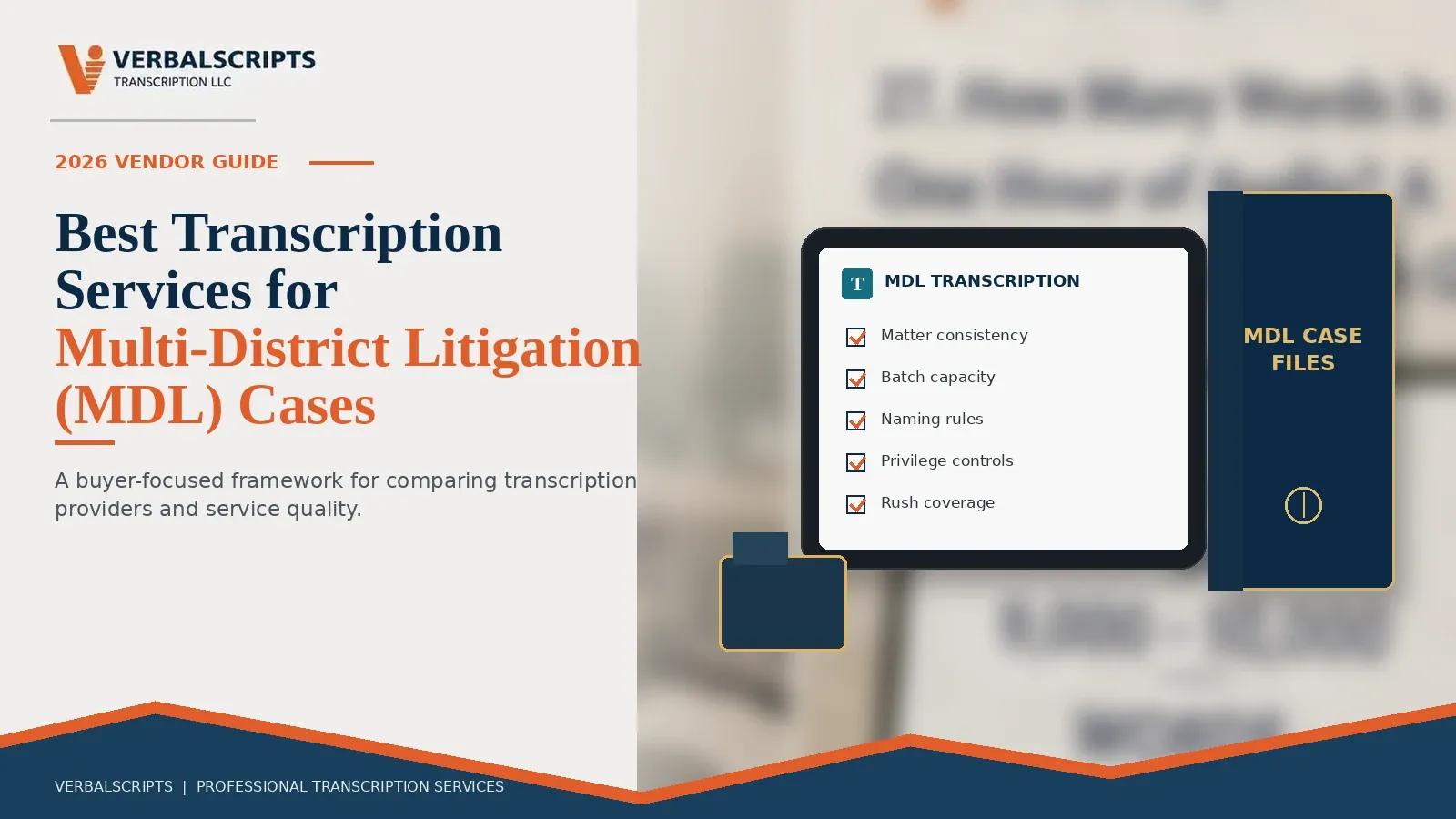
Best Transcription Services for Multi-District Litigation (MDL) Cases
Contents
Quick answer: For MDL counsel, litigation support, discovery teams, common-benefit committees, and law-firm operations, MDL transcription services should be evaluated on more than price. Start with capacity for simultaneous productions across many plaintiffs and firms and centralized style guide, caption, and terminology governance, then verify accuracy, security, turnaround, and contract accountability. The strongest choice is the provider that can prove.
A transcription purchase can look simple until the recording contains privileged strategy, protected health information, research-participant data, evidentiary material, or a deadline that cannot move. For MDL counsel, litigation support, discovery teams, common-benefit committees, and law-firm operations, the decision is therefore not merely who can turn speech into text. It is whether the provider can deliver usable text without creating a new quality, privacy, security, or operational problem.
This 2026 guide approaches MDL transcription services as a buyer and governance decision. The best MDL transcription service is one that can manage high volume, matter-level security, uniform formatting, rush waves, centralized glossaries, cross-firm access rules, and defensible version control. A managed legal transcription provider is often the best fit for non-official audio. The practical objective is a repeatable process: define what the transcript must do, define what the vendor may do with the data, identify objective proof points, price the complete deliverable, and make the service level enforceable.
Why does MDL transcription services require a buyer-specific evaluation?
The best MDL transcription service is one that can manage high volume, matter-level security, uniform formatting, rush waves, centralized glossaries, cross-firm access rules, and defensible version control. A managed legal transcription provider is often the best fit for non-official audio. Convert that principle into a written operating specification that the buyer can test, contract, and monitor.
What should buyers require from MDL transcription services?
1. Capacity for simultaneous productions across many plaintiffs and firms
Make capacity for simultaneous productions across many plaintiffs and firms a written requirement, not an informal expectation. Test it with a representative file and record the result. Connect the sales promise to a person, system, handoff, QA step, or contract obligation that can still be verified after onboarding.
2. Centralized style guide, caption, and terminology governance
Treat centralized style guide, caption, and terminology governance as an acceptance criterion for MDL transcription services. Set the threshold according to the recording and consequence of failure. Higher-risk work needs stronger evidence, tighter access, clearer corrections, and more explicit escalation than public or low-sensitivity content.
3. Matter, plaintiff, deponent, and source-file traceability
Ask the vendor to demonstrate matter, plaintiff, deponent, and source-file traceability with evidence during evaluation. Convert the promise into operational language covering scope, responsibility, turnaround, data handling, evidence, and escalation. If the control is vague before award, it will be harder to resolve under deadline.
4. Privilege and common-interest confidentiality controls
For MDL counsel, litigation support, discovery teams, common-benefit committees, and law-firm operations, document privilege and common-interest confidentiality controls before production begins. Define the owner, acceptable proof, exception process, and escalation if it is missed. A mature provider should show a sample, workflow, policy excerpt, technical detail, report, or contract term instead of relying on a broad marketing statement.
5. Rush capacity around depositions, hearings, and bellwether milestones
Make rush capacity around depositions, hearings, and bellwether milestones a written requirement, not an informal expectation. Test it with a representative file and record the result. Connect the sales promise to a person, system, handoff, QA step, or contract obligation that can still be verified after onboarding.
6. Consistent correction logs and version control
Treat consistent correction logs and version control as an acceptance criterion for MDL transcription services. Set the threshold according to the recording and consequence of failure. Higher-risk work needs stronger evidence, tighter access, clearer corrections, and more explicit escalation than public or low-sensitivity content.
7. Reporting that supports cost allocation and common-benefit administration
Ask the vendor to demonstrate reporting that supports cost allocation and common-benefit administration with evidence during evaluation. Convert the promise into operational language covering scope, responsibility, turnaround, data handling, evidence, and escalation. If the control is vague before award, it will be harder to resolve under deadline.
How can MDL counsel compare vendors objectively?
Use a weighted scorecard so every finalist is judged against the same evidence. A simple 1-to-5 rating can work if each score has a definition and reviewers write the evidence behind it. Security and legal requirements can be pass/fail gates while quality, turnaround, support, and commercial terms receive weighted scores.
capacity for simultaneous productions across many plaintiffs and firms — Weak approach: Vague promise; evidence supplied only after an incident or deadline problem. | Strong approach: Defined owner, written procedure, measurable requirement, and evidence available during evaluation. | Evidence to request: Ask for a sample, policy excerpt, contract clause, report, or test result addressing capacity for simultaneous productions across many plaintiffs and firms.
centralized style guide, caption, and terminology governance — Weak approach: Vague promise; evidence supplied only after an incident or deadline problem. | Strong approach: Defined owner, written procedure, measurable requirement, and evidence available during evaluation. | Evidence to request: Ask for a sample, policy excerpt, contract clause, report, or test result addressing centralized style guide, caption, and terminology governance.
matter, plaintiff, deponent, and source-file traceability — Weak approach: Vague promise; evidence supplied only after an incident or deadline problem. | Strong approach: Defined owner, written procedure, measurable requirement, and evidence available during evaluation. | Evidence to request: Ask for a sample, policy excerpt, contract clause, report, or test result addressing matter, plaintiff, deponent, and source-file traceability.
privilege and common-interest confidentiality controls — Weak approach: Vague promise; evidence supplied only after an incident or deadline problem. | Strong approach: Defined owner, written procedure, measurable requirement, and evidence available during evaluation. | Evidence to request: Ask for a sample, policy excerpt, contract clause, report, or test result addressing privilege and common-interest confidentiality controls.
rush capacity around depositions, hearings, and bellwether milestones — Weak approach: Vague promise; evidence supplied only after an incident or deadline problem. | Strong approach: Defined owner, written procedure, measurable requirement, and evidence available during evaluation. | Evidence to request: Ask for a sample, policy excerpt, contract clause, report, or test result addressing rush capacity around depositions, hearings, and bellwether milestones.
consistent correction logs and version control — Weak approach: Vague promise; evidence supplied only after an incident or deadline problem. | Strong approach: Defined owner, written procedure, measurable requirement, and evidence available during evaluation. | Evidence to request: Ask for a sample, policy excerpt, contract clause, report, or test result addressing consistent correction logs and version control.
Do not average away a critical failure. A vendor that scores well on price and support but cannot meet a mandatory confidentiality, court, HIPAA, CJIS, accessibility, or data-residency requirement should not advance until the exception is formally accepted by the responsible owner.
Which contract and service-level terms matter most for MDL transcription services?
Scope, formats, and turnaround
Define recordings, transcript types, verbatim level, speaker labels, timestamps, formatting, languages, exclusions, when the turnaround clock starts, rush cutoffs, and escalation for a missed MDL transcription services deadline.
Quality and correction
Define review stages, acceptance criteria, unclear-audio treatment, correction windows, version naming, and whether a correction changes pagination, synchronized media, Bates ranges, or other delivery formats.
Data use, confidentiality, and security
Limit data use to the contracted service; define confidentiality duties, access controls, approved transfer methods, incident notification, subprocessor conditions, and restrictions on unauthorized model training or unrelated analytics.
Retention, deletion, and exit
Set source-recording and transcript retention, backup handling, legal holds, deletion triggers, return or export at termination, and any deletion confirmation the buyer requires.
Commercial and governance terms
Set pricing units, minimums, complexity and rush charges, invoice detail, volume tiers, support, reporting, renewal, price-change notice, service credits where appropriate, termination, and transition assistance.
The most useful contract language mirrors the real workflow. If the operating team says one thing, the sales proposal says another, and the MSA is silent, the buyer has created an avoidable dispute. Attach the final style guide, service-level table, security addendum, data-use terms, and rate card to the agreement where practical.
How should a buyer pilot and monitor MDL transcription services after award?
Use a live matter-style pilot, not a generic marketing sample. Provide a representative recording, caption format, names, exhibits, and deadline. Ask the vendor to show how it handles inaudible passages, competing speakers, privilege, source-file identity, corrections, and final delivery. Compare the result against a written rubric before discussing long-term volume commitments.
A pilot should produce a written acceptance note: what worked, what changed, which assumptions were confirmed, and which exceptions remain. That note becomes the onboarding baseline. After launch, track performance by program or matter rather than relying on anecdotes from individual files.
A seven-step process for selecting and governing MDL transcription services
Step 1: Define the use case
Write down why the MDL transcription services output exists, who will rely on it, and what happens if it is late or wrong.
Step 2: Classify the recording
Identify confidentiality, privilege, PHI/PII, research restrictions, CJI/CUI, export or cross-border concerns, and any court, client, agency, or grant obligations.
Step 3: Standardize the specification
Use one test package containing representative audio, speaker information, terminology, formatting rules, reference documents, and a defined deadline.
Step 4: Score evidence, not claims
Create a weighted matrix for quality, security, workflow fit, capacity, support, price, and contractual accountability. Require the same evidence from each finalist.
Step 5: Run a controlled pilot
Use realistic files and test normal, difficult, and deadline-sensitive scenarios. Measure corrections, response time, formatting consistency, and handling of unclear audio.
Step 6: Contract the operating model
Move agreed controls, turnaround definitions, pricing, retention, data-use restrictions, escalation, and exit obligations into the signed agreement and SOW.
Step 7: Monitor the service
Review recurring metrics such as on-time delivery, correction rate, rush performance, incident tickets, unresolved questions, invoice accuracy, and upcoming volume forecasts.
What are the most common buying mistakes?
• Choosing MDL transcription services on headline price before normalizing what is included in the deliverable.
• Treating a marketing claim as proof instead of asking for a policy, sample, contract clause, technical detail, or pilot result.
• Skipping a real-file pilot and discovering terminology, speaker-label, formatting, security, or turnaround problems after rollout.
• Allowing offices or project teams to create conflicting requirements that the vendor cannot operationalize consistently.
• Failing to define who can approve exceptions, rush work, retention changes, corrections, disclosure of sensitive recordings, or the final transition at termination.
How Verbalscripts fits into the evaluation
Verbalscripts is one option to include when the buyer wants a managed, human-reviewed transcription workflow rather than a raw speech-to-text output. The right fit still depends on the file, jurisdiction, data classification, deadline, and required deliverable. Buyers should evaluate Verbalscripts with the same scorecard and evidence requirements used for any competing provider.
For workflow context, compare Legal Transcription Services, Transcription for Legal Professionals, and Transcription for Lawyers and Attorneys. Use these pages to confirm how the requested use case maps to Verbalscripts before a pilot.
Additional buyer references include Transcription for Corporate Counsel, Strict-Confidentiality Transcription Workflow, and Support for Court Reporters. Compare those published workflows against the same security, quality, turnaround, and contract criteria used for every finalist.
Important legal, compliance, or policy note
Court-reporter and official-transcript requirements still apply where mandated. This guide addresses outsourced transcription for recordings and litigation-support use cases.
Frequently asked questions
What is the most important requirement for MDL transcription services?
Start with the consequence of an error or disclosure, then prioritize capacity for simultaneous productions across many plaintiffs and firms, centralized style guide, caption, and terminology governance, and documented quality review. The threshold should match the use case: a privileged legal recording, clinical interview, public podcast, and routine internal meeting do not carry the same risk.
Should price be the deciding factor when selecting MDL transcription services?
No. Normalize proposals for scope before comparing rates. A low quote may exclude review, timestamps, formatting, security, revisions, difficult audio, rush capacity, or support. Compare total delivered cost, likely rework, operational risk, and the time your staff must spend fixing or managing the output.
How should buyers test MDL transcription services before signing a long contract?
Run a pilot with representative audio, including one difficult file and one realistic deadline. Give finalists the same instructions. Measure accuracy, speaker labels, formatting, unclear-audio treatment, response time, secure delivery, correction turnaround, and whether the invoice matches the quoted assumptions.
What proof should a transcription vendor provide?
For MDL transcription services, request evidence proportionate to risk: a workflow, security overview, access and retention description, sample deliverable, QA explanation, incident contact, subprocessor information, and proposed contract language. Regulated buyers may additionally need questionnaires, assessments, BAAs, DPAs, certificates, or agency-specific documentation.
How often should a transcription vendor be reviewed after onboarding?
Review MDL transcription services operational metrics monthly or continuously for active programs, then follow the organization’s normal formal vendor-review cycle. Reassess sooner after a major security change, new subprocessor, repeated quality issue, new data type, cross-border expansion, acquisition, or material increase in volume.
When is it time to replace a transcription vendor?
Replace or re-source MDL transcription services when failures become systemic: repeated missed SLAs, unstable quality, unclear data practices, weak support, inability to scale, unresolved billing problems, or refusal to document critical controls. Preserve templates, glossaries, open matters, correction history, and retention obligations before transitioning.
Conclusion: choosing MDL transcription services in 2026
The strongest MDL transcription services decision is a documented operating decision, not a price-only purchase. Define the transcript’s purpose, classify the data, specify quality and formatting, test a representative file, verify security and retention, contract the service level, and monitor performance. That approach gives MDL counsel, litigation support, discovery teams, common-benefit committees, and law-firm operations a defensible way to buy transcription at the level of quality and control the work actually requires.
If you are evaluating a new program, Verbalscripts can review a representative file and your formatting, security, turnaround, and delivery requirements so you can compare a concrete workflow rather than a generic quote.
Authoritative sources and further reading
• ABA Model Rule 1.6 - Confidentiality of Information
• Federal Rule of Evidence 901 - Authenticating or Identifying Evidence
• NIST SP 800-161 Rev. 1 - Cybersecurity Supply Chain Risk Management
This article provides general information and is not legal, medical, regulatory, or compliance advice. Requirements vary by jurisdiction, organization, contract, and intended use.
Subscribe to our newsletter.
Get latest updates for our Articles & Blogs. We post fresh content every week.
- Weekly articles
- Stay updated with our weekly articles covering various topics.
- No spam
- We respect your inbox. No spam, just valuable content.

Sign up for our monthly newsletter