
The top five legal transcription businesses operating in Los Angeles will be discussed in this article.
Aug 3, 2026
How Accurate Is Professional Transcription? The Complete 2026 Guide
by Verbalscripts—2 minute read
Contents
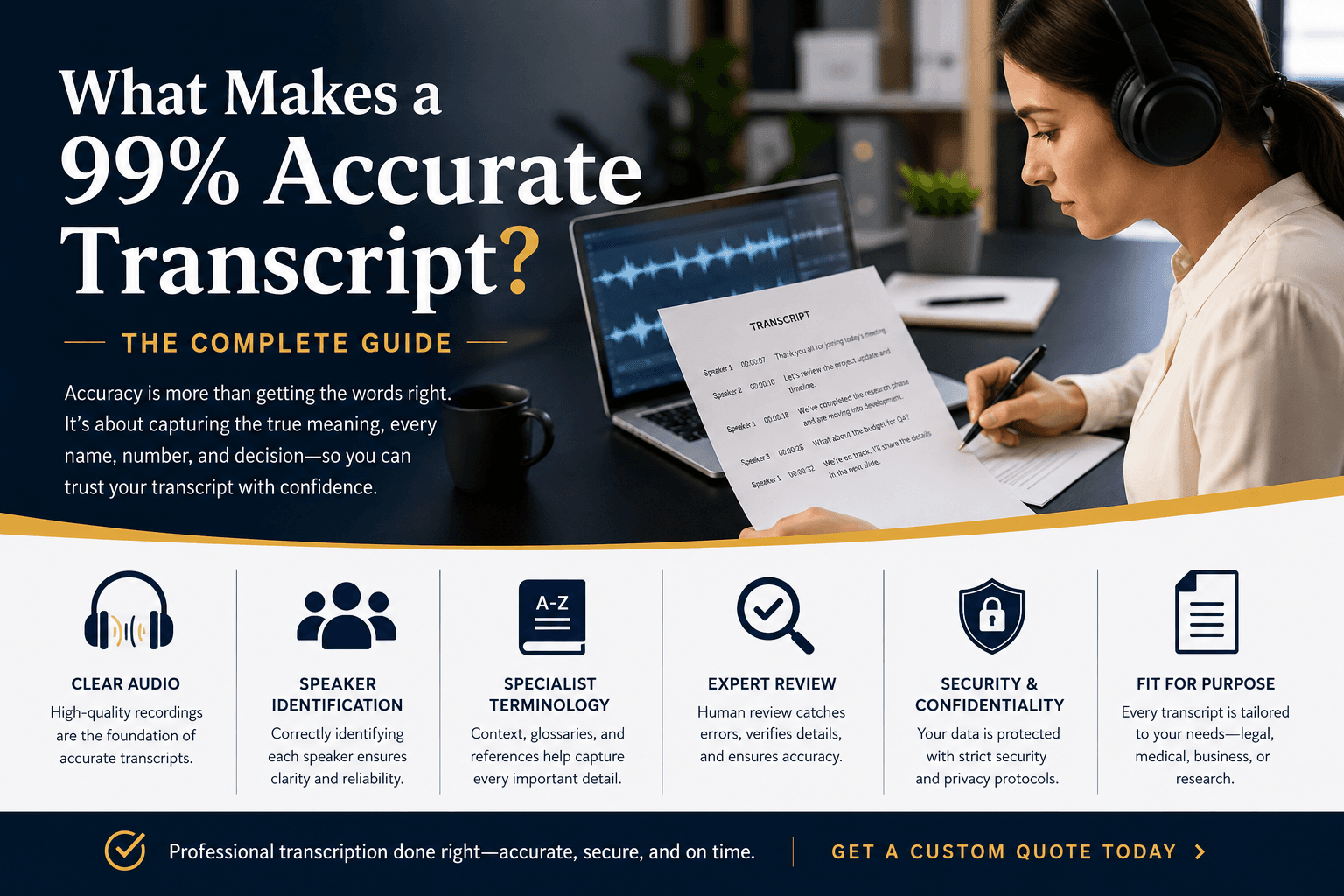
Professional transcription can be highly accurate, but no responsible provider can promise one percentage for every recording. The result depends on what is actually audible, how many people speak, the terminology involved, the transcript's intended use, and the review process applied before delivery.
A clean interview with two speakers presents a different accuracy challenge from a noisy conference call, a deposition with interruptions, or a clinical discussion filled with specialist terms. This guide explains what transcription accuracy means, why percentages can be misleading, how human review differs from automated speech recognition, and what clients can do to obtain a transcript they can rely on.
Quick answer: How accurate is professional transcription?
A professionally reviewed transcript from clear audio can be a dependable working record. Accuracy falls when words are masked by noise, people speak over one another, speaker identities are unknown, or specialist terms lack context. The strongest process combines suitable technology, trained human judgment, targeted verification, and transparent labels for words that cannot be heard with confidence.
What does transcription accuracy mean?
Accuracy is not simply correct spelling. An accurate transcript represents the audible speech faithfully, preserves meaning, identifies speakers consistently, and records important details such as names, dates, figures, quotations, and technical terminology correctly. It also follows the requested transcript style and clearly marks genuine uncertainty instead of replacing it with a guess.
The standard must match the purpose. A readable interview for content planning may use clean verbatim, which removes nonessential fillers without changing meaning. A deposition, research interview, disciplinary hearing, or other high-stakes recording may require full verbatim treatment, timestamps, stricter speaker labeling, and closer review of every material statement.
Why a single accuracy percentage can be misleading
An accuracy claim only makes sense when the measurement method and test conditions are known. Automated speech-recognition systems are often evaluated with word error rate, which counts substitutions, deletions, and insertions against a reference transcript. That metric is useful, but it does not capture every issue that matters to a client: a transcript may contain few word errors yet still mislabel a speaker, change an important number, or mishandle a proper name.
Conditions also matter. Performance measured on clean, controlled speech cannot automatically be applied to a multi-speaker meeting recorded across a room. Ask a provider how accuracy is checked, which details receive special verification, how inaudible audio is marked, and how corrections are handled. Those answers are more useful than a percentage presented without context.
The factors that affect transcription accuracy
Audio quality
Noise, echo, low volume, compression, dropouts, and distant microphones can conceal words. Record close to each speaker, reduce background noise, and provide the least-compressed source file available.
Speaker overlap and identification
Cross-talk makes both the words and the speaker attribution harder to resolve. Encourage turn-taking and provide a participant list with correct names, roles, and likely speaking order.
Specialist terminology, names, and numbers
Legal, medical, academic, financial, and technical terms may sound similar to common words. Names, dates, amounts, dosages, citations, and product codes deserve special attention because a small error can have disproportionate consequences. Supply a glossary, agenda, case list, slide deck, or spelling guide.
Transcript style and intended use
Full verbatim, clean verbatim, timestamps, and speaker-label rules create different review requirements. Explain how the transcript will be used and agree on the output style before work begins.
Quality assurance
A first draft may contain errors that become clear only during replay and contextual review. A dependable workflow includes proofreading, audio checks, terminology verification, consistent formatting, and a clear revision process.
Human transcription, AI transcription, and hybrid review
Where automated transcription helps
Automated speech recognition can produce a fast first draft, create searchable notes, and reduce manual effort for straightforward recordings. It is most useful when the audio is clean, the language is general, speaker turns are clear, and the transcript is not yet the final record.
Where automated transcription needs caution
Software can confidently output the wrong word when audio is ambiguous. Common risk areas include overlapping speakers, unfamiliar accents, proper nouns, acronyms, specialist vocabulary, and numbers. The danger is not only the number of errors, but whether an error changes meaning or affects a decision.
What human review adds
A trained reviewer can replay difficult sections, use context to compare plausible interpretations, verify terms against supplied references, normalize formatting, and recognize when a word cannot be recovered. Human review does not make inaudible audio audible; its value is careful judgment and honest handling of uncertainty. For many projects, a hybrid workflow offers a practical balance: technology creates the draft and a person reviews the parts where accuracy matters.
How professional quality assurance works
A credible quality process is visible and repeatable. It defines how the transcript moves from intake to delivery, which checks are required, and what happens when the audio remains unclear.
Confirm the project requirements
Agree on transcript style, speaker labels, timestamps, file type, deadline, confidentiality requirements, and intended use.
Review the reference material
Collect participant names, terminology, agendas, supporting documents, and formatting instructions before transcription begins.
Create and verify the draft
Transcribe the recording, mark uncertain passages consistently, replay difficult sections, and check material details such as names, dates, figures, and quotations.
Review language and formatting
Correct punctuation, paragraphing, labels, timestamps, and house-style issues without changing the speaker's meaning.
Complete final QA and revisions
Confirm completeness, file integrity, confidentiality requirements, and the agreed delivery format. Give the client a clear route to submit additional context or corrections.
How to prepare audio for the most accurate transcript
Before recording
Choose a quiet setting, place microphones close to speakers, test recording levels, ask participants to identify themselves, and encourage one person to speak at a time. For remote meetings, record locally when the platform allows it.
Before uploading
Listen briefly for missing audio, dropouts, severe noise, or damaged sections. Provide speaker names, correct spellings, a terminology glossary, reference documents, the intended use, transcript style, timestamp requirements, and the deadline. Flag passages where exact wording or figures are especially important.
How to evaluate a completed transcript
Begin with the parts where an error would matter most. Compare names, dates, amounts, decisions, quotations, technical terms, and marked-unclear passages against the recording. Then confirm speaker labels, timestamps, paragraphing, and the requested file format.
Do not treat every difference as the same kind of error. A punctuation preference is not equivalent to an incorrect dosage, case name, financial figure, or speaker attribution. Review should prioritize meaning and consequence while still enforcing a consistent style.
Questions to ask a transcription provider
How do you review transcript accuracy?
Look for a defined process that covers audio verification, names, numbers, speaker labels, terminology, formatting, and final quality control.
How do you handle unclear audio?
A responsible provider should mark uncertain or inaudible speech consistently rather than insert a confident guess.
Can you follow project-specific references?
Confirm that the team can use your glossary, participant list, template, case information, or organization-specific style guide.
How are files protected and revisions handled?
Ask about secure transfer, processing, storage, access controls, delivery, retention, and the process for requesting corrections after delivery.
Frequently asked questions
Can professional transcription be 100% accurate?
No provider can recover words that were never captured clearly. Professional quality means producing a faithful record of what is audible, checking important details, and labeling genuine uncertainty instead of guessing.
Is 99% transcription accuracy realistic?
It can be a useful target under suitable conditions, but the number needs context. Ask what material was tested, how errors were counted, whether the audio was clean, and whether the result included human review. A percentage alone does not tell you whether critical names, figures, or speaker labels are correct.
Is human transcription always more accurate than AI?
Not in every simple recording, and not without a capable reviewer. AI may perform well on clean, predictable audio, while experienced human review becomes especially valuable for ambiguity, specialist language, overlapping speech, and high-stakes use.
Should I choose full verbatim or clean verbatim?
Choose full verbatim when repetitions, false starts, filler words, and other spoken features may be significant. Choose clean verbatim when readability is the priority and nonessential disfluencies can be removed without changing meaning.
What should I send with my recording?
Send the source file, participant names, a glossary, relevant reference documents, the intended use, your preferred transcript style, timestamp and formatting requirements, and the deadline.
The bottom line
Professional transcription accuracy is a managed process, not a slogan. Clear source audio, useful context, an appropriate transcript style, trained review, targeted verification, and transparent handling of uncertainty produce a record that is easier to trust, search, quote, and use.
Need an accuracy and turnaround assessment? Share the file length, number of speakers, subject area, audio condition, and deadline with Verbalscripts to request a tailored quote.
Subscribe to our newsletter.
Get latest updates for our Articles & Blogs. We post fresh content every week.
- Weekly articles
- Stay updated with our weekly articles covering various topics.
- No spam
- We respect your inbox. No spam, just valuable content.

Legal TranscriptionAudio and Video Transcription servicesGeneral TranscriptionFocus groups and InterviewsMedical TranscriptionAcademic & Conference Transcription
Court reporting & LegalCorporate & general businessMedia productionDigital & online learningGovernmentHealthcare
About UsBlogsLocationsFrequently Asked QuestionsPrivacy PolicyTerms of Service
Sign up for our monthly newsletter
© Verbalscripts 2026. All rights reserved.