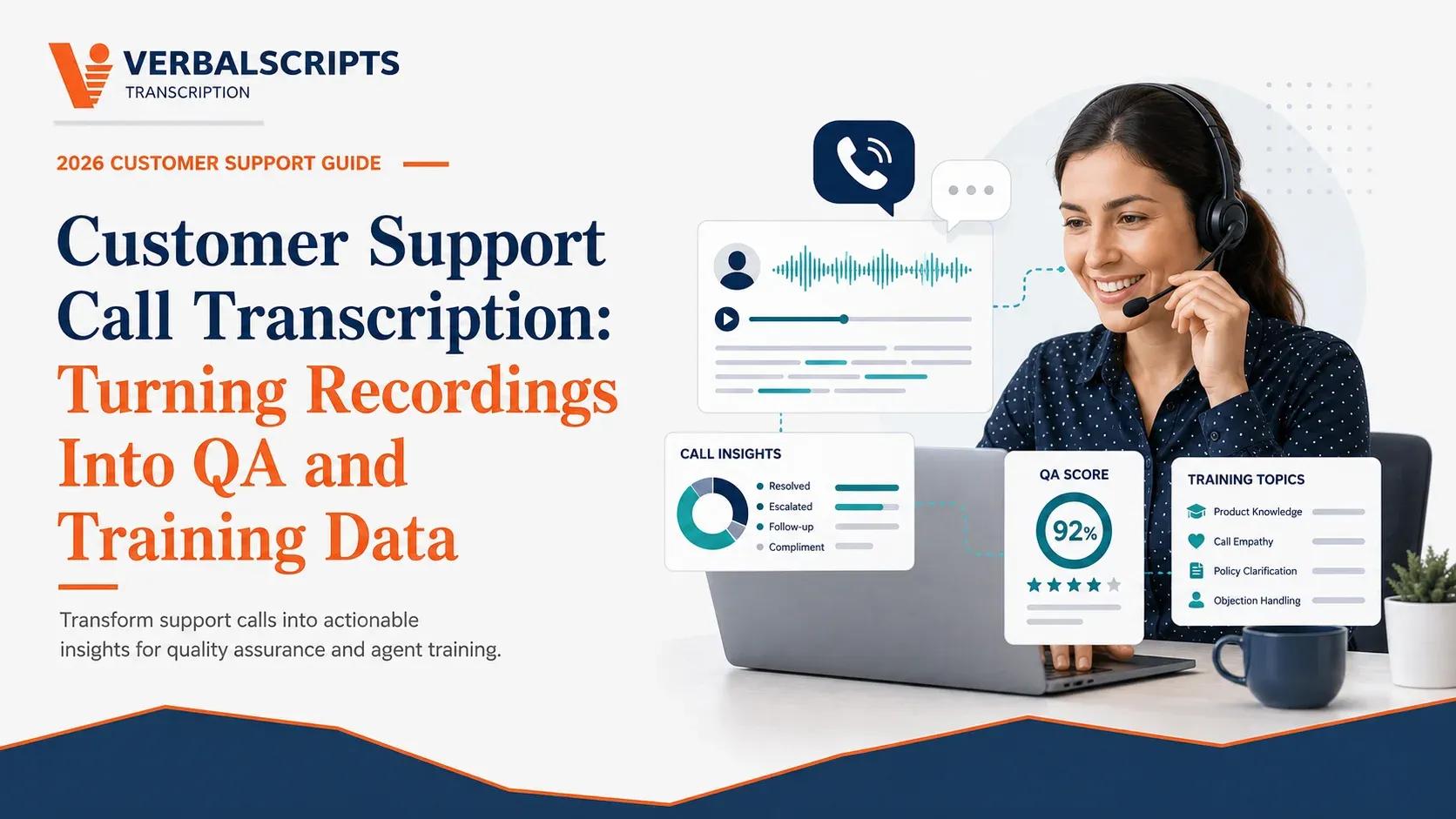
Customer Support Call Transcription: Turning Recordings Into QA and Training Data
Contents
Quick answer: Customer support call transcription turns recordings into a searchable quality-assurance layer. Instead of scoring a call only by listening, teams can review exact wording, escalation language, disclosures, troubleshooting steps, sentiment cues, and handoff failures in text. Because support recordings may contain account, payment, identity, or other personal information, privacy, retention, and vendor security need to be designed into the workflow.[1][2]
Key takeaways
• Opening disclosures and identity-verification steps.
• Using real customer personal data unnecessarily in training materials.
• Define which calls are transcribed and why.
• Human review should be matched to the risk of the transcript’s downstream use.
• Ask the vendor to define security, turnaround, formatting, and what is included in the quoted price.
Why this transcription workflow matters in 2026
Recorded speech has become a routine business record, but a recording is difficult to search, quote, compare, audit, or move into a structured workflow. Create searchable QA records from support calls for coaching, escalation review, and training libraries. The practical goal is not merely to turn sound into words. It is to create a dependable text asset that preserves the facts people will rely on later.
For customer support call transcription, the best process starts by defining the downstream use. A rough internal transcript can tolerate more uncertainty than a record that will influence a legal decision, patient documentation, employee action, research coding, public communication, or investor disclosure. That is why the right combination of audio quality, instructions, human review, security, and formatting matters more than a headline accuracy percentage.
What a high-quality transcript should capture
A useful transcript should make the original recording easier to verify, not harder. Before a project starts, define which details are essential and which are optional. For this use case, the specification should normally address:
• Opening disclosures and identity-verification steps.
• Customer problem statement, chronology, promised actions, and resolution.
• Agent troubleshooting steps, escalation points, and supervisor involvement.
• Product names, account references, dates, numbers, and commitments.
• Speaker turns and timestamps for coaching or complaint review.
When a word cannot be confirmed from the recording, the safer editorial choice is usually to flag the uncertainty using the agreed notation instead of guessing. This is especially important for proper names, numbers, medications, legal terms, financial figures, and statements that change meaning when a single word is wrong.
Where organizations use these transcripts
The same recording can serve different departments once it is converted to structured text. Common workflows include:
• Qa scorecard calibration.
• Agent coaching and onboarding.
• Root-cause analysis across repeat contacts.
• Complaint and escalation investigation.
• Building de-identified training examples and knowledge-base content.
The format should follow the use. A searchable internal archive may need clean speaker labels and timestamps; a publication may need editorial cleanup; an evidentiary or regulated workflow may require stricter verbatim rules, certification, authorization, or preservation of source files. Do not assume one transcript format is correct for every downstream purpose.
The mistakes that create the most risk
Most transcription failures are not caused by typing speed. They come from unclear scope, poor source audio, missing context, overconfident automation, inconsistent style, or weak data handling. Watch for the following:
• Using real customer personal data unnecessarily in training materials.
• Keeping call recordings and transcripts indefinitely without a defined business need.
• Inconsistent redaction of card, health, or authentication data.
• Assuming a recorded-call notice is legally sufficient in every jurisdiction.
• Measuring agent performance on a transcript that has not been checked for asr errors.
A mature workflow treats the transcript as a controlled derivative of the recording. The source audio remains available for verification, the delivered version is clearly labeled, edits are traceable where the risk justifies it, and the team knows who is authorized to approve the final document.
Best-practice workflow: from recording to approved transcript
1. Define which calls are transcribed and why.
2. Mask or redact sensitive fields that are not needed for qa.
3. Maintain a retention schedule for both audio and text.
4. Validate recording-consent requirements for the jurisdictions and call types involved.
5. Use a stable qa rubric so reviewers score the same behaviors.
6. Sample-check transcript accuracy before using text for disciplinary or regulatory decisions.
For recurring work, convert these steps into a one-page transcription style guide. Include speaker-label rules, timestamp frequency, verbatim level, treatment of inaudibles, capitalization of products and acronyms, number formatting, redaction conventions, file naming, and the approval contact. A small style guide prevents repeated corrections across dozens or hundreds of files.
Human transcription, AI, and hybrid review
Automation can be valuable for quick search, rough notes, and high-volume first passes. Human transcription and review add the ability to reason from context, verify speakers, research proper names, follow a style guide, and mark genuine uncertainty. The correct mix depends on risk. Routine internal calls may be suitable for an AI-assisted workflow; high-stakes legal, HR, clinical, financial, or public records often justify stronger human verification.
Do not buy a percentage in isolation. Ask how the vendor measures quality, whether the reviewer listens to the source audio, how corrections are handled, and what happens when the recording is genuinely unclear. The transcript should be defensible because of the process behind it, not because a marketing page promised a number.
How to evaluate a transcription vendor
Before sending sensitive or high-volume recordings, ask operational questions that can be answered in writing:
• Security controls and contractual confidentiality.
• Redaction workflows.
• Consistent timestamps and speaker labels.
• Support for batches and recurring uploads.
• Human review for noisy calls, accents, or product jargon.
• Ability to export clean text for qa platforms and analytics.
Also ask who has access to recordings, whether subcontractors are used, where files are stored, how long source audio and transcripts are retained, how correction requests work, and whether the quoted turnaround includes the final review step. Those details become more important as the transcript moves closer to a legal, clinical, financial, HR, or research decision.
Compliance and accuracy note
The FTC recommends collecting and retaining only data that the business actually needs and putting security expectations for service providers in writing.[1] The FCC notes that state laws can restrict telephone recording even though the FCC does not impose a general individual call-recording rule.[3] Obtain legal guidance for your specific jurisdictions and call types.
How Verbalscripts can support this workflow
Verbalscripts provides human-reviewed transcription for legal, medical, research, corporate, government, and media workflows. Start with the Phone Call Recording Transcription, Audio & Video Transcription, Corporate & General Business Transcription, and How Verbalscripts Protects Confidentiality & Security. For a project-specific estimate, requirements review, or large-volume workflow, request a quote.
For the strongest quote, include total recorded minutes, typical speaker count, audio sample, required verbatim level, timestamps, formatting/template needs, deadline and time zone, confidentiality/compliance requirements, and whether the final transcript will be used internally, publicly, clinically, academically, or in a legal proceeding.
Frequently asked questions
What is the best format for customer support call transcription?
Use a format that matches the downstream workflow. Word is common for editable documents; PDF is useful for controlled review; plain text can feed analysis systems; SRT/VTT is appropriate for captions. Legal or regulated work may require a specific template, page layout, certificate, or authorized producer.
Should I choose clean verbatim or full verbatim?
Clean verbatim removes non-substantive fillers and obvious false starts while preserving meaning. Full verbatim keeps more speech detail and may be preferable for evidentiary, qualitative-research, linguistic, HR-investigation, or disputed-content use. Define the rule before production begins.
Do timestamps increase transcription cost?
Often, yes. Timestamps add production and QA work, especially when they are required frequently or must match video frames precisely. Cost can usually be controlled by using timestamps at speaker changes, paragraph intervals, topic changes, or only around unclear/disputed sections.
Can AI be used to reduce cost?
Yes, for suitable recordings and low-risk uses. The important question is what happens after the AI output is created. If the transcript will drive a consequential decision, request human verification against the source audio and confirm which parts of the file receive that review.
What should I send with the audio?
Send a speaker list, spellings, agenda or case/project context, glossary, relevant documents, formatting sample, deadline, verbatim preference, timestamp rules, redaction instructions, and a short explanation of how the transcript will be used. Context reduces avoidable errors.
How do I get an accurate quote?
Provide the actual duration and a representative audio sample. State the number of speakers, audio quality, industry, turnaround, format, timestamps, verbatim level, and any compliance or certification requirement. A precise specification is the fastest way to avoid surprise charges.
Readers looking for additional help with customer support transcription can use the Verbalscripts resources below.
• Phone Call Recording Transcription
• Corporate & General Business Transcription
• How Verbalscripts Protects Confidentiality & Security
References and external sources
1. Federal Trade Commission. Start with Security: A Guide for Business. https://www.ftc.gov/business-guidance/resources/start-security-guide-business (accessed August 10, 2026).
2. National Institute of Standards and Technology. NIST Privacy Framework. https://www.nist.gov/privacy-framework (accessed August 10, 2026).
3. Federal Communications Commission. Recording Telephone Conversations. https://www.fcc.gov/consumers/guides/recording-telephone-conversations (accessed August 10, 2026).
Need a transcript you can actually use?
Send Verbalscripts your recording, deadline, and formatting requirements for a project-specific quote.
Regulations, platform features, vendor prices, and court requirements can change. Verify current rules and pricing before publication or reliance. This article provides general information and is not legal, medical, accounting, or compliance advice.
Subscribe to our newsletter.
Get latest updates for our Articles & Blogs. We post fresh content every week.
- Weekly articles
- Stay updated with our weekly articles covering various topics.
- No spam
- We respect your inbox. No spam, just valuable content.

Sign up for our monthly newsletter