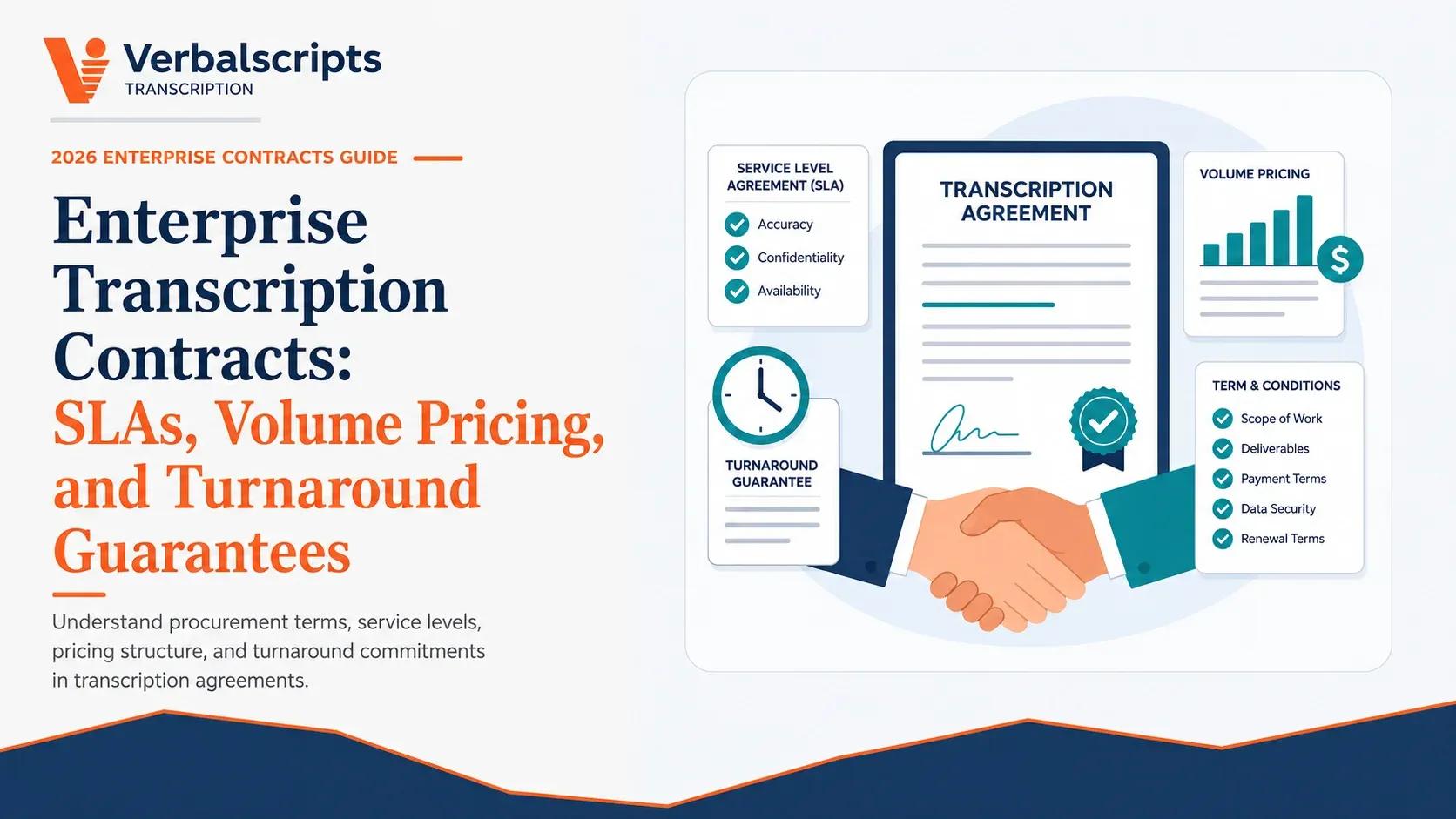
Enterprise Transcription Contracts: SLAs, Volume Pricing, and Turnaround Guarantees
Contents
A 2026 contract guide for procurement teams translating transcription promises into measurable service levels, normalized pricing, capacity commitments and enforceable data-handling terms.
Quick answer: An enterprise transcription contract should define exactly what starts and stops the turnaround clock, which audio conditions and formats are in scope, quality acceptance and correction rules, capacity/rush tiers, support/escalation, security and permitted data use, retention/deletion, and a normalized pricing schedule. Service credits can reinforce performance, but clear definitions and operational remedies matter more than aggressive headline penalties.
Key takeaways
• Define units before comparing price: audio minute, finished page, hour, project minimum, rush and specialty surcharges can produce very different effective costs.
• An SLA needs a clock definition, calendar, acceptance criteria and exclusions—not just “24-hour turnaround.”
• Separate quality warranty/correction obligations from claims like “99% accuracy” unless the metric and test method are precisely defined.
• Volume discounts should state whether they are committed, earned, tiered, prepaid/retainer or retrospective.
• Security, AI/model data use, subprocessors, retention and termination deletion should be contractual for high-risk content.
Start by defining the service, not the price
A transcription MSA or order form is easier to negotiate when the statement of work defines the content and output: expected monthly audio minutes, file lengths, speaker counts, audio conditions, languages, verbatim style, timestamps, templates, certification needs, turnaround classes and regulated data.
Without that baseline, a low per-minute quote can become expensive after minimums, difficult-audio fees, timestamp charges, rush multipliers or reformatting. Normalize the total expected spend against the same workload.
Turnaround SLA: make the clock measurable
Start — Contract question: When does time begin? | Example drafting concept: After upload completes and required instructions/files are available
End — Contract question: What counts as delivered? | Example drafting concept: Final deliverable available in approved channel
Calendar — Contract question: 24/7 or business days/hours? | Example drafting concept: Define holidays/time zone and weekend treatment
Volume band — Contract question: How much can meet each SLA? | Example drafting concept: X audio minutes/day or project batch threshold
Dependencies — Contract question: What pauses the clock? | Example drafting concept: Customer questions, corrupted files, missing authorization
Rush — Contract question: How is priority invoked? | Example drafting concept: Written acceptance + specific rush rate/capacity
Corrections — Contract question: Does correction have its own SLA? | Example drafting concept: Critical correction acknowledgement and resolution targets
Escalation — Contract question: Who handles threatened breach? | Example drafting concept: Named service manager/on-call path
Quality clauses: avoid an undefined “99%” warranty
If accuracy is important enough to be contractual, define the denominator, reference transcript, punctuation/speaker treatment, excluded audio conditions, sampling method, critical-error handling and remedy. Otherwise, a headline percentage can create disputes without improving quality.
For high-stakes work, combine measurable acceptance with a correction warranty. Define critical terms—names, dates, dollar amounts, medications/doses, exhibit references, negations, speaker identity—and require prompt correction of verified errors.
Volume pricing models
Pay-as-you-go — How it works: Fixed rate per unit with no commitment | Watch-outs: Higher rate; capacity may not be reserved
Earned tiers — How it works: Rate decreases after actual volume threshold | Watch-outs: Define measurement period and whether tier is retroactive
Committed tiers — How it works: Lower rate for minimum monthly/annual volume | Watch-outs: Unused commitment, rollover and true-up rules
Prepaid/retainer — How it works: Funds/credits consumed as orders arrive | Watch-outs: Expiry, refundability, reconciliation
Blended enterprise rate — How it works: One rate includes common complexity | Watch-outs: Clearly state exclusions and exceptional work
Project/batch quote — How it works: Fixed price for defined collection | Watch-outs: Change-order process for scope drift
Normalize every proposal to the same cost model
1. Base transcription unit/rate and rounding rule.
2. Minimum charge per file/order/project.
3. Rush/expedited multipliers.
4. Poor/difficult audio surcharge and objective trigger.
5. Number-of-speaker surcharge.
6. Timestamps—periodic, speaker-change or exact/forensic.
7. Verbatim/court-style formatting charges.
8. Certification/notarization/affidavit charges where applicable.
9. Translation, captioning or multilingual charges.
10. Project management, API/integration or dedicated-support fees.
11. Storage/retention/export fees.
12. Correction/rework charges and warranty period.
Security and data-use clauses enterprise buyers often miss
Confidentiality alone may not answer what the vendor can do with recordings. Address permitted use, no-sale/no-unapproved-secondary-use, AI/model training, subprocessors, processing locations where relevant, security controls, incident notification, legal requests, retention/deletion, backups and return/destruction at termination.
Where HIPAA, FERPA or another sector rule applies, attach the appropriate agreement and ensure the SOW uses the approved workflow. Contract language should follow the actual data path, not an idealized one.
Service credits and remedies
Service credits can create accountability, but they should not be the only remedy for chronic failure or a serious confidentiality/security problem. Define when a credit applies, how it is calculated, claim procedure, caps and whether repeated misses trigger a service-improvement plan or termination right.
Single turnaround miss: Priority completion + root-cause review; credit if SLA defines one
Repeated SLA misses: Service-improvement plan + executive review
Verified quality defect: Corrected transcript under defined correction SLA
Capacity shortfall: Escalation and recovery plan; alternate-routing right if negotiated
Security incident: Incident obligations under security/BAA/DPA; not merely a service credit
Bottom line
A strong enterprise transcription contract makes the operational promise testable. Define workload, clock, quality, price, security and exceptions in the same vocabulary used by the people who upload files and receive transcripts.
Use the contract to remove surprises—not to create a penalty maze. A clear SOW, realistic capacity model, objective acceptance process and security schedule usually create more value than an impressive but ambiguous accuracy/turnaround claim.
For further guidance on verbalscripts, review the Verbalscripts services and articles below.
• Transcription services - Service overview.
• Transcript output formats - Output formats.
• Strict-confidentiality transcription - Confidential workflows.
• Compare human transcription services - Human-service comparison.
• Compare and switch providers - Buyer comparison guidance.
Frequently asked questions
What should a transcription SLA include?
At minimum: turnaround clock start/end, business calendar, volume/capacity band, deliverable/format, dependencies/exclusions, correction SLA, escalation and any remedies.
What is the best way to price enterprise transcription?
It depends on volume predictability and complexity. Compare pay-as-you-go, earned/committed tiers, prepaid retainers and blended rates using the same expected workload and all surcharges.
Should “99% accuracy” go in the contract?
Only if both parties can define and measure it. Many buyers are better served by critical-error rules, sampling/acceptance criteria and a correction warranty.
What is a turnaround guarantee?
A contractual commitment is meaningful only if the start, end, calendar, capacity and exclusions are defined. Ask what remedy/escalation follows a miss.
Can an SLA cover security?
Security obligations are usually better handled in a security schedule, DPA/BAA or MSA clauses, with incident-specific obligations. Availability/support metrics can still appear in an SLA.
References and further reading
1. AICPA & CIMA: SOC suite of services - Official SOC overview.
2. AICPA & CIMA: Trust Services Criteria - Official Trust Services Criteria.
3. HHS: Business Associates - Official HHS business-associate/BAA guidance.
4. U.S. Department of Education: FERPA - Official FERPA overview.
Contracting examples are educational, not legal advice. Have qualified counsel and procurement/security teams adapt service levels, credits, privacy terms and regulated-data clauses to the transaction.
Subscribe to our newsletter.
Get latest updates for our Articles & Blogs. We post fresh content every week.
- Weekly articles
- Stay updated with our weekly articles covering various topics.
- No spam
- We respect your inbox. No spam, just valuable content.

Sign up for our monthly newsletter