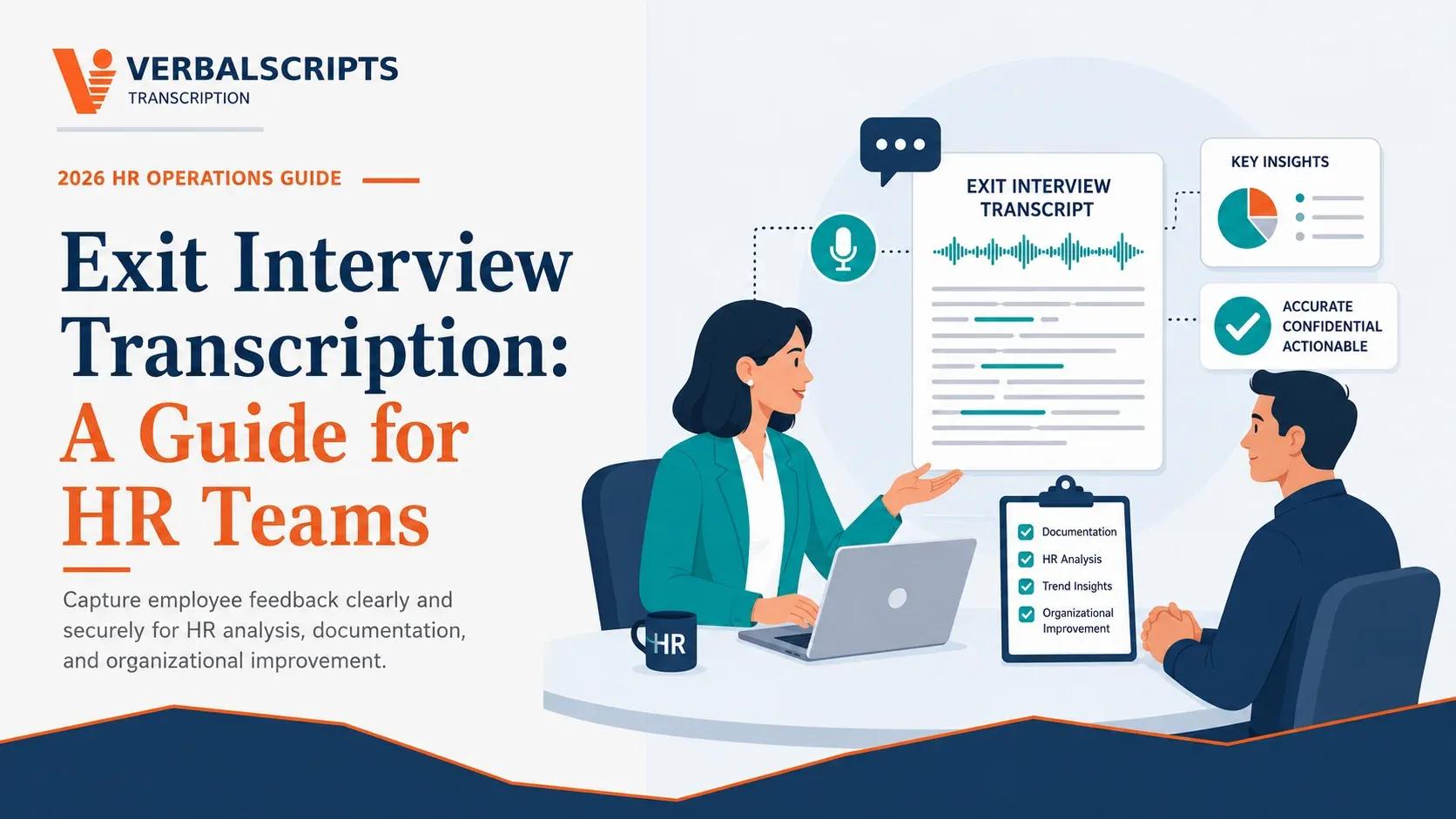
Exit Interview Transcription: A Guide for HR Teams
Contents
A practical HR guide to recording and transcribing exit interviews while protecting confidentiality, preserving context and separating routine feedback from allegations that need escalation.
Quick answer: Exit interview transcription can make employee feedback searchable and auditable, but HR should decide the purpose before recording: organizational learning, case documentation, investigation support or litigation hold. Obtain recording approval/consent under applicable law and policy, restrict transcript access, preserve exact wording for allegations and critical facts, and set retention based on HR/legal requirements—not the transcription vendor’s default.
Key takeaways
• Recording consent and employer policy should be resolved before the interview is recorded.
• Keep routine culture feedback separate from allegations of discrimination, harassment, retaliation, safety or other matters that trigger investigation/escalation.
• Use human verification for names, dates, quotations, allegations and speaker identity in consequential interviews.
• Access to transcripts should be role-based; do not automatically place every raw transcript in a broadly accessible personnel file.
• Retention may be affected by employment-record rules, investigations, claims and legal holds; define it with HR/legal rather than using a generic deletion schedule.
Why transcribe exit interviews?
Structured notes are sufficient for many routine departures. A transcript becomes more valuable when HR needs exact language, wants to analyze recurring themes across interviews, expects handoff to employee relations/legal, or needs a reliable record of what was said.
The tradeoff is sensitivity. Exit interviews can contain allegations, health/family information, compensation details, coworker names, trade secrets or emotionally charged opinions. Treat the transcript as a sensitive HR record from creation through deletion.
Decide the record purpose before hitting Record
Routine feedback: Consent + clean transcript or structured summary; minimize unnecessary identifiers
Leadership analytics: De-identify/categorize where possible before wider reporting
Specific complaint: Higher-fidelity transcript + prompt HR/ER escalation
Investigation support: Verbatim/near-verbatim, speakers/timestamps, version control, restricted access
Anticipated claim/litigation: Follow counsel/legal-hold instructions; preserve source recording and metadata
Recording-consent and notice
Recording laws differ across U.S. states and situations; employer policies, union/works-council arrangements and international privacy rules may add constraints. The safest operational pattern is to use an HR-approved recording script and consent process rather than improvising.
For remote interviews, participant locations can matter. If HR is unsure, pause the recording plan and ask counsel. A transcription vendor should not be asked to determine whether the underlying recording was lawful.
Critical content that deserves human verification
1. Employee, manager and coworker names.
2. Dates, job titles, locations and reporting lines.
3. Direct quotations of alleged conduct.
4. Words indicating discrimination, harassment, retaliation, threats, safety issues or wage/pay concerns.
5. Negations and qualifiers such as “never,” “not,” “I think,” “I was told.”
6. Amounts, compensation or benefit figures.
7. Speaker identity during interruptions or multi-party interviews.
8. Unclear passages—mark them rather than inventing certainty.
Confidentiality, access and retention
Use least privilege. The interviewer, employee-relations team, counsel and analytics users may need different versions or access. A de-identified themes dataset can often serve workforce analytics without circulating full verbatim records.
EEOC regulations impose federal recordkeeping obligations on covered employers for certain personnel/employment records, and specific charges/claims can affect preservation. Other federal/state rules and company policy may also apply. HR/legal should set the authoritative retention schedule and legal-hold process; the transcription vendor’s copies should be minimized accordingly.
Exit interview transcript template
Matter metadata: Employee ID/name as policy permits, role, date, interviewer
Consent/notice: Record that approved notice/consent procedure was completed
Speaker labels: Consistent HR / Employee / Other participant
Transcript: Clean or full verbatim per purpose
Timestamps: At allegations/key topics or regular intervals if needed
Escalation markers: Internal workflow tag—not alteration of spoken text
Uncertainty: [inaudible] / [unclear] with timestamp
Version: Draft/final/corrected version + date
How to use transcripts for analytics responsibly
Create a taxonomy for themes such as manager quality, workload, compensation, growth, culture, process and tools. Analyze aggregated patterns; avoid treating one emotionally charged transcript as a quantitative trend.
Separate confidential case allegations from broad dashboards. If an analytics/AI tool will ingest transcripts, run a separate privacy/security/data-use assessment; “internal analytics” can still expose highly sensitive employee information.
Bottom line
Exit interview transcription is most useful when HR knows why the record is being made and who should use it. Pair consent, restricted access, human verification of critical statements and a legally approved retention schedule.
If an interview surfaces a serious allegation, the transcript should support—not replace—the organization’s investigation and response process.
For further guidance on verbalscripts, review the Verbalscripts services and articles below.
• Phone-call recording transcription - Recorded-call workflows.
• Strict-confidentiality transcription - Confidential workflows.
• Compare human transcription services - Human-service comparison.
• Transcription services - Service overview.
• Transcript output formats - Output formats.
Frequently asked questions
Should every exit interview be recorded and transcribed?
No. Many organizations use notes or structured forms. Recording/transcription should have a defined purpose and an approved legal/privacy/HR process.
Can HR secretly record an exit interview?
Recording laws and policies vary. Use an HR-approved consent/notice process and get legal guidance rather than relying on a generic state-law summary.
How long should exit interview transcripts be kept?
There is no universal period. Retention depends on employer policy, federal/state recordkeeping, investigations, claims and legal holds. HR/legal should set the schedule.
Should exit interview transcripts be verbatim?
Use fuller verbatim when exact allegations or legal/investigative context matters; clean verbatim may be better for routine feedback. Define the purpose first.
Can AI summarize exit interview transcripts?
Potentially, but employee records are sensitive. Assess privacy/security, secondary use/model training, access and human verification before using AI outputs for consequential HR decisions.
References and further reading
1. EEOC: Selected Recordkeeping Obligations - Federal employment recordkeeping summary.
2. Reporters Committee: Reporter’s Recording Guide - State-by-state recording-law overview.
General HR information only, not employment-law advice. Recording, notice, retention, employee-record and investigation obligations vary by jurisdiction and employer; follow counsel and HR policy.
Subscribe to our newsletter.
Get latest updates for our Articles & Blogs. We post fresh content every week.
- Weekly articles
- Stay updated with our weekly articles covering various topics.
- No spam
- We respect your inbox. No spam, just valuable content.

Sign up for our monthly newsletter