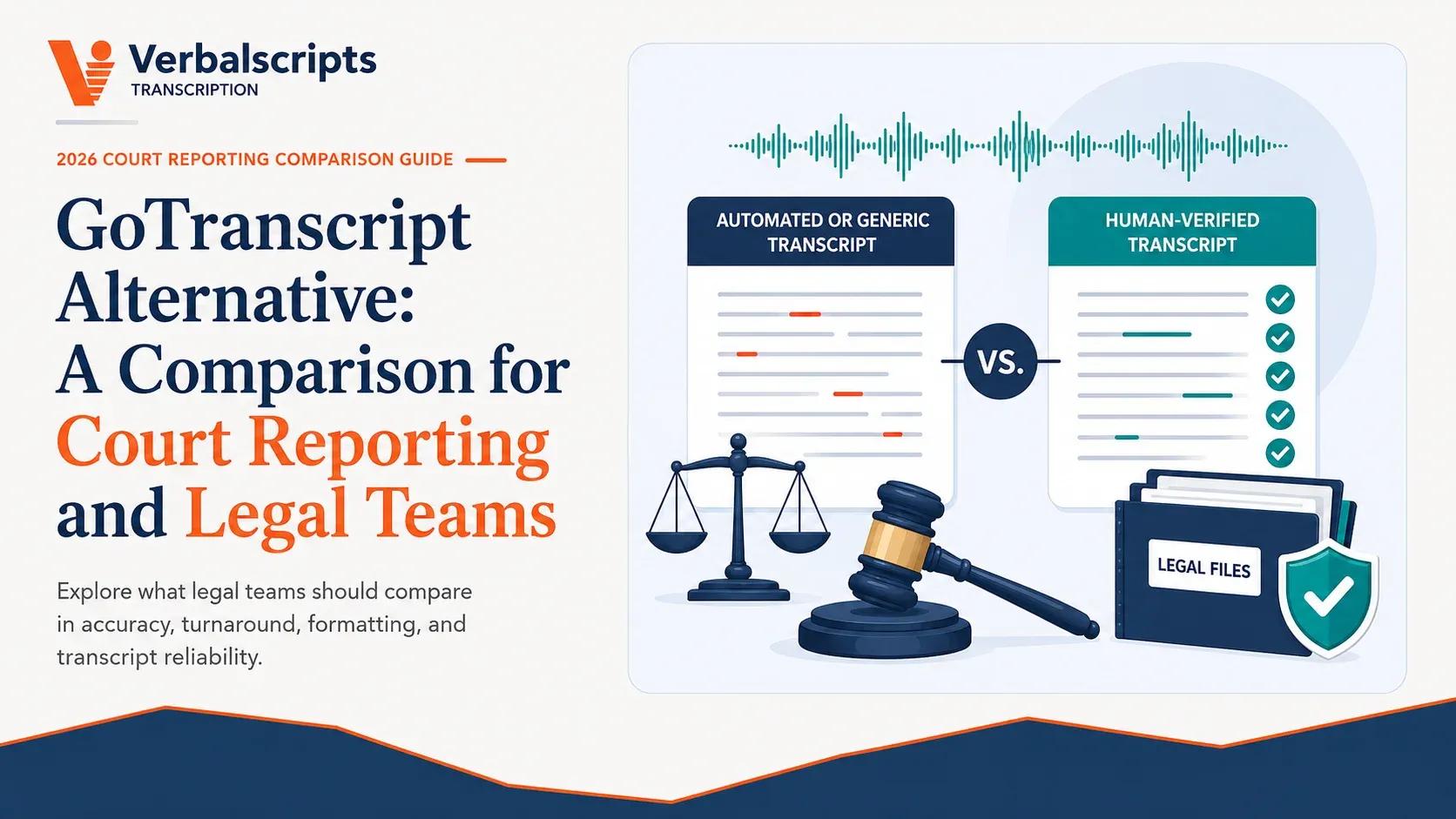
GoTranscript Alternative: A Comparison for Court Reporting and Legal Teams
Contents
A balanced 2026 comparison for legal, medical, research, and enterprise teams deciding whether GoTranscript or a specialist human-verified workflow better fits consequential recordings.
Quick answer: GoTranscript can be a strong option for some workflows. For high-stakes recordings, compare the exact product tier, human review, security terms, transcript format, and official-record requirements. Verbalscripts is most relevant when the buyer already has audio/video and wants a human-reviewed transcript prepared to project-specific instructions.
Key takeaways
• Do not choose from a headline accuracy percentage alone; ask how it was measured and whether your exact order receives human review.
• Court reporting and legal transcription are not interchangeable; verify whether you need a reporter-created official record, transcript from existing audio, certification, page/line format, or court-approved status.
• Court reporting and transcription from an existing recording are different services; follow court rules for official records.
• For regulated data, verify the BAA/DPA, subprocessors, retention, access, deletion, and secondary/AI use before upload.
• A paid pilot using your own difficult audio is more informative than a vendor demo.
Why teams search for a GoTranscript alternative
The query “GoTranscript alternative” usually reflects a workflow gap rather than a simple brand preference. A buyer may like the convenience of a broad transcription platform yet need stronger human review, legal formatting, specialty terminology, privacy terms, predictable turnaround, or a different difficult-audio process for the files where an error has consequences.
GoTranscript offers human transcription, captions, translation and legal transcription, with public pricing/turnaround information.
Start with the consequence of error. A transcript used only to search a meeting can tolerate a different error profile from one quoted in a legal filing, used to code research, reviewed during an investigation, or used in a clinical workflow.
Human-verified vs AI-first transcription
Modern ASR is valuable for fast drafts, search, indexing, and triage. The limitation is that aggregate word error rate can hide a critical mistake: a negation, dosage, surname, exhibit number, dollar amount, address, or the speaker who made the statement.
Research continues to find production-relevant challenges in noisy/conversational audio, clinical vocabulary, and speaker diarization. Human reviewers can also make mistakes, but a designed human workflow adds replay, context, glossary use, style compliance, and explicit uncertainty marking.
Best use — AI-first / platform workflow: Fast drafts, notes, search, discovery | Human-verified high-stakes workflow: Legal, clinical, research, investigative, publication-ready output
Specialist terms — AI-first / platform workflow: Model/context dependent | Human-verified high-stakes workflow: Reviewer can use supplied glossary and references
Crosstalk/speakers — AI-first / platform workflow: Diarization can swap or merge speakers | Human-verified high-stakes workflow: Human can relisten and flag uncertainty
Unclear audio — AI-first / platform workflow: May output plausible text | Human-verified high-stakes workflow: Can mark inaudible/unclear rather than guess
Formatting — AI-first / platform workflow: Platform-dependent | Human-verified high-stakes workflow: Custom Q&A, timestamps, line/page or client templates
QA evidence — AI-first / platform workflow: Model metrics may not match your file | Human-verified high-stakes workflow: Project-specific QA can be specified/tested
GoTranscript vs. Verbalscripts: compare the purchased workflow
GoTranscript offers human transcription, captions, translation and legal transcription, with public pricing/turnaround information. It can fit buyers seeking a broad transcription marketplace with visible pricing and legal options. By contrast, Verbalscripts’ public pages emphasize human transcription and review for legal, medical, research, and other professional recordings. Because this article is published by Verbalscripts, use the comparison as a procurement framework and independently verify both vendors’ current terms.
What are you buying? — GoTranscript: Confirm the exact product/service tier | Verbalscripts checkpoint: Confirm human-reviewed scope, deadline and instructions
Human review — GoTranscript: Verify whether included in your tier | Verbalscripts checkpoint: Make the review/QA steps explicit in the engagement
Legal use — GoTranscript: Verify official-record and format requirements | Verbalscripts checkpoint: Strong fit for prerecorded legal audio; court authorization still depends on rules
Regulated data — GoTranscript: Verify BAA/DPA/security by plan | Verbalscripts checkpoint: Request applicable agreement and confirm service scope
Difficult audio — GoTranscript: Ask how uncertainty and low-confidence speech are handled | Verbalscripts checkpoint: Use references; require uncertainty marking rather than guessing
Formatting — GoTranscript: Confirm templates/exports | Verbalscripts checkpoint: Specify Q&A, speakers, timestamps, title/certificate pages and output
10 questions to ask before switching
Send the same questions to every finalist so proposals are comparable.
1. Will this exact order be transcribed or reviewed by humans? Describe each QA step.
2. How do you define accuracy, and what audio conditions are excluded?
3. How do reviewers handle names, numbers, citations, jargon, crosstalk and unclear speech?
4. Can you follow our style guide and run a paid test on our own audio?
5. Which people and subprocessors can access customer content, and from where?
6. Is content used for AI/model training or product improvement, and can that use be contractually restricted?
7. What encryption, access-control and secure-transfer controls apply?
8. What is the retention/deletion lifecycle, including backups?
9. What turnaround is a commitment rather than a target?
10. If we need an official/certified record, who is authorized under the relevant court or agency rules?
When AI is still the right purchase
Human verification should be proportional to risk. AI-first transcription can be rational for low-risk meeting search, early discovery over large collections, content ideation, rough notes, or first-pass indexing. Many teams get the best economics from a tiered model: AI for triage and human verification only when text becomes evidence, a final deliverable, medical/research data, a compliance record, or published content.
The error is not using AI; it is assuming every plan and use case has the same accuracy, security, retention, and review controls. Document the intended use so procurement can choose the right tier.
How to run a defensible pilot
Select 10–20 minutes that looks like production, not the cleanest clip. Include multiple speakers, jargon, names, numbers, interruptions, quiet speech, and at least one known difficult passage. Give each vendor the same glossary and instructions, then score results blindly where practical.
Score critical errors separately from ordinary word differences. A missed “not,” wrong dose, swapped speaker, or wrong exhibit number can matter more than punctuation. Include security/workflow, format compliance, turnaround, and correction handling in the score.
Critical-term accuracy — Weight: 25% | Measure: Names, numbers, specialist terms, negations
Speaker attribution — Weight: 15% | Measure: Labels through turns, overlap and interruptions
Style/format — Weight: 15% | Measure: Verbatim level, timestamps, template
Difficult-audio handling — Weight: 15% | Measure: Uncertainty is flagged, not invented
Security/workflow — Weight: 15% | Measure: Transfer, access, retention, BAA/DPA if needed
Turnaround/service — Weight: 15% | Measure: Deadline and escalation performance
Bottom line
If you are looking for a GoTranscript alternative, define the problem first. If the gap is difficult-audio accuracy, test human review. If it is compliance, demand evidence and contract terms. If it is official court status, use the authorized channel. If it is cost/speed, normalize all included services and pilot representative audio.
Verbalscripts can be shortlisted for prerecorded professional audio when the buyer wants a reviewed final transcript rather than an unverified draft. The strongest buying decision is one you can explain later: purpose, risk, test results, controls, service level, and contract.
For further guidance on verbalscripts, review the Verbalscripts services and articles below.
• GoTranscript alternatives - Verbalscripts comparison resource.
• Compare human transcription services - Human-service comparison.
• Legal transcription services - Legal transcription workflows.
• Strict-confidentiality transcription - Confidential workflows.
• Compare and switch providers - Buyer comparison guidance.
Frequently asked questions
Is GoTranscript accurate enough for legal transcription?
It may be suitable for some legal workflows, but legal transcription ranges from internal notes to official records. Verify human review, required formatting/certification, confidentiality, and any court-authorized process.
Why choose a GoTranscript alternative?
Usually because the purchased workflow does not match the risk—for example, the team needs more human verification, specialist terminology, custom formatting, a BAA/DPA, stricter retention, or project-specific QA.
Is human transcription always more accurate than AI?
No. Humans can err too. The advantage of a strong human workflow is contextual replay, reference use, uncertainty marking, and accountable QA. Test on representative audio.
Can I use AI first and human review second?
Yes. A risk-tiered workflow is often efficient: AI for discovery/first pass, human verification for consequential text.
Does “99% accuracy” mean one error per 100 words?
Not necessarily. Vendors may define and measure accuracy differently. Ask about the reference, audio conditions, exclusions, punctuation, speakers, names, and whether the metric is before or after human review.
References and further reading
1. GoTranscript: Legal Transcription - Official legal service page.
2. GoTranscript: Pricing - Official pricing page.
3. GoTranscript: 2026 comparison - Current comparison resource.
4. 2026 research: realistic ASR benchmarking - Real-world noise/conversation can expose failures missed by clean benchmarks.
5. EACL 2026: clinical ASR vocabulary - Clinical vocabulary and medication-name challenges.
6. Research: speaker diarization in legal proceedings - Courtroom speaker diarization challenges.
This article is buyer education, not legal, medical, compliance, or court-procedure advice. Vendor plans, prices, features and security terms change; verify current information directly and follow the rules that govern the record.
Subscribe to our newsletter.
Get latest updates for our Articles & Blogs. We post fresh content every week.
- Weekly articles
- Stay updated with our weekly articles covering various topics.
- No spam
- We respect your inbox. No spam, just valuable content.

Sign up for our monthly newsletter