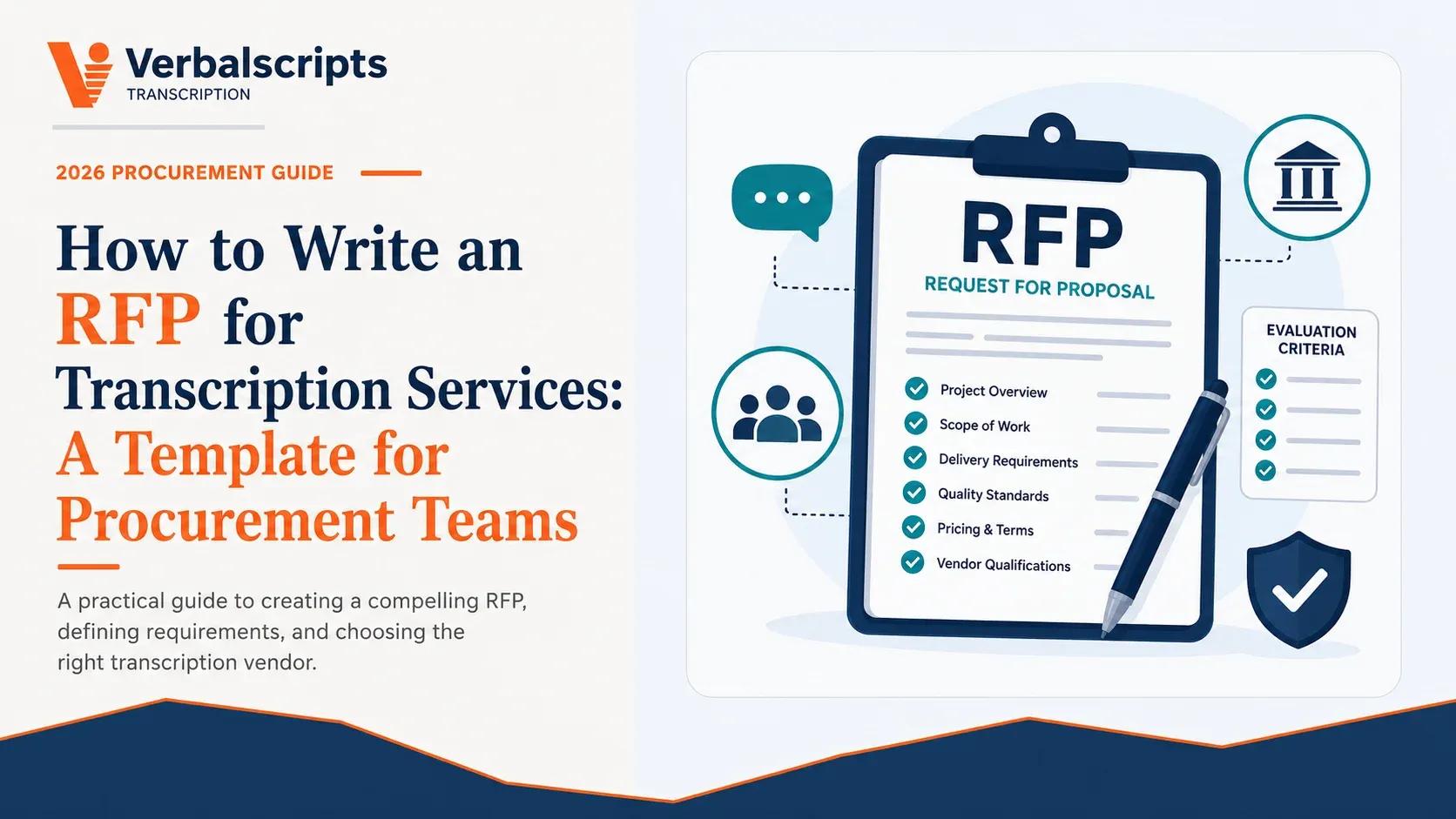
How to Write an RFP for Transcription Services: A Template for Procurement Teams
Contents
A copy-ready RFP structure for enterprise, legal, healthcare, government and research teams buying transcription with comparable pricing, quality, security and service-level responses.
Quick answer: A strong transcription RFP gives every bidder the same workload profile, deliverable specification, quality test, turnaround definition, privacy/security questions and pricing sheet. Require vendors to distinguish AI-only, AI-plus-human and human-first workflows; disclose subprocessors and data use; price the same scenarios; and complete a representative pilot. Use a weighted scoring rubric so procurement can explain the selection later.
Key takeaways
• The RFP should describe real audio conditions and downstream use, not just annual minutes.
• Standardize the pricing table so vendors cannot hide differences in minimums, rush, timestamps, speaker count or difficult-audio fees.
• Ask for workflow-specific security answers, including human access and AI/model data use.
• Use a paid pilot with identical audio, glossary and instructions for finalists.
• Disclose the scoring methodology and distinguish mandatory requirements from weighted preferences.
RFP section 1: procurement instructions
State the issuing organization, procurement contact, question deadline, proposal deadline, required response format, validity period, anticipated award/go-live dates, confidentiality rules and whether exceptions/redlines must be submitted with the proposal.
Tell bidders which requirements are mandatory. This prevents a polished proposal from advancing when the vendor cannot satisfy a non-negotiable BAA, court authorization, data-location rule or turnaround requirement.
RFP section 2: organization, use cases and workload profile
Describe why transcripts are created and who uses them. A law firm, hospital, university and media company may all buy transcription but have different risks and acceptance criteria.
Monthly/annual audio minutes: Typical, minimum and peak
File length distribution: Median and long-tail duration
Speaker count: Typical/max; crosstalk frequency
Audio quality: Clean / remote calls / field / legacy / mixed
Subject matter: Legal, medical, technical, research, general
Languages/accents: Current and expected
Turnaround tiers: Standard, rush, emergency
Output: DOCX/PDF/TXT/RTF/captions/client template
Verbatim level: Full, clean, edited; disfluency rules
Timestamps: None / intervals / speaker change / exact
Regulated/sensitive data: PHI, education records, privileged, financial, confidential
Integrations: Portal, SFTP, API, storage or case/EHR workflow
RFP section 3: workflow and quality questions
1. Describe the workflow from file receipt to final approval.
2. For each tier, identify whether output is AI-only, AI-generated with human editing, or human-transcribed/reviewed.
3. Describe reviewer qualifications and specialist assignment.
4. Explain how names, numbers, citations, medications, exhibits and jargon are verified.
5. Explain how unclear speech, crosstalk and speaker uncertainty are marked.
6. State the quality metric(s), sampling method and correction/escalation process.
7. Describe custom glossary/style-guide management and change control.
8. Provide sample deliverables matching the requested format.
RFP section 4: security, privacy and compliance
Ask vendors to answer for the exact service proposed. Generic corporate policies are not enough if the purchased workflow routes files through different tools or subprocessors.
1. Provide a current data-flow diagram and systems in scope.
2. Describe encryption, IAM/MFA, least privilege, logging, endpoint controls and access review.
3. Describe human reviewer employment/contractor model and permitted processing locations.
4. List subprocessors and change-notification process.
5. Identify all AI/ASR/model providers, content retention, training/secondary use and opt-out/contract controls.
6. Provide retention/deletion lifecycle including backups.
7. Provide incident response and contractual notification terms.
8. Provide current SOC 2 or equivalent assurance if required, with scope/period/exceptions.
9. For PHI, describe BAA process and HIPAA scope.
10. For FERPA data, describe contractual direct-control/use/redisclosure controls as applicable.
RFP section 5: standardized pricing sheet
Standard transcription: Rate/unit + included services
Rush tiers: Rate/multiplier + capacity
Minimums/rounding: Per file/order/project rules
Difficult audio: Rate + objective definition
Multi-speaker: Rate + threshold
Timestamps: Each requested timestamp type
Specialty/legal/medical: Included or surcharge
Certification/formatting: Each requested deliverable
Volume discounts: Threshold, period, committed/earned
Implementation/integration: One-time + recurring
Storage/retention: If any
Correction/rework: Warranty vs billable
RFP section 6: qualifications, support and continuity
1. Relevant industry experience and representative references the buyer may contact.
2. Primary service locations and hours.
3. Named implementation/customer-success and escalation contacts.
4. Peak capacity and how capacity is reserved.
5. Business continuity/disaster recovery approach and testing.
6. Insurance coverage required by buyer policy.
7. Financial/organizational stability information appropriate to procurement.
8. Process for material service, model, subprocessor or ownership changes.
RFP section 7: paid finalist pilot
Give every finalist the same representative audio, glossary, style guide, deadline and expected output. If regulated data is involved, use de-identified content until the required agreements and approved transfer path are in place.
Score blind where practical and penalize critical errors separately. The pilot should also test service behavior: intake questions, deadline communication, secure delivery, corrections and adherence to instructions.
Example weighted evaluation rubric
Transcript quality — Weight: 25% | What to score: Critical terms, general fidelity, speakers, uncertainty
Security/privacy — Weight: 20% | What to score: Evidence, data flow, access, AI use, retention, incidents
Workflow/fit — Weight: 15% | What to score: Formats, glossary, integrations, support
Turnaround/capacity — Weight: 15% | What to score: SLA definitions, peak capacity, escalation
Price/TCO — Weight: 10% | What to score: Normalized all-in cost
Relevant experience — Weight: 5% | What to score: Comparable work/references
Implementation — Weight: 5% | What to score: Onboarding, change management
Contract/commercial — Weight: 5% | What to score: Exceptions, flexibility, risk allocation
Bottom line
The RFP should make vendor answers comparable. If bidders can choose their own pricing units, accuracy definitions and security scope, procurement receives marketing narratives rather than a decision-ready dataset.
A disciplined RFP plus a real-audio pilot allows a buyer to explain why the selected provider—including Verbalscripts if shortlisted—was the best fit for the specified requirements, rather than simply the lowest headline rate.
Continue with these selected Verbalscripts resources covering verbalscripts.
• Transcription services - Service overview.
• Compare human transcription services - Human-service comparison.
• Transcript output formats - Output formats.
• Strict-confidentiality transcription - Confidential workflows.
• Compare and switch providers - Buyer comparison guidance.
Frequently asked questions
What should be in a transcription RFP?
Procurement instructions, workload/use cases, workflow/quality requirements, security/privacy, standardized pricing, SLAs/capacity, qualifications/support, contract terms, pilot and scoring rubric.
Should vendors disclose whether they use AI?
Yes. Ask exactly where AI/ASR is used, which providers receive content, data retention/training terms and which human review steps apply to the proposed tier.
How many vendors should reach the pilot?
There is no universal number. Many teams reduce the field after mandatory/commercial review and test a manageable set of finalists using identical conditions.
Should an RFP ask for accuracy percentages?
You can ask, but require the methodology. A representative pilot and critical-error score may be more decision-useful than an incomparable marketing percentage.
How should transcription proposals be scored?
Use mandatory gates plus a weighted rubric that reflects consequence of error, security/privacy, workflow, turnaround/capacity, total cost and relevant experience.
References and further reading
1. AICPA & CIMA: SOC suite of services - Official SOC overview.
2. AICPA & CIMA: Trust Services Criteria - Official Trust Services Criteria.
3. HHS: Business Associates - Official HHS business-associate/BAA guidance.
4. HHS: HIPAA Security Rule - Official safeguard guidance.
5. U.S. Department of Education: FERPA - Official FERPA overview.
6. U.S. Department of Education: Who is a school official under FERPA? - Third-party contractor conditions.
RFP language is a starting template, not legal, security or procurement advice. Tailor mandatory requirements, scoring, contract terms and regulated-data controls to your organization.
Subscribe to our newsletter.
Get latest updates for our Articles & Blogs. We post fresh content every week.
- Weekly articles
- Stay updated with our weekly articles covering various topics.
- No spam
- We respect your inbox. No spam, just valuable content.

Sign up for our monthly newsletter