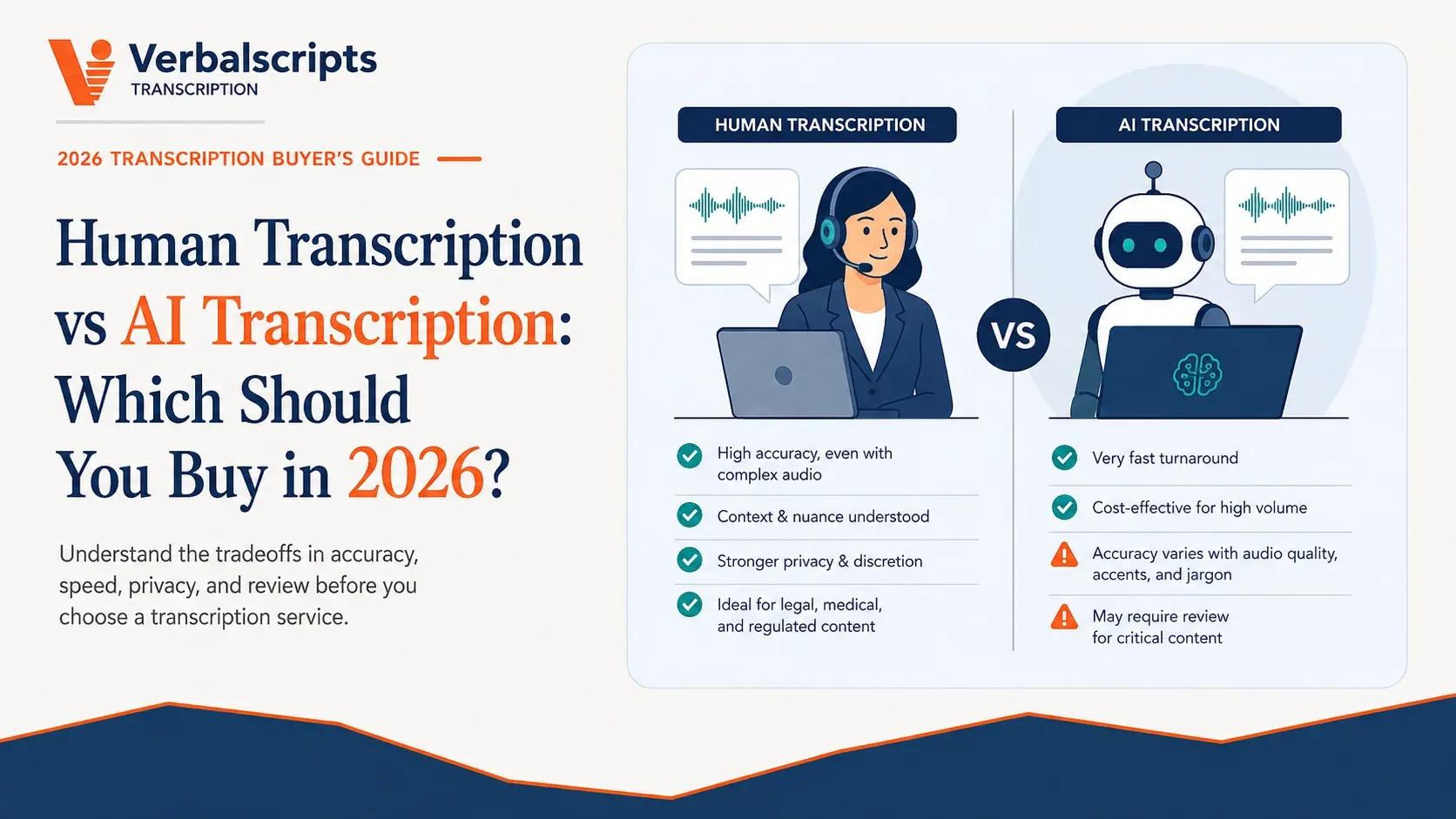
Human Transcription vs AI Transcription: Which Should You Buy in 2026?
Contents
A risk-based framework for choosing AI, human review, or a hybrid workflow instead of treating one method as universally best.
Quick answer: Buy AI transcription when speed, searchability and low cost matter more than final-record precision. Buy human-verified transcription when errors can affect legal strategy, clinical meaning, research coding, compliance, publication or a customer-facing record. For many organizations, the strongest 2026 architecture is hybrid: AI for triage and human verification for consequential output.
Key takeaways
• AI is excellent for fast drafts and search, but aggregate accuracy claims do not describe every file or critical term.
• Human review adds context, replay, glossary use, style compliance and explicit uncertainty handling, but it costs more and takes longer.
• Crosstalk, background noise, accents, similar voices, proper nouns, numbers and specialized vocabulary are common stress tests.
• Security/privacy can outweigh accuracy: assess data flow, retention, subprocessors, AI-training use, BAA/DPA and human access.
• Use risk tiers: automate low-consequence content and reserve verified human work for text that becomes evidence, records, decisions or publications.
The 2026 answer: choose by consequence of error
The useful question is not “Are humans better than AI?” It is “What happens if this transcript is wrong?” A meeting-search transcript, discovery index, podcast draft, deposition excerpt, medication name and HR investigation do not carry the same cost of error. The buying model should reflect that difference.
Speech-recognition systems can perform impressively on clear audio, yet production audio varies. Research continues to document challenges around real-world noise, domain vocabulary and speaker separation. Human transcription can also fail, so specify QA and test it rather than relying on a category label.
AI, human and hybrid transcription compared
Speed — AI transcription: Seconds to minutes | Human-verified: Hours to days | Hybrid: Fast draft; slower final where selected
Cost — AI transcription: Usually lowest marginal cost | Human-verified: Higher due to labor/QA | Hybrid: Controls spend by verifying what matters
Specialist terms — AI transcription: Model/context dependent | Human-verified: Reviewer can use glossary/references | Hybrid: AI draft + terminology QA
Crosstalk/speakers — AI transcription: Can misattribute speakers | Human-verified: Human can relisten/contextualize | Hybrid: Verify high-risk speaker turns
Formatting — AI transcription: Platform-dependent | Human-verified: Custom legal/research/client format | Hybrid: Automated base + human final
Unclear audio — AI transcription: May output plausible text | Human-verified: Can flag uncertainty | Hybrid: Confidence-based targeting
Security — AI transcription: Varies by vendor/plan | Human-verified: Varies by vendor/workforce | Hybrid: Must govern both data paths
What “accuracy” actually means
A common ASR metric is word error rate (WER), based on substitutions, deletions and insertions compared with a reference. A low WER can still conceal a high-consequence mistake: “can” vs “can’t,” a wrong dosage, a swapped speaker, or a wrong exhibit number.
Human services also market accuracy percentages. Ask whether a claim is measured before or after review, what audio is excluded, whether speaker labels and punctuation count, and how inaudible passages are treated. Add a critical-term score for high-stakes work.
Where AI is usually the best buy
• Internal meeting search where the recording remains the source of truth.
• Early discovery over large audio collections.
• Rough content drafts, indexing and keyword search.
• Low-risk voice notes and productivity.
• Time-sensitive triage where consequential text will be verified before final use.
Where human verification earns its cost
• Depositions, hearings, witness interviews, investigations and case audio that will be quoted or relied upon.
• Clinical dictation, patient interviews or health research with specialist terminology/privacy requirements.
• Qualitative research where wording drives coding and auditability.
• Financial/compliance calls, disciplinary interviews and employment investigations.
• Poor-quality, accented, multi-speaker, crosstalk-heavy or archival audio.
• Final captions/subtitles or published transcripts where accessibility and brand quality matter.
Security and privacy can outweigh accuracy
A vendor handles both source recording and derived text. Procurement should map who can access them, where data travels, how long it remains, which subprocessors receive it, whether content trains models, and how deletion is verified.
For HIPAA workflows, business-associate analysis and a BAA may apply. FERPA uses a different framework for education records and third parties. “Secure” is not a substitute for the right contract and data-flow analysis.
A risk-tiered hybrid model
Classify recordings into risk tiers. Tier 1 can be AI-only; Tier 2 AI plus targeted human review; Tier 3 full human transcription and independent QA. Triggers can include legal use, regulated data, public publication, adverse employment action, research coding, financial decision-making or simply difficult audio.
This approach makes cost predictable: spend human attention where it changes the outcome instead of paying premium rates for every minute or accepting AI-only risk everywhere.
Procurement scorecard
Critical-term accuracy — Weight: 20% | Buyer question: How are names, numbers, negations, jargon and speaker identity tested?
Human QA — Weight: 15% | Buyer question: Who reviews what and how is unclear audio escalated?
Security/privacy — Weight: 20% | Buyer question: Encryption, access, retention, AI training, subprocessors, BAA/DPA?
Turnaround — Weight: 10% | Buyer question: What is guaranteed and what are rush options?
Formatting/workflow — Weight: 10% | Buyer question: Templates, exports, timestamps, integrations?
Cost predictability — Weight: 10% | Buyer question: Unit, subscription, volume tiers, minimums, surcharges?
Difficult-audio performance — Weight: 10% | Buyer question: Crosstalk/noise/poor microphone process?
Service/escalation — Weight: 5% | Buyer question: Support, corrections, incident path?
Bottom line
In 2026, AI transcription is not a novelty and human transcription is not obsolete. They solve different parts of the workflow. Automate low-consequence material, verify what becomes authoritative, and define the escalation path before the first difficult file arrives.
Verbalscripts can be evaluated as a human-verified option for legal, medical, research, compliance and professional audio; the right decision still comes from a representative pilot, written requirements and a contract that matches the data and deadline.
Use the Verbalscripts guides and service pages below to learn more about verbalscripts.
• Compare human transcription services - Human-service comparison.
• Compare and switch providers - Buyer comparison guidance.
• Legal transcription services - Legal transcription workflows.
• Medical transcription services - Healthcare transcription workflows.
• Transcription for qualitative researchers - Research interviews and focus groups.
Frequently asked questions
Is AI transcription accurate enough in 2026?
Often yes for clear, low-risk audio and search/notes, but performance varies by recording, vocabulary, speakers and model. Verify critical content before relying on it.
Is human transcription 100% accurate?
No. Humans can mishear too. Strong services reduce risk through replay, context, instructions, review, proofreading and explicit uncertainty handling.
What is word error rate?
WER is an ASR metric based on substitutions, deletions and insertions versus a reference transcript. It does not capture every buyer-relevant issue such as speaker attribution or critical-error severity.
What is the cheapest model for a large archive?
Often AI-first triage followed by human verification only for relevant/high-consequence segments. Exact economics depend on audio, volume, turnaround and required QA.
Should law firms use AI transcription?
AI can help discovery/search, but counsel should verify confidentiality, intended use, court rules and any text that will be quoted or filed. Official transcripts can have separate requirements.
References and further reading
1. 2026 research: realistic ASR benchmarking - Real-world noise/conversation can expose failures missed by clean benchmarks.
2. EACL 2026: clinical ASR vocabulary - Clinical vocabulary and medication-name challenges.
3. Research: speaker diarization in legal proceedings - Courtroom speaker diarization challenges.
4. HHS: Business Associates - Official HHS business-associate/BAA guidance.
5. U.S. Department of Education: FERPA - Official FERPA overview.
Educational comparison only; not legal, medical, privacy or compliance advice. AI models, vendor plans and regulations change. Verify current terms and rules before relying on a transcript.
Subscribe to our newsletter.
Get latest updates for our Articles & Blogs. We post fresh content every week.
- Weekly articles
- Stay updated with our weekly articles covering various topics.
- No spam
- We respect your inbox. No spam, just valuable content.

Sign up for our monthly newsletter