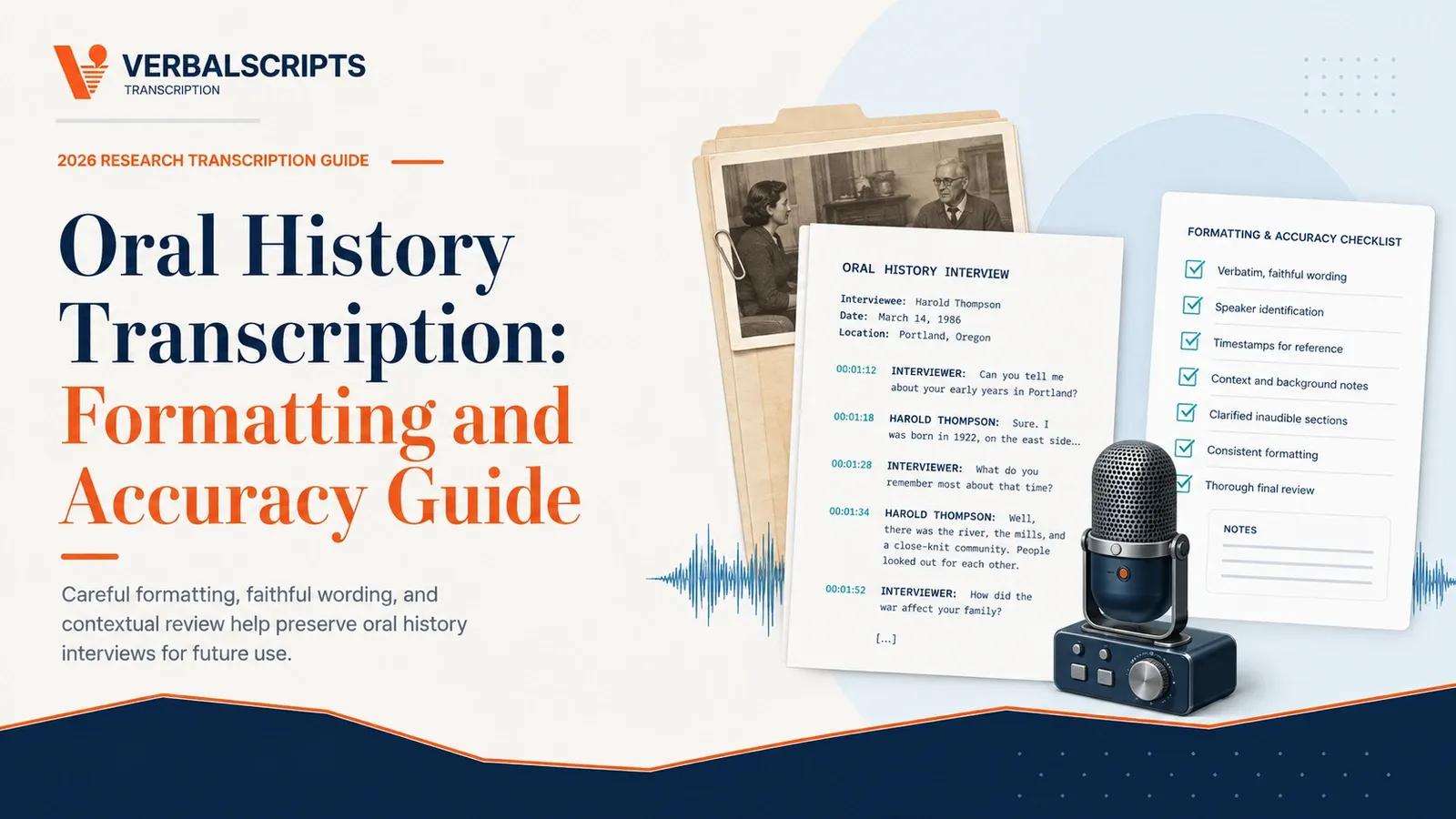
Oral History Transcription: Formatting and Accuracy Guide
Contents
Updated August 5, 2026 · Reviewed by the Verbalscripts Transcription Team
Quick answer: An oral history transcript should preserve the narrator’s meaning and voice while making the interview searchable and usable. Use consistent speaker labels, transparent editorial rules, source-based timestamps, verified names and dates, contextual notes, metadata, and documented restrictions. Review the final transcript against the recording and preserve the original audio as the primary source.
Oral history is both a recorded encounter and a source created through the relationship between narrator and interviewer. Its transcript is not merely a cleaned article. It is an access tool, research aid, and sometimes a long-term archival object that should remain connected to the recording and the project’s rights and consent documentation.
Formatting choices affect how future readers understand the interview. Over-editing can erase voice and historical texture; under-editing can make a long conversation difficult to navigate. The goal is faithful, transparent, consistent representation.
At a glance
| Element | Recommended practice | Reason |
| --- | --- | --- |
| Speaker labels | Use Interviewer and narrator name or approved identifier consistently | Makes turns immediately understandable |
| Timestamps | Add periodic and topic-change timestamps | Connects text to the recording |
| Editorial changes | Define and disclose punctuation, false-start, and filler rules | Prevents silent alteration of the source |
| Metadata | Record interview date, place, participants, source file, and restrictions | Supports context and discovery |
| Review | Audit proper names, dates, quotations, and uncertain passages | Protects historical accuracy |
Keep the recording as the primary source
The transcript makes an interview searchable and readable, but voice, cadence, emotion, timing, and interaction remain in the recording. Preserve the native audio or video and document any conversion, enhancement, or editing. The transcript header should identify the source file and the timestamp system used.
The Oral History Association’s archival guidance states that transcripts and captions aid discoverability and accessibility, recommends trained transcription and review, and encourages projects to create a style guide. It also emphasizes checking proper names and dates and noting differences between the recording and transcript.
Create an oral history style guide
Decide how to handle contractions, dialect, fillers, repetitions, false starts, unfinished sentences, laughter, long pauses, emotional expression, interruptions, and non-English speech. Punctuation is editorial because spoken language does not arrive with commas and paragraph breaks. Use punctuation to clarify syntax without turning the narrator into a different writer.
Specify how corrections and supplied information appear. Brackets can distinguish editorial clarification from spoken words: [name unclear], [laughs], or [local factory]. Avoid adding interpretation such as [angrily] unless the convention explicitly permits it and the observation is supportable.
Preserve narrator voice without creating unreadable text
A readable transcript can remove non-meaningful verbal clutter while retaining characteristic wording, grammar, rhythm, and story structure. The right balance depends on the project. A community archive may favor a close transcript; an edited publication may create a separate reading version.
Do not silently merge these purposes. Preserve an archival transcript that reflects the recording and create a separately labeled edited excerpt if publication requires compression. Record substantive changes and ensure rights and narrator-review procedures are followed.
Format speaker turns and paragraphs consistently
Use one label for each speaker throughout the collection. Begin a new paragraph when the speaker changes and when a long answer moves to a new topic. Hanging indents or bold labels can improve scanning, but the file should remain accessible and portable.
Include a title page or header with project name, interview number, narrator, interviewer, date, location, recording duration, source filename, transcriber, reviewer, transcript convention, and restrictions. The header should distinguish event date from transcription or revision date.
Use timestamps as finding aids
Periodic timestamps every few minutes help users move from text to audio. Topic-change timestamps or a separate time log can provide even stronger navigation for long interviews. Precise timestamps belong beside inaudible or disputed passages.
If silence has been removed or files concatenated, disclose which media version matches the transcript. For multi-part recordings, restart timestamps by file only when the header makes the convention unmistakable.
Verify names, dates, and historical terms
Proper nouns are among the most consequential transcription errors. Use project notes, archival sources, directories, maps, newspapers, and narrator-supplied spellings where appropriate. Do not replace what was spoken with an external “correction” without indicating the difference.
A narrator may remember a date differently from documentary records. The transcript should faithfully capture the statement. Editorial notes or footnotes can record a verified discrepancy if the project’s policy allows it. Preserve the distinction between transcription and historical fact-checking.
Represent unclear and damaged audio honestly
Old tapes may contain hiss, dropouts, print-through, speed variation, clipping, or microphone loss. Gentle enhancement can improve audibility, but it cannot recreate missing speech. Use a consistent notation such as [inaudible 00:43:18], [unclear name], or [tape stops].
Review uncertain passages more than once and, where possible, ask someone familiar with local names or the narrator’s history. Keep guesses out of the final text. If a probable word is included, mark uncertainty according to the style guide.
Respect rights, restrictions, and narrator participation
Access is not determined by the transcript alone. Releases, deeds of gift, consent documents, embargoes, copyright, privacy, community expectations, and repository policy may govern use. Display restrictions clearly on the transcript and in metadata.
Oral History Association guidance emphasizes ongoing transparency, narrator rights, and attention to vulnerable participants and communities. Narrator review can correct names and clarify meaning, but projects should define whether changes alter the historical record, create an addendum, or produce a revised transcript.
Prepare for long-term preservation and discovery
Use durable, non-proprietary or widely supported text formats alongside formatted access copies. Maintain a preservation master, a readable PDF or Word version, and structured metadata. Ensure file names and identifiers match the audio collection.
Indexes, subject headings, summaries, and controlled vocabulary can make an interview discoverable even when a full transcript is unavailable. When a transcript exists, its text can support search, accessibility, and research, but only if quality review and rights metadata are complete.
Prepare archival metadata and access notes with the transcript
An oral history transcript becomes more useful when it travels with reliable metadata. Record the project title, interview identifier, narrator and interviewer names as authorized, date and location, recording format, duration, language, rights status, restrictions, source-file names, transcript convention, transcriber, reviewer, revision history, and relationship between transcript timestamps and media files.
Create an access note that explains whether the interview is open, embargoed, restricted to a reading room, available only with permission, or subject to redactions. Rights and access can differ between the recording, transcript, photographs, and later edited publication. Keep these distinctions visible so future staff do not infer permission from the mere existence of a file.
Before deposit, test discoverability and usability. Open the files on another system, verify character encoding, check links and timestamps, and confirm that names and dates in finding aids match the approved transcript. Preserve an archival master separately from web copies or edited excerpts. This metadata work may seem administrative, but it determines whether the interview remains understandable and ethically usable decades later.
Practical checklist
Preserve the original recording and document derivative files.
Use one collection-wide style guide.
Keep speaker labels and paragraph rules consistent.
Add source-based timestamps and a clear legend.
Verify names, places, organizations, and dates.
Mark inaudible and uncertain material honestly.
Separate faithful transcripts from edited publication versions.
Record transcriber, reviewer, and revision history.
Display access and use restrictions clearly.
Deliver archival and access formats with matching metadata.
How Verbalscripts supports this workflow
Verbalscripts provides 100% human transcription supported by a four-step process: transcription and editing, review, proofreading, and final formatting. Every transcriber signs a confidentiality agreement, and projects can be delivered with consistent speaker labels, timestamps, terminology lists, and client-specific templates. Files are available in Word, PDF, RTF, TXT, SRT, VTT, and other agreed formats. For sensitive projects, ask about restricted assignment, project-specific NDAs, retention instructions, and deletion confirmation.
Frequently asked questions
Should oral history transcripts be verbatim?
They should faithfully represent the recording, but projects vary in how they handle fillers and false starts. The convention should be documented and consistently applied.
Can a narrator edit the transcript?
Many projects allow narrator review, but the scope and treatment of changes should be defined in advance and documented.
Should incorrect dates be corrected in the transcript?
Transcribe what was said. A project may add a clearly identified editorial note rather than silently changing the narrator’s words.
How often should timestamps appear?
Common approaches use periodic timestamps every few minutes, topic-change markers, or a separate time log. Unclear passages should have precise timestamps.
What is the best file format for oral history transcripts?
Use an accessible reading format plus a durable text-based archival format. The repository’s preservation policy should guide the final package.
Can automatic transcription be used for old recordings?
It can create a rough draft, but old media, noise, accents, and historical names require careful human review.
Is the transcript a replacement for the audio?
No. The recording retains voice, cadence, timing, emotion, and interaction that text cannot fully preserve.
Related Verbalscripts resources
Academic and conference transcription
Transcription services for university professors
How to transcribe poor-quality audio accurately
When to add transcript timestamps
Authoritative external resources
Oral History Association principles and best practices
OHA Archiving Oral History manual
Library of Congress oral history resources
Request a project-specific quote
Share the recording length, number of speakers, audio quality, intended use, preferred format, deadline, and any confidentiality or institutional requirements through the Verbalscripts quote form. A project-specific review helps determine the right transcript style, turnaround, and quality-control plan for your material.
This article provides general information and is not legal, regulatory, accessibility, investment, employment, or research-ethics advice. Requirements vary by jurisdiction, institution, contract, platform, and intended use.
Updated August 5, 2026 · Reviewed by the Verbalscripts Transcription Team
Quick answer: An oral history transcript should preserve the narrator’s meaning and voice while making the interview searchable and usable. Use consistent speaker labels, transparent editorial rules, source-based timestamps, verified names and dates, contextual notes, metadata, and documented restrictions. Review the final transcript against the recording and preserve the original audio as the primary source.
Oral history is both a recorded encounter and a source created through the relationship between narrator and interviewer. Its transcript is not merely a cleaned article. It is an access tool, research aid, and sometimes a long-term archival object that should remain connected to the recording and the project’s rights and consent documentation.
Formatting choices affect how future readers understand the interview. Over-editing can erase voice and historical texture; under-editing can make a long conversation difficult to navigate. The goal is faithful, transparent, consistent representation.
At a glance
| Element | Recommended practice | Reason |
| --- | --- | --- |
| Speaker labels | Use Interviewer and narrator name or approved identifier consistently | Makes turns immediately understandable |
| Timestamps | Add periodic and topic-change timestamps | Connects text to the recording |
| Editorial changes | Define and disclose punctuation, false-start, and filler rules | Prevents silent alteration of the source |
| Metadata | Record interview date, place, participants, source file, and restrictions | Supports context and discovery |
| Review | Audit proper names, dates, quotations, and uncertain passages | Protects historical accuracy |
Keep the recording as the primary source
The transcript makes an interview searchable and readable, but voice, cadence, emotion, timing, and interaction remain in the recording. Preserve the native audio or video and document any conversion, enhancement, or editing. The transcript header should identify the source file and the timestamp system used.
The Oral History Association’s archival guidance states that transcripts and captions aid discoverability and accessibility, recommends trained transcription and review, and encourages projects to create a style guide. It also emphasizes checking proper names and dates and noting differences between the recording and transcript.
Create an oral history style guide
Decide how to handle contractions, dialect, fillers, repetitions, false starts, unfinished sentences, laughter, long pauses, emotional expression, interruptions, and non-English speech. Punctuation is editorial because spoken language does not arrive with commas and paragraph breaks. Use punctuation to clarify syntax without turning the narrator into a different writer.
Specify how corrections and supplied information appear. Brackets can distinguish editorial clarification from spoken words: [name unclear], [laughs], or [local factory]. Avoid adding interpretation such as [angrily] unless the convention explicitly permits it and the observation is supportable.
Preserve narrator voice without creating unreadable text
A readable transcript can remove non-meaningful verbal clutter while retaining characteristic wording, grammar, rhythm, and story structure. The right balance depends on the project. A community archive may favor a close transcript; an edited publication may create a separate reading version.
Do not silently merge these purposes. Preserve an archival transcript that reflects the recording and create a separately labeled edited excerpt if publication requires compression. Record substantive changes and ensure rights and narrator-review procedures are followed.
Format speaker turns and paragraphs consistently
Use one label for each speaker throughout the collection. Begin a new paragraph when the speaker changes and when a long answer moves to a new topic. Hanging indents or bold labels can improve scanning, but the file should remain accessible and portable.
Include a title page or header with project name, interview number, narrator, interviewer, date, location, recording duration, source filename, transcriber, reviewer, transcript convention, and restrictions. The header should distinguish event date from transcription or revision date.
Use timestamps as finding aids
Periodic timestamps every few minutes help users move from text to audio. Topic-change timestamps or a separate time log can provide even stronger navigation for long interviews. Precise timestamps belong beside inaudible or disputed passages.
If silence has been removed or files concatenated, disclose which media version matches the transcript. For multi-part recordings, restart timestamps by file only when the header makes the convention unmistakable.
Verify names, dates, and historical terms
Proper nouns are among the most consequential transcription errors. Use project notes, archival sources, directories, maps, newspapers, and narrator-supplied spellings where appropriate. Do not replace what was spoken with an external “correction” without indicating the difference.
A narrator may remember a date differently from documentary records. The transcript should faithfully capture the statement. Editorial notes or footnotes can record a verified discrepancy if the project’s policy allows it. Preserve the distinction between transcription and historical fact-checking.
Represent unclear and damaged audio honestly
Old tapes may contain hiss, dropouts, print-through, speed variation, clipping, or microphone loss. Gentle enhancement can improve audibility, but it cannot recreate missing speech. Use a consistent notation such as [inaudible 00:43:18], [unclear name], or [tape stops].
Review uncertain passages more than once and, where possible, ask someone familiar with local names or the narrator’s history. Keep guesses out of the final text. If a probable word is included, mark uncertainty according to the style guide.
Respect rights, restrictions, and narrator participation
Access is not determined by the transcript alone. Releases, deeds of gift, consent documents, embargoes, copyright, privacy, community expectations, and repository policy may govern use. Display restrictions clearly on the transcript and in metadata.
Oral History Association guidance emphasizes ongoing transparency, narrator rights, and attention to vulnerable participants and communities. Narrator review can correct names and clarify meaning, but projects should define whether changes alter the historical record, create an addendum, or produce a revised transcript.
Prepare for long-term preservation and discovery
Use durable, non-proprietary or widely supported text formats alongside formatted access copies. Maintain a preservation master, a readable PDF or Word version, and structured metadata. Ensure file names and identifiers match the audio collection.
Indexes, subject headings, summaries, and controlled vocabulary can make an interview discoverable even when a full transcript is unavailable. When a transcript exists, its text can support search, accessibility, and research, but only if quality review and rights metadata are complete.
Prepare archival metadata and access notes with the transcript
An oral history transcript becomes more useful when it travels with reliable metadata. Record the project title, interview identifier, narrator and interviewer names as authorized, date and location, recording format, duration, language, rights status, restrictions, source-file names, transcript convention, transcriber, reviewer, revision history, and relationship between transcript timestamps and media files.
Create an access note that explains whether the interview is open, embargoed, restricted to a reading room, available only with permission, or subject to redactions. Rights and access can differ between the recording, transcript, photographs, and later edited publication. Keep these distinctions visible so future staff do not infer permission from the mere existence of a file.
Before deposit, test discoverability and usability. Open the files on another system, verify character encoding, check links and timestamps, and confirm that names and dates in finding aids match the approved transcript. Preserve an archival master separately from web copies or edited excerpts. This metadata work may seem administrative, but it determines whether the interview remains understandable and ethically usable decades later.
Practical checklist
Preserve the original recording and document derivative files.
Use one collection-wide style guide.
Keep speaker labels and paragraph rules consistent.
Add source-based timestamps and a clear legend.
Verify names, places, organizations, and dates.
Mark inaudible and uncertain material honestly.
Separate faithful transcripts from edited publication versions.
Record transcriber, reviewer, and revision history.
Display access and use restrictions clearly.
Deliver archival and access formats with matching metadata.
How Verbalscripts supports this workflow
Verbalscripts provides 100% human transcription supported by a four-step process: transcription and editing, review, proofreading, and final formatting. Every transcriber signs a confidentiality agreement, and projects can be delivered with consistent speaker labels, timestamps, terminology lists, and client-specific templates. Files are available in Word, PDF, RTF, TXT, SRT, VTT, and other agreed formats. For sensitive projects, ask about restricted assignment, project-specific NDAs, retention instructions, and deletion confirmation.
Frequently asked questions
Should oral history transcripts be verbatim?
They should faithfully represent the recording, but projects vary in how they handle fillers and false starts. The convention should be documented and consistently applied.
Can a narrator edit the transcript?
Many projects allow narrator review, but the scope and treatment of changes should be defined in advance and documented.
Should incorrect dates be corrected in the transcript?
Transcribe what was said. A project may add a clearly identified editorial note rather than silently changing the narrator’s words.
How often should timestamps appear?
Common approaches use periodic timestamps every few minutes, topic-change markers, or a separate time log. Unclear passages should have precise timestamps.
What is the best file format for oral history transcripts?
Use an accessible reading format plus a durable text-based archival format. The repository’s preservation policy should guide the final package.
Can automatic transcription be used for old recordings?
It can create a rough draft, but old media, noise, accents, and historical names require careful human review.
Is the transcript a replacement for the audio?
No. The recording retains voice, cadence, timing, emotion, and interaction that text cannot fully preserve.
Related Verbalscripts resources
Academic and conference transcription
Transcription services for university professors
How to transcribe poor-quality audio accurately
When to add transcript timestamps
Authoritative external resources
Oral History Association principles and best practices
OHA Archiving Oral History manual
Library of Congress oral history resources
Request a project-specific quote
Share the recording length, number of speakers, audio quality, intended use, preferred format, deadline, and any confidentiality or institutional requirements through the Verbalscripts quote form. A project-specific review helps determine the right transcript style, turnaround, and quality-control plan for your material.
This article provides general information and is not legal, regulatory, accessibility, investment, employment, or research-ethics advice. Requirements vary by jurisdiction, institution, contract, platform, and intended use.
Subscribe to our newsletter.
Get latest updates for our Articles & Blogs. We post fresh content every week.
- Weekly articles
- Stay updated with our weekly articles covering various topics.
- No spam
- We respect your inbox. No spam, just valuable content.

Sign up for our monthly newsletter