.png%3F2025-10-21T13%3A16%3A03.380Z&w=2048&q=80)
what AI transcription errors mean and the six common AI transcription mistakes while offering solutions for fixing them.
Jul 5, 2026
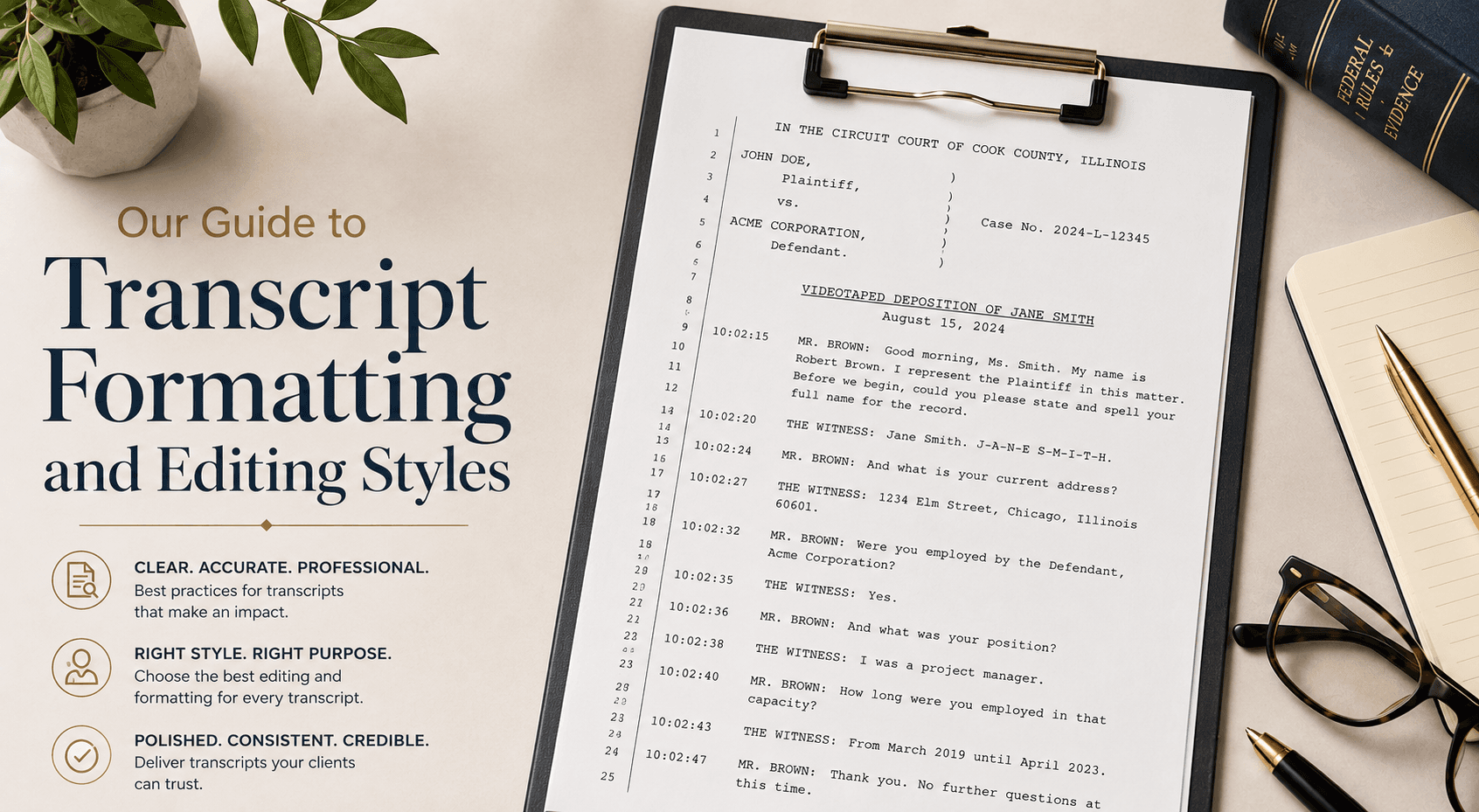
Our Guide to Transcript Formatting and Editing Styles
by Content Specialist—7 min read
Contents
Would you like to format or edit a transcript? But you do not know how to do it?
It poses many challenges if you do not know how to carry out this process especially if you're a beginner transcriptionist or freelancer.
But we are here to help to make your transcript understandable to the targeted users. Transcript formatting and editing styles are usual transcription practices you cannot escape from.
Making your document the best fit for your client. It's something that can attract many clients to your transcription job.
This guide walks you through proven practices for transcript formatting, editing and the key practices you can undertake to ensure you polish up the documents according to the organization's needs.
But first, let's understand what transcript formatting and editing is and why the two practices are necessary.
Here we go!
What’s Transcript Formatting and Editing?
Transcript formatting and editing involve the preparation of the transcribed texts into a clear, structured and easy-to-read document.
The processes require one to make effective decisions to ensure that the end document becomes helpful in its purpose.
Even though the two practices should be done on the same document, the processes are distinct from each other. Transcript formatting and editing are not the same.
Transcript formatting deals with ensuring the readability of a document. Does your document appear professional, or how well is your document structured?
When you learn how to arrange your document, this is all about transcript formatting. Transcript formatting examines elements such as paragraphing, spacing, headings, and consistency.
On the other hand, transcript editing entails refining the document for accuracy. Here we talk of the different sub-types of transcriptions, as well as editing grammar, word spelling or polishing up the document language where and when it’s needed.
Transcript formatting and editing are essential during transcription. The two processes ensure the end document is complete and accurate according to the required standards.
But why undertake these end processes in a document? Why is it essential? Let's inform you about it.
Why is Transcript Formatting and Editing Necessary?
Transcript formatting and editing depend on the final purpose of the transcribed texts. This means that how the end document gets polished and prepared depends on what the transcript will be ultimately used for.
So, the style or the level of formatting or editing a transcript is determined by the transcript's purpose.
In other words, the level of detail to be included in a transcript, its structure and how to polish it should correspond to the objective or the goal of the document.
For example, a legal court transcript cannot be formatted or edited like an academic document or a magazine interview. At the same time, you cannot edit or format a focus group transcribed text the same as a medical document.
The end use of a transcript dictates its formatting rules and the editing style to be used. So, why is transcript formatting and editing necessary?
● Proper editing ensures the text accurately reflects what is said.
● Well-formatted transcripts are easy to follow.
● Well-formatted and edited transcripts appear polished and credible.
● A clear, edited, and formatted transcript makes it easy for readers to search for the required information quickly.
● A correct and consistent document can easily be accessed by people with hearing impairments.
● In demanding fields like medical and legal set-ups, undertaking formatting and transcript editing practices makes you comply with the industry standards.
● Professional and well-organized documents are not exhausting to read and make it easy to follow the content.
But how should the two processes be done? Let's have a look at how to format and edit a transcript. How do you do it?
All About Transcript Editing
Generally, there are four main types of transcript editing styles. Here they are:
a) Verbatim
Verbatim style captures every word as they have been spoken. This style includes filler words, false starts, stutters and conversational pauses.
For example, if Speaker 1 says, "Um, I, I think we should, uh, start… You know, like right now." When editing the transcript using the verbatim style, the sentence remains as it is.
b) Clean Verbatim (Edited Verbatim)
Clean verbatim transcript editing style removes filler words, stutters, pauses, and false starts alike. It smoothens the texts, making the document easy to read.
For example, using the same speaker 1 statement, "Um, I, I think we should, uh, start… You know, like right now." Clean verbatim will remove the filler words, pauses and stutters, polishing the speaker's statement, making the sentence clean.
Therefore, the sentence will read, "I think we should start right now."
c) Intelligent (Polished Style)
Intelligent transcription usually rephrases the uttered texts, polishing the words even more. This style polishes the document like done in academic set -ups.
Intelligent editing style is mostly ideal for academic, media, and publication purposes, such as writing books, articles, reports, and other types of content.
For example, the same speaker 1 says, "Um, I, I think we should, uh, start… You know, like right now." Using the intelligent editing style, the statement will read, "We should begin immediately."
d) Summary Editing
The summary editing style highlights the main points in a document. Instead of writing every word, it creates a condensed version of what the document is all about.
Like the statement uttered by Speaker 1 , "Um, I, I think we should, uh, start… You know, like right now." Using the summary style, the statement gets summarised as follows: "The team agreed to begin immediately with project implementation."
But How Do You Tell the Right Editing Style to Use?
The transcript editing style depends on the purpose of your document, the audience and how the transcript will be used. Here is how you can tell:
● Consider the transcript's purpose.
● Consider the audience of the transcript.
● Check the client’s instructions or preference
All About Transcript Formatting
Formatting is the last step after selecting the transcript editing style. Once you know the right transcript editing style to use, it's time to choose the right transcript formatting style.
The following are the main formatting styles you need to consider:
a) Speaker Labels
Identifying your speakers is all about the speaker labels. Will you use the speaker’s initials or full names or will you choose to bold the names or not?
No matter the speaker label style you settle for, remember to be consistent. For example, if the name of speaker 1 is Jane Melvin and you select to label the speaker as 'JM,' stick with this style.
Otherwise, if you decide to refer to the speaker with full names, such as "Jane Melvin’’, stick to this same style.
b) Time-Stamps
Most times, time stamps are added whenever a new speaker takes the course. Time stamp the dialogue sections at regular intervals of 30 seconds or at the key discussion points. But remember to make them consistent in every section you choose.
c) Paragraphing
Paragraph your dialogues. Always start a new line when the speaker changes. However, ensure that you break long stretches of dialogue into shorter, digestible sections.
Paragraphing helps to make the document clear so that you can easily detect the dialogue spoken out by each speaker.
d) Punctuation
Use correct punctuation to improve clarity. But include it where necessary to totally reflect the speaker’s meaning.
The writing style you choose to follow, such as APA, MLA, and others, may dictate the punctuation format to use. But it’s always good to ensure you follow the instructions given by the client.
e) Special Notes
These are the special elements that occur in dialogues, such as laughter, coughs, pauses, and others. Put the special aspects in brackets or use italics to show more emphasis.
But How Do You Select the Correct Formatting Style to Use?
Here is what you can consider:
● Check the purpose of the transcript.
● Think about the audience.
● Follow the required formatting style if given by a client.
● Observe the key formatting elements like speaker labels and others.
With such a guide, now you don't need to start from anywhere when formatting or editing your transcript. Directly follow what is required to achieve a precise and easy-to-read document.
Conclusion
Transcripts are more than afterthought processes. They support communication and become reliable documents when needed in future.
Ensure to create a professional image of your work by following the correct formatting and editing styles in a transcript. This way, you will make a credible image of your transcription roles while providing a polished document that fits its purpose.
So, the key takeaway here is consistency and professionalism, as Verbalscripts advocates all the time. Verbalscripts transcription services are all about professionalism.
The team here adheres to the correct transcript formatting and editing styles as required. Most of all, doing it through the human way.
Human transcription practices are what make Verbalscripts professional and credible. Through this method, the Verbalscripts team helps to preserve the voices of dialogue most effectively.
In case you require a well-formatted and edited transcript, no matter the industry you serve in. Verbalscripts will delightfully serve you.

Let's' examine the various types of court hearings and provide helpful details about them as they are necessary legal actions.
Subscribe to our newsletter.
Get latest updates for our Articles & Blogs. We post fresh content every week.
- Weekly articles
- Stay updated with our weekly articles covering various topics.
- No spam
- We respect your inbox. No spam, just valuable content.

Legal TranscriptionAudio and Video Transcription servicesGeneral TranscriptionFocus groups and InterviewsMedical TranscriptionAcademic & Conference Transcription
Court reporting & LegalCorporate & general businessMedia productionDigital & online learningGovernmentHealthcare
About UsBlogsTranscription solutionsLocationsFrequently Asked QuestionsPrivacy PolicyTerms of Service
Sign up for our monthly newsletter
© Verbalscripts 2026. All rights reserved.