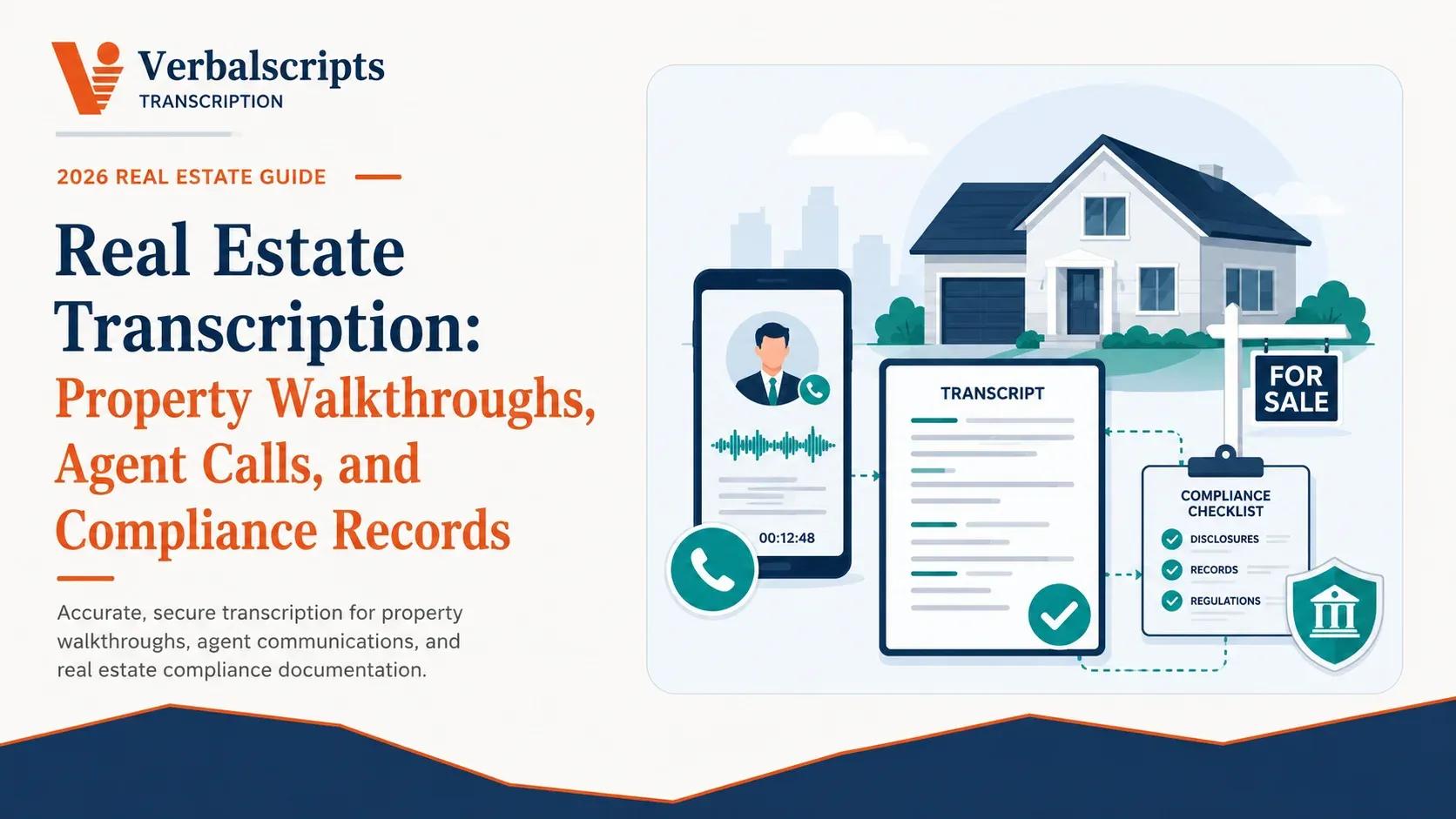
Real Estate Transcription: Property Walkthroughs, Agent Calls, and Compliance Records
Contents
How brokers, property managers, inspectors, investors and legal teams turn real-estate audio into searchable, reviewable records without losing addresses, measurements, money or speaker context.
Quick answer: Real-estate transcription is most valuable when the audio contains details people need to search, quote, compare or hand off: property addresses, unit numbers, measurements, repair items, dollar amounts, dates, names and commitments. Use human review for consequential records, provide a property-specific glossary, preserve the source recording, and confirm recording-consent/privacy rules before recording—transcription does not make an unlawfully made recording lawful.
Key takeaways
• Property and unit identifiers, measurements, prices, dates and names should be treated as critical fields.
• A structured transcript can make walkthroughs and calls easier to search, compare and route to teams, but the source recording should be preserved according to policy.
• Recording-consent laws vary by jurisdiction and circumstances; check the law before recording phone or in-person conversations.
• Separate observation from interpretation: faithful transcription should not turn uncertain audio into a stronger factual statement.
• For recurring portfolios, standardize speaker labels, property IDs, timestamps and issue tags.
Where real-estate transcription creates operational value
Property walkthrough: Room-by-room observations, defects, finishes, measurements, follow-up items
Agent/client call: Searchable record of needs, dates, property names and next steps
Property management call: Maintenance issue, unit, vendor, access and resolution notes
Inspection/field note: Time-aligned observations for report drafting and QA
Investor/asset meeting: Decisions, assumptions, capex items, action owners
Training/webinar: Searchable reference and accessible learning asset
Legal/claims interview: Verbatim or clean-verbatim record with speakers/timestamps as instructed
Critical fields to verify
Real-estate speech is deceptively error-sensitive. “Unit 1502” versus “1503,” “0.8 acres” versus “8 acres,” or “$415,000” versus “$450,000” can change the meaning dramatically. Names of streets, subdivisions, HOAs, contractors and technical building components also deserve focused review.
1. Full property address and unit/suite.
2. Names and roles of speakers.
3. Dates, appointment windows and deadlines.
4. Prices, deposits, fees, budgets and repair estimates.
5. Dimensions, acreage, quantities and units.
6. Parcel/lot/building identifiers when spoken.
7. Mechanical/electrical/building-system terminology.
8. Conditions/qualifiers such as “approximately,” “reported,” “appears,” or “not verified.”
Recording laws come before transcription
U.S. recording-consent rules vary by state and by whether the communication is in-person, telephone/electronic, private or otherwise regulated. The Reporters Committee for Freedom of the Press maintains a state-by-state recording guide that illustrates why multi-state calls can be complicated.
Set a recording policy that considers where participants are located, reasonable expectations of privacy, employment/client policies and any sector-specific requirements. When in doubt, obtain clear consent and seek legal advice. A transcript can document a recording; it cannot cure a recording that was unlawful to create.
A repeatable real-estate transcription workflow
1. Name the file with property ID, date and recording type.
2. Collect a glossary: addresses, people, companies, developments, streets and technical terms.
3. Choose verbatim level based on use—clean for operations, fuller verbatim for disputes/investigations.
4. Add timestamps at speaker changes or issue points when teams need to jump back to audio.
5. Require human verification for addresses, money, measurements, dates and names.
6. Mark unclear language rather than guessing.
7. Deliver in a consistent template with property metadata and action-item section if requested.
8. Store/transmit files under the organization’s privacy, retention and legal-hold rules.
Walkthrough transcript template
Property: [Street address / unit / property ID]
Date/time: [Local date/time]
Participants: [Name — role]
Area: [Exterior / kitchen / unit 4B / roof]
Timestamp: [00:18:42]
Observation: Faithful spoken observation
Uncertainty: [inaudible] / [unclear term] rather than invented text
Follow-up tag: Repair / verify / quote / document / legal review
When human review is worth the cost
AI-generated notes may be enough for low-risk internal recall. Human review becomes more valuable when the transcript will support a claim, legal matter, compliance investigation, valuation/transaction decision, formal report, insurance discussion or customer dispute, or when the recording has accents, field noise and overlapping speakers.
Use a risk-tiered approach: quick machine transcript for search/triage; human-verified transcript for consequential excerpts or final records.
Bottom line
Real-estate transcription works best as structured evidence-to-text, not as generic note taking. Decide which fields are critical, create a property glossary, standardize the format and preserve the connection to the source audio.
For sensitive calls and field recordings, confirm recording authority and privacy before capture, then use a secure transcription workflow consistent with your organization’s retention and access requirements.
Continue your research with Phone-call recording transcription, Video transcription, Transcription services, Compare human transcription services, and Strict-confidentiality transcription Each page covers a practical next step related to this topic.
Frequently asked questions
What can real-estate teams transcribe?
Property walkthroughs, agent/client calls, property-management calls, inspection/field notes, investor meetings, interviews, training and other recorded operational content where recording is authorized.
Should walkthrough transcripts include timestamps?
Use timestamps when reviewers need to return to the exact audio/video moment, especially for field observations, disputes or report QA.
Can I record a client or agent call without telling them?
Recording laws and policies vary by jurisdiction and circumstances, including participant locations. Check applicable law and organizational policy; clear consent is the safer operational practice when uncertain.
What accuracy issues matter most in real estate?
Addresses, unit numbers, names, money, dates, measurements, quantities and qualifying language are common high-consequence fields.
Can AI transcribe property walkthroughs?
Yes for drafts/triage, but field noise, movement, jargon and critical numbers can create errors. Add human verification when the transcript will drive consequential decisions or formal records.
References and further reading
1. Reporters Committee: Reporter’s Recording Guide - State-by-state overview of recording laws; not a substitute for legal advice.
2. 2026 research: realistic ASR benchmarking - Real-world noise/conversation can expose failures missed by clean benchmarks.
This guide does not provide legal advice about recording, privacy, real-estate licensing, evidence or record retention. Laws and policies vary; verify authority before recording and follow applicable professional/organizational requirements.
Subscribe to our newsletter.
Get latest updates for our Articles & Blogs. We post fresh content every week.
- Weekly articles
- Stay updated with our weekly articles covering various topics.
- No spam
- We respect your inbox. No spam, just valuable content.

Sign up for our monthly newsletter