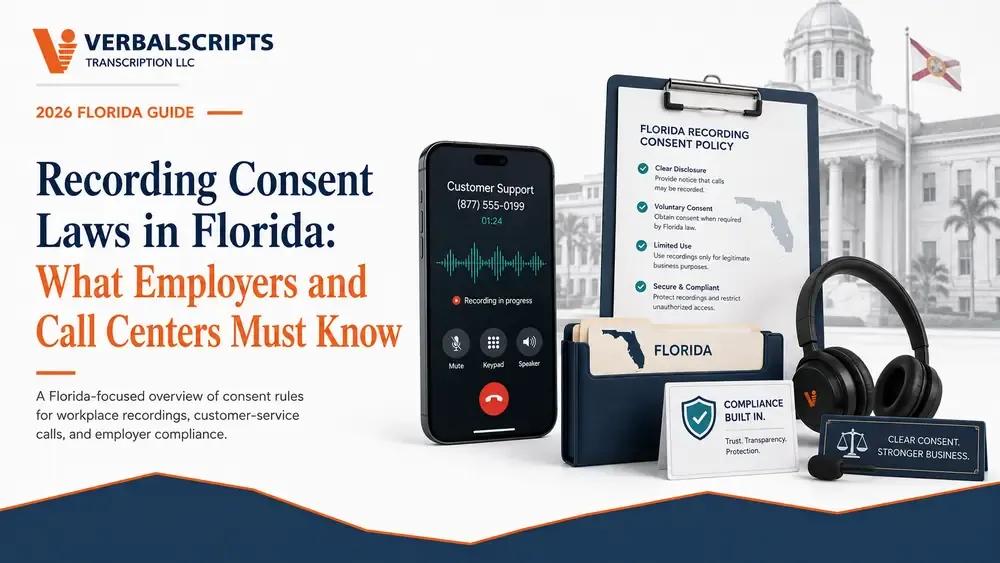
Recording Consent Laws in Florida: What Employers and Call Centers Must Know
Contents
Quick answer: Florida is generally treated as an all-party-consent state for protected oral and wire communications. Businesses and employers should obtain clear consent before recording calls or private conversations rather than relying on a federal one-party baseline. Whether a particular communication is protected still depends on the statute, circumstances, privacy expectations, and recognized exceptions.
This article provides general operational information, not legal, medical, compliance, educational or regulatory advice. Requirements can change by jurisdiction, contract, institution and facts. Confirm current rules with qualified counsel or the responsible authority before relying on a recording or transcript for a high-stakes purpose.
The 2026 answer in plain English
Florida is generally treated as an all-party-consent state for protected oral and wire communications. Businesses and employers should obtain clear consent before recording calls or private conversations rather than relying on a federal one-party baseline. Whether a particular communication is protected still depends on the statute, circumstances, privacy expectations, and recognized exceptions.
For buyers, the practical distinction is between the legal authority to make a recording and the operational controls needed to use that recording responsibly. Consent, disclosure, privacy expectations, workplace rules, contract terms, retention, security and later disclosure are separate questions. A defensible workflow addresses all of them before audio is sent for transcription.
This guide is general information for U.S. organizations, not legal advice. Recording law is unusually fact-specific, and interstate calls can create conflicts between jurisdictions. For a high-risk investigation, employment matter, healthcare encounter, privileged discussion or disputed recording, obtain advice from counsel familiar with the states and facts involved.
What the controlling law actually focuses on
Florida Statutes section 934.03 prohibits specified interceptions and disclosures of wire, oral, or electronic communications unless an exception applies. Florida’s definitions and case law make the expectation of privacy and the nature of the communication important, so businesses should avoid reducing the analysis to a single slogan.
For employers and call centers, the practical solution is consistent disclosure: pre-call announcements, visible meeting notices, agent scripts, documented exceptions, and technical controls that prevent recording from starting when consent is not obtained. Cross-state calls should be routed through the stricter policy rather than trying to make agents choose a law in real time.
The federal starting point is 18 U.S.C. section 2511. In many circumstances, federal law permits a participant to consent to the interception, but the federal rule does not erase a more protective state statute. Businesses therefore need a “highest applicable standard” approach for multi-state calls instead of training employees to remember a fifty-state chart during a live conversation.
Why businesses get recording compliance wrong
Most failures are operational, not philosophical. A company may have a correct legal memo and still fail because the recording prompt starts after the call is already being captured, a late participant joins without notice, a platform records by default, or an employee uses a personal device outside the approved system. Another common problem is confusing consent to participate in a call with consent to create and retain a recording.
The safest program makes the consent event observable. Use a pre-call announcement, written invitation language, an on-screen banner, an affirmative checkbox, or a verbal acknowledgment appropriate to the workflow. Keep enough evidence to show which notice was used and when. If the person declines and recording is not legally necessary, provide a non-recorded path rather than pressuring the participant.
Common scenarios and the safer operational response
Customer-service call with Florida participant — Practical approach: Use upfront recording notice and consent workflow. | Risk / note: High priority
Private HR meeting — Practical approach: Obtain all-party consent and document the business purpose. | Risk / note: High
Open public meeting subject to public-record/open-meeting rules — Practical approach: Different transparency rules may apply; check agency-specific requirements. | Risk / note: Context-specific
Florida participant calls one-party state — Practical approach: Do not assume the other state’s rule displaces Florida protections. | Risk / note: High
Interstate calls: which state rule should a company follow?
An interstate call is where simple “one-party” labels become unreliable. The caller may be in one state, the employee in another, a cloud platform in a third, and the company headquartered somewhere else. Courts can analyze choice-of-law questions differently, and the business may not know where a mobile participant is located at the moment of the call.
For recurring national workflows, the lowest-friction answer is often to standardize on conspicuous notice and consent that works in stricter jurisdictions. That reduces agent decision-making and creates a consistent customer or employee experience. Counsel can then define narrow exceptions for emergency, fraud-prevention, law-enforcement, or other circumstances where a different rule is justified.
A seven-step recording-to-transcript workflow
1. Define the purpose. State why the organization wants a recording and whether a transcript is actually necessary.
2. Identify participants and jurisdictions. Determine where known participants are located and whether special sector rules apply.
3. Give notice and obtain the required consent before substantive recording begins. Build a method for late joiners and transfers.
4. Record through an approved system. Avoid personal devices and uncontrolled apps for confidential matters.
5. Transfer the source securely. Limit the vendor to the minimum files and reference material needed to perform the work.
6. Transcribe and quality-review. Require speaker identification, uncertain-audio notation, terminology checks and client-specific formatting.
7. Deliver, retain and delete deliberately. Apply the organization’s records schedule, legal holds and access rules to both audio and transcript.
What a professional transcript adds after lawful recording
A searchable transcript can reduce the need for many people to listen repeatedly to sensitive audio. Legal, compliance and operations teams can locate statements, compare versions, quote accurately and review long recordings faster. For high-stakes material, human review is especially useful for names, numbers, accented speech, cross-talk, technical vocabulary and statements where punctuation changes meaning.
The transcript should not silently repair the recording. If a word is unclear, mark it according to the project convention. If speakers interrupt, preserve the overlap or use a defined interruption style. If the audio contradicts a reference document, the transcript should follow the audio unless the client specifically requests an editorial correction with a transparent notation.
Security, retention, and access are part of the legal risk
A lawful recording can still become a liability when it is copied into personal drives, emailed without control, retained forever, used for a new purpose, or shared with a vendor under vague terms. Classify the audio before upload. Decide whether it contains privileged material, health information, student data, payment data, trade secrets, CUI, investigative allegations or other sensitive information.
Vendor review should cover encryption in transit and at rest, account controls, worker access, subcontractors, breach procedures, deletion, backup retention, data location where relevant, and contract commitments. “We use encryption” is not enough; the buyer needs to understand who can actually see the file and what happens after final delivery.
Buyer checklist before ordering transcription
Confirm that the recording was lawfully obtained; identify the transcript’s intended use; choose strict verbatim, full verbatim or clean verbatim; provide a speaker roster and spelling list; specify timestamps, certification or page-line needs; identify confidential segments; set the deadline and rush priority; and document who may receive the final files. These decisions prevent costly rework and make quotations more comparable across vendors.
For Verbalscripts, the most useful project brief includes audio duration, file count, number of speakers, jurisdiction or proceeding type when relevant, desired transcript format, special terminology, turnaround, and any security or contract requirements. A written scope is more valuable than a low headline rate that excludes the features the project actually needs.
How to write a transcription specification that vendors can actually quote
A useful specification separates mandatory requirements from preferences. Mandatory items might include verbatim level, speaker naming, confidentiality, a page-line template, timestamp intervals, output file type, certification language, data-location restrictions or a fixed filing deadline. Preferences might include paragraph style, whether filler words are retained, or whether a second convenience format is delivered.
Include acceptance criteria. For example: all named speakers must match the supplied roster; every inaudible segment must carry a timestamp; numbers and dates receive a targeted review; headings must match the template; and corrections caused by vendor error are returned within an agreed period. Acceptance criteria turn “high quality” into something both parties can test.
Price the accepted transcript, not the cheapest first pass
A low per-minute quote can be expensive if it excludes human review, difficult audio, speaker identification, timestamps, formatting, rush service or project management. Normalize quotes into the same scope. If one vendor sends a raw draft and another sends a reviewed, client-ready file, the two prices are not measuring the same product.
Internal labor belongs in the calculation. Track how long attorneys, coordinators, researchers, editors or HR staff spend correcting names, speakers and formatting. A service that costs more per audio minute can have a lower total cost when it removes hours of skilled employee cleanup and reduces the chance of a consequential error reaching the final user.
Quality assurance questions for the vendor demo
Ask who performs the final review, whether the reviewer listens to the audio or only proofreads text, how low-confidence audio is escalated, whether client corrections are fed back into the project glossary, and how consistency is maintained across multiple transcribers. For recurring work, request one named style guide that follows the project rather than living in email threads.
Test edge cases deliberately. Include a name that sounds like a common word, a rapid number sequence, overlapping speakers, a quoted document and a weak-audio segment. The goal is not to make the vendor fail; it is to learn whether the workflow exposes uncertainty honestly and resolves it before delivery.
What to do after the first transcript is delivered
Review the first file promptly and return consolidated feedback. Correct participant names, preferred punctuation, role labels and template choices once, then turn those decisions into the project style sheet. Repeated piecemeal changes create inconsistency and unnecessary revision cycles.
For ongoing matters, establish version control. The file name or cover page should make clear whether a transcript is draft, reviewed, corrected or final. If a later client correction changes substantive wording, preserve the earlier version according to the organization’s records policy so users can understand what changed and why.
Frequently asked questions
Is a recording automatically legal if one participant agrees?
No. Federal law often permits one-party consent, but state law may require all-party consent and context-specific exceptions can apply. Other privacy, workplace, contractual and sector rules may also restrict recording or later use.
Does saying “this call may be recorded” always create valid consent?
Not automatically. The effectiveness of notice depends on applicable law and the facts. Businesses should use language and an acknowledgment process reviewed for the jurisdictions and workflow involved.
Can a transcript fix a recording-consent problem?
No. Transcription does not cure an unlawfully obtained recording. The legal basis for recording should be established before the file is created or sent to a vendor.
Should we delete the audio after receiving a transcript?
Sometimes, but not automatically. The answer depends on litigation holds, records schedules, regulatory duties, evidentiary needs and organizational policy. Define retention before the project starts.
Is automated transcription enough for a legal or compliance recording?
It can be useful for rough search, but high-stakes records benefit from human verification for speaker identity, names, numbers, terminology, inaudible passages and client-specific formatting.
What should we send with the audio?
Send only what the transcription team needs: participant names and roles, spelling/terminology references, format instructions, timestamp requirements, deadline, and clear handling instructions for sensitive information.
Related Verbalscripts resources
Related resources: general transcription services, legal transcription services, audio and video transcription, professional transcription accuracy guide and Get a transcription quote.
Authoritative sources and further reading
• Florida Statutes § 934.03 - Official Florida interception statute.
• Florida Statutes Chapter 934 - Florida Security of Communications chapter.
• 18 U.S.C. § 2511 - Federal baseline, which does not override more protective state rules.
Plan the transcript before the deadline is close
Once your organization has confirmed that the recording may be lawfully shared and transcribed, send Verbalscripts the project parameters: total minutes, speakers, intended use, deadline, transcript style, timestamps, formatting and security requirements. The quote should reflect the finished, reviewed deliverable—not merely the cost of producing a raw draft.
Next step: request a written transcription quote with the exact workflow and deadline you need.
Subscribe to our newsletter.
Get latest updates for our Articles & Blogs. We post fresh content every week.
- Weekly articles
- Stay updated with our weekly articles covering various topics.
- No spam
- We respect your inbox. No spam, just valuable content.

Sign up for our monthly newsletter