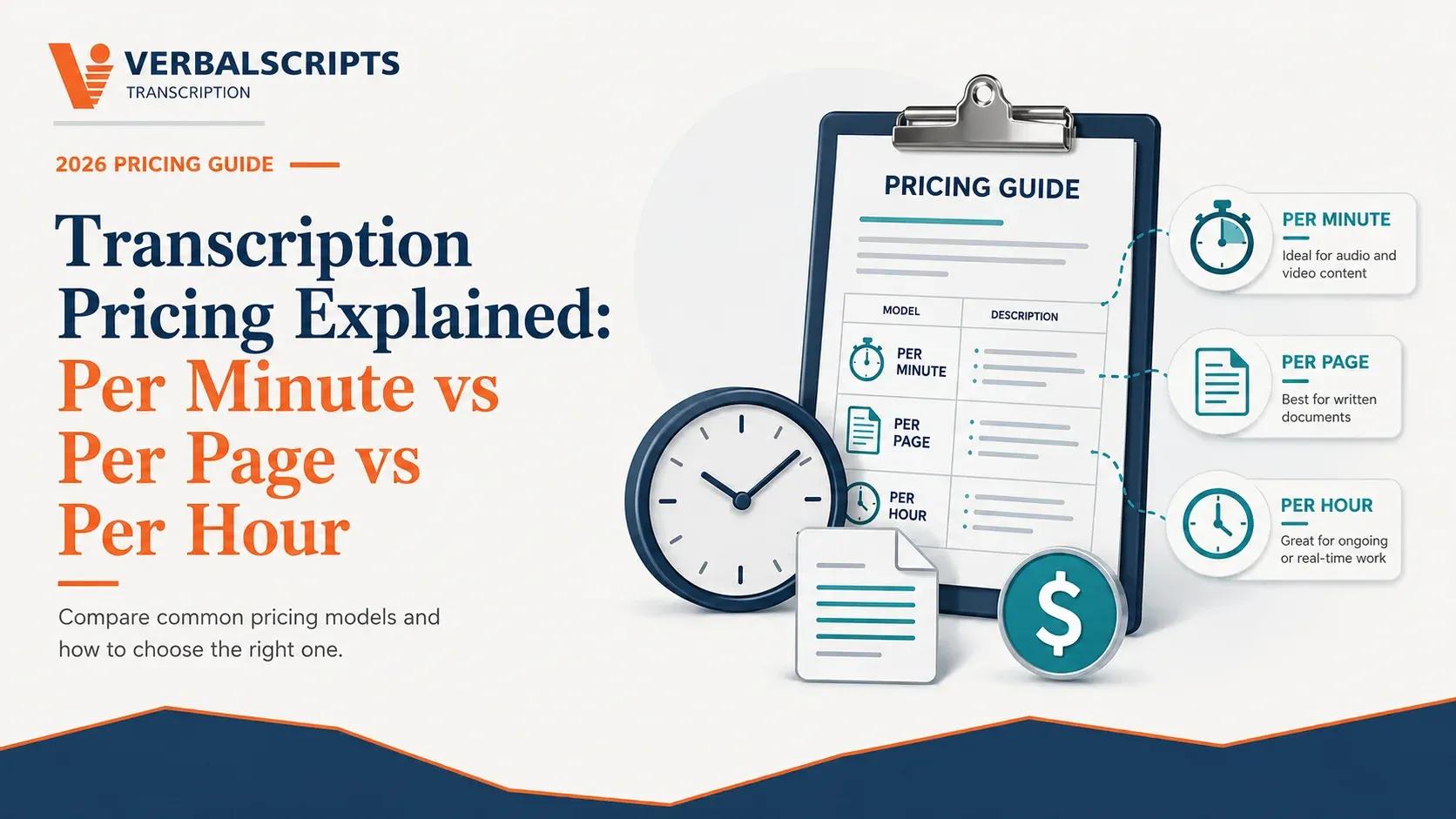
Transcription Pricing Explained: Per Minute vs Per Page vs Per Hour
Contents
Quick answer: Transcription can be billed per audio minute, per page, per recorded hour, or per labor hour—and those units are not interchangeable. Per-audio-minute pricing is usually easiest for clients to forecast because it is tied to file duration. Per-page pricing is common in official court-transcript ecosystems, where formatting and authorized rate schedules may matter; for example, federal courts publish page-based transcript rates that vary by delivery speed.[1] Labor-hour pricing shifts more uncertainty to the client because difficult audio takes longer to process.
Key takeaways
• What the billable unit actually measures.
• Comparing a per-page court rate with a general transcription per-minute rate.
• Ask every vendor to quote the same specification.
• Human review should be matched to the risk of the transcript’s downstream use.
• Ask the vendor to define security, turnaround, formatting, and what is included in the quoted price.
Why this transcription workflow matters in 2026
Recorded speech has become a routine business record, but a recording is difficult to search, quote, compare, audit, or move into a structured workflow. Compare the real economics of audio-minute, page-based, and labor-hour transcription billing models. The practical goal is not merely to turn sound into words. It is to create a dependable text asset that preserves the facts people will rely on later.
For transcription pricing per minute vs per page vs per hour, the best process starts by defining the downstream use. A rough internal transcript can tolerate more uncertainty than a record that will influence a legal decision, patient documentation, employee action, research coding, public communication, or investor disclosure. That is why the right combination of audio quality, instructions, human review, security, and formatting matters more than a headline accuracy percentage.
What a high-quality transcript should capture
A useful transcript should make the original recording easier to verify, not harder. Before a project starts, define which details are essential and which are optional. For this use case, the specification should normally address:
• What the billable unit actually measures.
• Whether partial minutes/pages/hours are rounded.
• Which complexity factors trigger surcharges.
• What review, proofreading, certification, or formatting is included.
• How rush delivery changes the effective price.
When a word cannot be confirmed from the recording, the safer editorial choice is usually to flag the uncertainty using the agreed notation instead of guessing. This is especially important for proper names, numbers, medications, legal terms, financial figures, and statements that change meaning when a single word is wrong.
Where organizations use these transcripts
The same recording can serve different departments once it is converted to structured text. Common workflows include:
• One-off general transcription.
• Official or court-authorized transcript production.
• Large research batches.
• Recurring corporate work.
• Projects with unusual formatting or enhancement requirements.
The format should follow the use. A searchable internal archive may need clean speaker labels and timestamps; a publication may need editorial cleanup; an evidentiary or regulated workflow may require stricter verbatim rules, certification, authorization, or preservation of source files. Do not assume one transcript format is correct for every downstream purpose.
The mistakes that create the most risk
Most transcription failures are not caused by typing speed. They come from unclear scope, poor source audio, missing context, overconfident automation, inconsistent style, or weak data handling. Watch for the following:
• Comparing a per-page court rate with a general transcription per-minute rate.
• Confusing one audio hour with one labor hour.
• Ignoring minimum charges.
• Failing to price add-ons consistently.
• Accepting an open-ended labor-hour quote without an estimate or approval cap.
A mature workflow treats the transcript as a controlled derivative of the recording. The source audio remains available for verification, the delivered version is clearly labeled, edits are traceable where the risk justifies it, and the team knows who is authorized to approve the final document.
Best-practice workflow: from recording to approved transcript
1. Ask every vendor to quote the same specification.
2. Convert rates to an estimated cost for your actual files.
3. Request a sample if audio difficulty is uncertain.
4. Confirm whether timestamps, verbatim, speaker labels, certification, and rush are included.
5. For legal matters, confirm whether the producer must be court-authorized.
6. Document the approved scope before work begins.
For recurring work, convert these steps into a one-page transcription style guide. Include speaker-label rules, timestamp frequency, verbatim level, treatment of inaudibles, capitalization of products and acronyms, number formatting, redaction conventions, file naming, and the approval contact. A small style guide prevents repeated corrections across dozens or hundreds of files.
What actually drives transcription cost
The billable unit is only the starting point. Two files with the same duration can require very different labor. The strongest cost predictors are intelligibility, speaker separation, number of speakers, technical vocabulary, verbatim detail, timestamps, formatting, redaction, certification/authorization requirements, and turnaround. Volume can lower unit cost when the workflow is standardized, while rush work usually raises it because staffing and review have to be compressed.
Rev AI — Listed base rate: $0.25/audio min | 60 recorded min.: $15.00 | Notes: Automated; review may be needed
Rev standard human — Listed base rate: $1.99/audio min | 60 recorded min.: $119.40 | Notes: Human transcript; add-ons can apply
Benchmark source: Rev pricing, updated March 5, 2026. Prices can change and are not Verbalscripts rates.
How to evaluate a transcription vendor
Before sending sensitive or high-volume recordings, ask operational questions that can be answered in writing:
• Transparent scope and unit definitions.
• Written estimates.
• Approval process for unexpected complexity.
• Clear add-on pricing.
• Appropriate authorization/certification where required.
• Volume discounts for predictable batches.
Also ask who has access to recordings, whether subcontractors are used, where files are stored, how long source audio and transcripts are retained, how correction requests work, and whether the quoted turnaround includes the final review step. Those details become more important as the transcript moves closer to a legal, clinical, financial, HR, or research decision.
Compliance and accuracy note
Per-page pricing can be the correct model for official court transcripts, while per-audio-minute pricing is often simpler for recorded interviews, meetings, podcasts, and client-provided legal audio. The right unit depends on the record type, required authority, formatting standard, and who controls the source recording.
How Verbalscripts can support this workflow
Verbalscripts provides human-reviewed transcription for legal, medical, research, corporate, government, and media workflows. Start with the Transcription Services, Legal Transcription Services, General Transcription Services, and Get a Transcription Quote. For a project-specific estimate, requirements review, or large-volume workflow, request a quote.
For the strongest quote, include total recorded minutes, typical speaker count, audio sample, required verbatim level, timestamps, formatting/template needs, deadline and time zone, confidentiality/compliance requirements, and whether the final transcript will be used internally, publicly, clinically, academically, or in a legal proceeding.
Frequently asked questions
What is the best format for transcription pricing per minute vs per page vs per hour?
Use a format that matches the downstream workflow. Word is common for editable documents; PDF is useful for controlled review; plain text can feed analysis systems; SRT/VTT is appropriate for captions. Legal or regulated work may require a specific template, page layout, certificate, or authorized producer.
Should I choose clean verbatim or full verbatim?
Clean verbatim removes non-substantive fillers and obvious false starts while preserving meaning. Full verbatim keeps more speech detail and may be preferable for evidentiary, qualitative-research, linguistic, HR-investigation, or disputed-content use. Define the rule before production begins.
Do timestamps increase transcription cost?
Often, yes. Timestamps add production and QA work, especially when they are required frequently or must match video frames precisely. Cost can usually be controlled by using timestamps at speaker changes, paragraph intervals, topic changes, or only around unclear/disputed sections.
Can AI be used to reduce cost?
Yes, for suitable recordings and low-risk uses. The important question is what happens after the AI output is created. If the transcript will drive a consequential decision, request human verification against the source audio and confirm which parts of the file receive that review.
What should I send with the audio?
Send a speaker list, spellings, agenda or case/project context, glossary, relevant documents, formatting sample, deadline, verbatim preference, timestamp rules, redaction instructions, and a short explanation of how the transcript will be used. Context reduces avoidable errors.
How do I get an accurate quote?
Provide the actual duration and a representative audio sample. State the number of speakers, audio quality, industry, turnaround, format, timestamps, verbatim level, and any compliance or certification requirement. A precise specification is the fastest way to avoid surprise charges.
Continue with these selected Verbalscripts resources covering transcription pricing.
• Legal Transcription Services
• General Transcription Services
References and external sources
1. U.S. District Court, Central District of California. Court Reporter/Recorder Transcript Rates. https://www.cacd.uscourts.gov/court-reporting-services/court-reporterrecorder-transcripts (accessed August 10, 2026).
2. Rev. Pricing - Human and AI Transcription (Updated March 5, 2026). https://support.rev.com/hc/en-us/articles/18893487380365-Pricing (accessed August 10, 2026).
3. GoTranscript. Pricing & Cost Estimates. https://gotranscript.com/pricing-and-cost-estimate (accessed August 10, 2026).
Need a transcript you can actually use?
Send Verbalscripts your recording, deadline, and formatting requirements for a project-specific quote.
Regulations, platform features, vendor prices, and court requirements can change. Verify current rules and pricing before publication or reliance. This article provides general information and is not legal, medical, accounting, or compliance advice.
Subscribe to our newsletter.
Get latest updates for our Articles & Blogs. We post fresh content every week.
- Weekly articles
- Stay updated with our weekly articles covering various topics.
- No spam
- We respect your inbox. No spam, just valuable content.

Sign up for our monthly newsletter