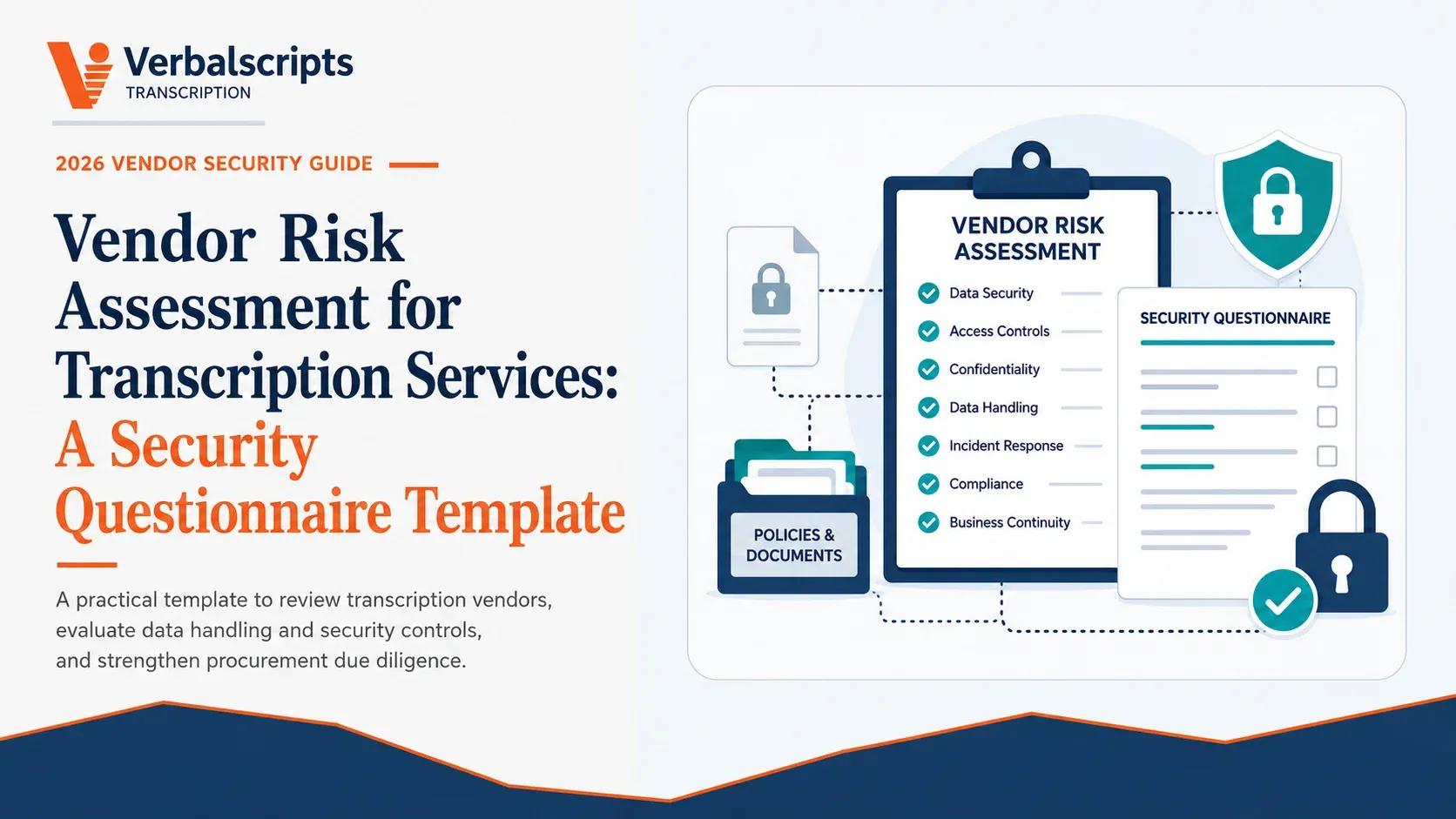
Vendor Risk Assessment for Transcription Services: A Security Questionnaire Template
Contents
A copy-ready 2026 security questionnaire and scoring model for legal, healthcare, research and enterprise teams evaluating transcription vendors.
Quick answer: A transcription vendor risk assessment should follow the recording from intake to deletion. At minimum, questionnaire sections should cover governance, data classification/flow, encryption, identity and access, human reviewer controls, endpoints, AI/model use, subprocessors, retention/backups, vulnerability management, incident response, continuity, regulated-data obligations, transcript QA and offboarding. Score evidence quality—not just yes/no answers—and define automatic blockers for your highest-risk data.
Key takeaways
• Ask questions about the exact service tier and workflow, not the vendor in the abstract.
• Require evidence for high-impact answers: policies, reports, diagrams, test summaries and contract language.
• Human reviewer access and AI/model processing are separate risk paths and should be assessed separately.
• Use a scoring model plus automatic blockers for non-negotiable controls such as an applicable BAA, unacceptable data use or missing incident obligations.
• Repeat the assessment when material subprocessors, models, regions, ownership or service architecture changes.
How to use this questionnaire
Send the questionnaire only after defining the intended use, data classes, volume, locations, integrations and service tier. A vendor cannot answer risk meaningfully if procurement has not said whether recordings contain public webinars, attorney-client material, PHI, education records, financial data or unreleased corporate information.
Require answers to reference evidence. “Yes, encrypted” is weaker than a concise statement identifying protocols, systems in scope, backups and an assurance artifact. For sensitive data, validate the most important controls through contract documents, SOC reports, architecture reviews or security calls.
Core transcription security questionnaire
The table below is designed to be copied into an RFP, spreadsheet or third-party risk platform. Expand it for your industry and data classification.
Governance — Question: Who owns security/privacy for this service? Provide policy/evidence dates. | Strong-answer indicator: Named accountable owner; current policy set
Data inventory — Question: What customer data types do you receive/create and where? | Strong-answer indicator: Complete inventory and current data-flow diagram
Encryption — Question: How is content encrypted in transit and at rest? | Strong-answer indicator: Modern protocols; encrypted storage/backups
IAM — Question: MFA, SSO, role-based access, privileged access, reviews? | Strong-answer indicator: Least privilege + recurring review
Human reviewers — Question: Who can hear/read files; locations; downloads; NDAs/training? | Strong-answer indicator: Need-to-know assignment + controlled endpoints
Endpoints — Question: Managed devices? Disk encryption, patching, EDR, removable media? | Strong-answer indicator: Documented baseline for staff handling content
Logging — Question: Which access/admin actions are logged and retained? | Strong-answer indicator: Auditable access and security events
AI/ASR — Question: Which models/providers receive content? Training/retention/region? | Strong-answer indicator: Explicit no-unapproved-secondary-use terms
Subprocessors — Question: List them and explain due diligence/change notice. | Strong-answer indicator: Current list + contractual flow-down
Retention — Question: Default/project retention for audio, drafts, finals, logs, backups? | Strong-answer indicator: Configurable/minimized lifecycle
Deletion — Question: How is deletion executed and verified, including backups? | Strong-answer indicator: Defined method and timeline
Vulnerability — Question: Scanning, patch SLAs, penetration testing? | Strong-answer indicator: Risk-based remediation + independent test
Incidents — Question: Detection, response, forensics, customer notice/cooperation? | Strong-answer indicator: Contracted escalation and notice
BC/DR — Question: RTO/RPO, backups and testing for critical service? | Strong-answer indicator: Tested recovery aligned to SLA
SOC/assurance — Question: SOC 2 or other assurance scope/period/exceptions? | Strong-answer indicator: Relevant, current evidence
HIPAA — Question: If PHI: BAA, safeguards and business-associate subprocessors? | Strong-answer indicator: Contract + workflow approved
FERPA — Question: If education records: school-official/direct-control/use limits? | Strong-answer indicator: Contract matches institution requirements
QA — Question: How are transcript errors measured, corrected and prevented? | Strong-answer indicator: Defined QA and corrective-action loop
Change mgmt — Question: How are material security/service changes reviewed? | Strong-answer indicator: Documented change process
Offboarding — Question: Return/destruction, access revocation, export and deletion? | Strong-answer indicator: Contractual termination procedure
Additional detailed questions by risk domain
Data use and AI
• Is customer content used to train, fine-tune, evaluate or improve any vendor or third-party model?
• Can all secondary/model-training use be disabled by contract and configuration?
• Does a model provider retain prompts/audio/transcripts after processing? For how long?
• Are embeddings, derived features or metadata retained after content deletion?
• Can the vendor identify the model/version used for a regulated project?
Workforce and human access
• Are reviewers employees, contractors or both?
• How are assignments limited to the minimum content needed?
• Can reviewers download content locally? If yes, what controls and deletion apply?
• How quickly is access revoked after role/contract termination?
• How are confidentiality violations detected, investigated and sanctioned?
Privacy and legal process
• Where can customer data be processed and stored?
• What privacy laws/contract regimes can the vendor support?
• How are government/law-enforcement requests handled and, where lawful, notified?
• How are data-subject/record-access requests supported when applicable?
• Which records demonstrate deletion, access and subprocessor changes?
Operational transcript integrity
• How are source audio and final transcript versions linked?
• Can the vendor show who edited/approved a transcript?
• How are corrections versioned and communicated?
• Does the workflow prevent one customer’s glossary/content from appearing in another customer’s project?
• How are inaudibles, uncertain names and overlapping speech documented?
Suggested scoring model
A numeric score helps compare vendors, but do not let averaging hide a critical failure. Score each domain from 0 to 4 and weight it based on your data. Separately define blockers that require remediation or executive risk acceptance.
4: Documented control with current independent or strong first-party evidence
3: Control documented; evidence adequate but with minor gaps
2: Partial control, limited evidence or compensating process needed
1: Informal/unclear control; material gap
0: Control absent, unacceptable or vendor will not answer
Example automatic blockers
• Vendor will not sign a required BAA or regulated-data agreement.
• Customer content may be used for model training/secondary use contrary to policy and cannot be disabled.
• Unknown or undisclosed subprocessors have access to high-risk content.
• No acceptable incident-notification/cooperation obligation.
• No secure approved transfer method for the data class.
• No defined retention/deletion process where minimization is required.
• Reviewer/end-user access cannot be restricted to authorized personnel.
• Official-record work requires authorization the vendor does not have.
Evidence request list
1. SOC 2 report/bridge letter or equivalent assurance where available.
2. Security/privacy policy summaries and current data-flow diagram.
3. Subprocessor list.
4. Penetration-test executive summary and vulnerability-management overview.
5. Incident response and BC/DR test summaries.
6. Retention/deletion policy.
7. Sample BAA/DPA/security addendum relevant to the workflow.
8. AI/model provider and data-use documentation.
9. Quality-management and correction procedure.
10. Proof of insurance where required by procurement.
Bottom line
A good security questionnaire makes the transcription process observable. It should tell you who and what can touch the recording, why access is needed, what safeguards apply, what is retained, how changes are managed and what happens when something goes wrong.
Use the template consistently across vendors—including Verbalscripts—then record evidence, open gaps, compensating controls and final risk acceptance.
For more detail, explore these Verbalscripts resources on verbalscripts.
• Strict-confidentiality transcription - Confidential workflows.
• Transcription services - Service overview.
• Compare human transcription services - Human-service comparison.
• How to order HIPAA-compliant transcription - BAA/HIPAA ordering guidance.
• Compare and switch providers - Buyer comparison guidance.
Frequently asked questions
What is the most important security question for a transcription vendor?
There is no single question, but mapping the exact data flow is foundational because it reveals systems, people, AI providers, subprocessors, locations and retention points that other controls must cover.
Should every transcription vendor have SOC 2?
Not necessarily for every use case. Enterprise buyers may require it or equivalent evidence based on risk. If it is absent, decide what alternative evidence and controls are sufficient.
How should we assess human transcriptionists?
Ask about employment/contractor status, confidentiality, training, identity/access, work assignment, endpoint controls, local downloads, monitoring and revocation.
What should we ask about AI even if we buy human transcription?
Ask whether AI is used anywhere for first drafts, QA, support, file processing or product analytics and whether content is retained or used to train/improve models.
How often should vendor risk be reassessed?
Use your risk program’s cadence and trigger reassessment for material changes such as new subprocessors/models, security incidents, ownership changes, new integrations, new data classes or new processing regions.
References and further reading
1. AICPA & CIMA: SOC suite of services - Official SOC overview.
2. AICPA & CIMA: Trust Services Criteria - Official Trust Services Criteria.
3. HHS: HIPAA Security Rule - Official safeguard guidance.
4. HHS: Business Associates - Official HHS business-associate/BAA guidance.
5. U.S. Department of Education: FERPA - Official FERPA overview.
6. U.S. Department of Education: Who is a school official under FERPA? - Third-party contractor conditions.
Template only. Tailor questions, evidence requirements, scoring and blockers with your security, privacy, legal and procurement teams. A questionnaire is not a substitute for risk analysis or contract review.
Subscribe to our newsletter.
Get latest updates for our Articles & Blogs. We post fresh content every week.
- Weekly articles
- Stay updated with our weekly articles covering various topics.
- No spam
- We respect your inbox. No spam, just valuable content.

Sign up for our monthly newsletter