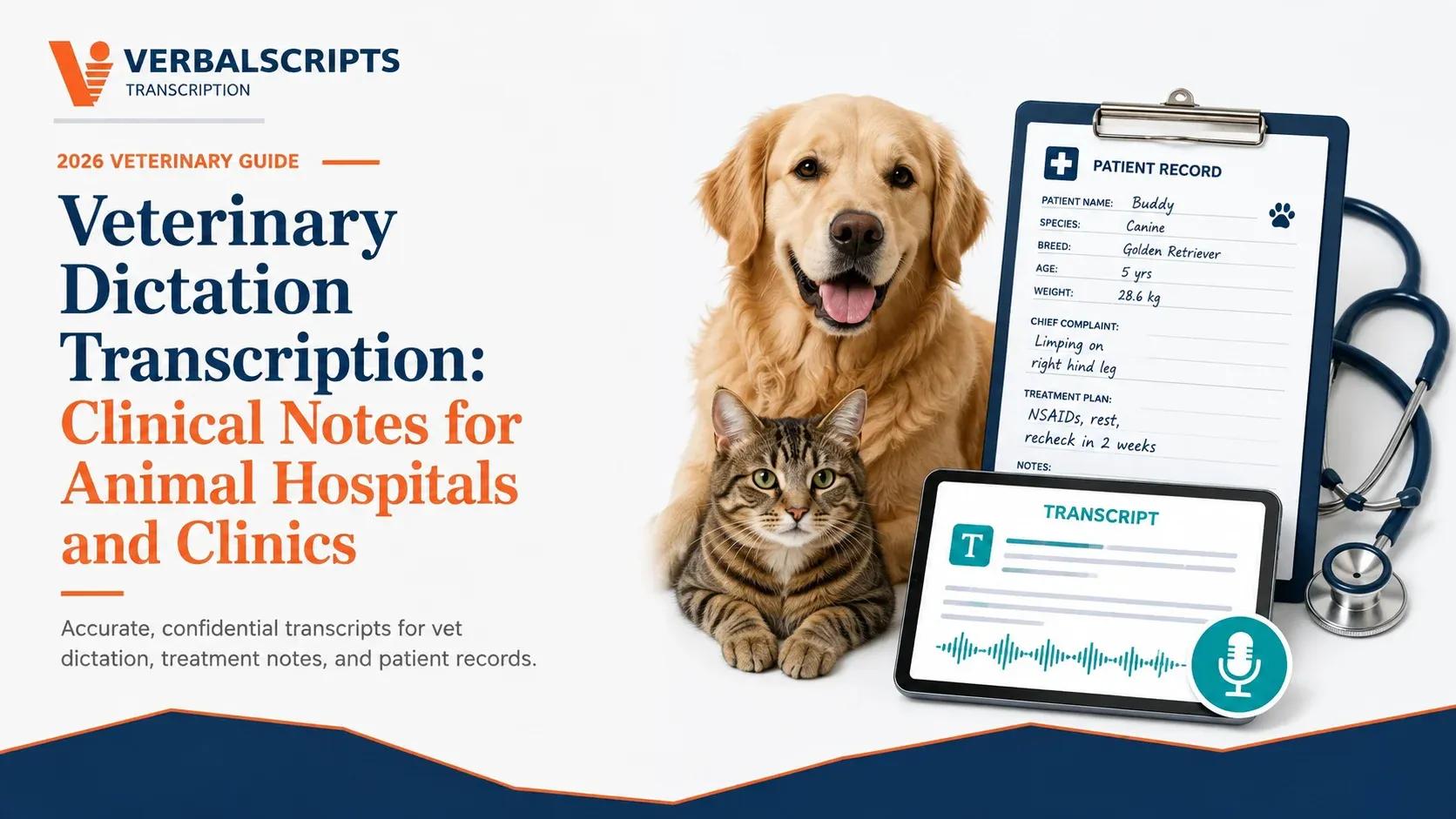
Veterinary Dictation Transcription: Clinical Notes for Animal Hospitals and Clinics
Contents
Quick answer: Veterinary dictation transcription converts a veterinarian's recorded assessment, treatment plan, discharge instructions, operative note, referral summary, or case update into a structured clinical document. The best workflow preserves veterinary terminology and medication details, supports rapid clinician sign-off, and keeps the record confidential. Veterinary records are not governed by HIPAA merely because they are medical, but professional and state-law confidentiality duties still matter.[1][2]
Key takeaways
• Signalment, presenting complaint, history, examination findings, assessment, diagnostics, treatment, medications, follow-up, and client instructions.
• Similar-sounding drug names or anatomy terms.
• Start every dictation with a patient identifier that is appropriate for your system.
• Human review should be matched to the risk of the transcript’s downstream use.
• Ask the vendor to define security, turnaround, formatting, and what is included in the quoted price.
Why this transcription workflow matters in 2026
Recorded speech has become a routine business record, but a recording is difficult to search, quote, compare, audit, or move into a structured workflow. Accurate clinical notes for veterinary teams, treatment records, referrals, and continuity of care. The practical goal is not merely to turn sound into words. It is to create a dependable text asset that preserves the facts people will rely on later.
For veterinary dictation transcription, the best process starts by defining the downstream use. A rough internal transcript can tolerate more uncertainty than a record that will influence a legal decision, patient documentation, employee action, research coding, public communication, or investor disclosure. That is why the right combination of audio quality, instructions, human review, security, and formatting matters more than a headline accuracy percentage.
What a high-quality transcript should capture
A useful transcript should make the original recording easier to verify, not harder. Before a project starts, define which details are essential and which are optional. For this use case, the specification should normally address:
• Signalment, presenting complaint, history, examination findings, assessment, diagnostics, treatment, medications, follow-up, and client instructions.
• Drug names, strengths, dosages, routes, frequencies, species-specific terminology, and proper names.
• Speaker identity when rounds, handoffs, or specialty consults involve more than one clinician.
• Uncertain audio flagged for clinician verification rather than guessed.
When a word cannot be confirmed from the recording, the safer editorial choice is usually to flag the uncertainty using the agreed notation instead of guessing. This is especially important for proper names, numbers, medications, legal terms, financial figures, and statements that change meaning when a single word is wrong.
Where organizations use these transcripts
The same recording can serve different departments once it is converted to structured text. Common workflows include:
• Same-day chart completion after appointments.
• Specialty referrals and consultation letters.
• Surgery and procedure notes.
• Mobile or after-hours dictation.
• Quality review and continuity-of-care documentation.
The format should follow the use. A searchable internal archive may need clean speaker labels and timestamps; a publication may need editorial cleanup; an evidentiary or regulated workflow may require stricter verbatim rules, certification, authorization, or preservation of source files. Do not assume one transcript format is correct for every downstream purpose.
The mistakes that create the most risk
Most transcription failures are not caused by typing speed. They come from unclear scope, poor source audio, missing context, overconfident automation, inconsistent style, or weak data handling. Watch for the following:
• Similar-sounding drug names or anatomy terms.
• Background noise from treatment areas.
• Dictation that jumps between patients without clear identifiers.
• Copy-forward language that is not actually stated.
• Confidential client and record information being sent through insecure channels.
A mature workflow treats the transcript as a controlled derivative of the recording. The source audio remains available for verification, the delivered version is clearly labeled, edits are traceable where the risk justifies it, and the team knows who is authorized to approve the final document.
Best-practice workflow: from recording to approved transcript
1. Start every dictation with a patient identifier that is appropriate for your system.
2. Dictate headings in a consistent order so notes map cleanly into the practice-management system.
3. Spell unusual drug, client, patient, breeder, or referring-clinic names.
4. State units and decimal values clearly; avoid ambiguous abbreviations where your policy prohibits them.
5. Review and authenticate the transcript before it becomes the final clinical record.
6. Use secure transfer and a vendor agreement that addresses access, retention, subcontractors, and deletion.
For recurring work, convert these steps into a one-page transcription style guide. Include speaker-label rules, timestamp frequency, verbatim level, treatment of inaudibles, capitalization of products and acronyms, number formatting, redaction conventions, file naming, and the approval contact. A small style guide prevents repeated corrections across dozens or hundreds of files.
Human transcription, AI, and hybrid review
Automation can be valuable for quick search, rough notes, and high-volume first passes. Human transcription and review add the ability to reason from context, verify speakers, research proper names, follow a style guide, and mark genuine uncertainty. The correct mix depends on risk. Routine internal calls may be suitable for an AI-assisted workflow; high-stakes legal, HR, clinical, financial, or public records often justify stronger human verification.
Do not buy a percentage in isolation. Ask how the vendor measures quality, whether the reviewer listens to the source audio, how corrections are handled, and what happens when the recording is genuinely unclear. The transcript should be defensible because of the process behind it, not because a marketing page promised a number.
How to evaluate a transcription vendor
Before sending sensitive or high-volume recordings, ask operational questions that can be answered in writing:
• Veterinary terminology competence.
• Secure file transfer and access controls.
• Clear handling of blanks/inaudibles.
• Templates for soap, operative, discharge, and referral formats.
• Turnaround options that match charting workload.
• Documented human review rather than machine-only output for difficult cases.
Also ask who has access to recordings, whether subcontractors are used, where files are stored, how long source audio and transcripts are retained, how correction requests work, and whether the quoted turnaround includes the final review step. Those details become more important as the transcript moves closer to a legal, clinical, financial, HR, or research decision.
Compliance and accuracy note
AAHA states that medical records should be clear, concise, secure, and thoroughly documented, while AVMA ethics treats information within veterinary medical records as confidential.[1][2] Transcription should support the veterinarian's documentation process—not replace professional review, diagnosis, or record authentication.
How Verbalscripts can support this workflow
Verbalscripts provides human-reviewed transcription for legal, medical, research, corporate, government, and media workflows. Start with the Medical Transcription Services, Audio & Video Transcription, How Verbalscripts Protects Confidentiality & Security, and Get a Transcription Quote. For a project-specific estimate, requirements review, or large-volume workflow, request a quote.
For the strongest quote, include total recorded minutes, typical speaker count, audio sample, required verbatim level, timestamps, formatting/template needs, deadline and time zone, confidentiality/compliance requirements, and whether the final transcript will be used internally, publicly, clinically, academically, or in a legal proceeding.
Frequently asked questions
What is the best format for veterinary dictation transcription?
Use a format that matches the downstream workflow. Word is common for editable documents; PDF is useful for controlled review; plain text can feed analysis systems; SRT/VTT is appropriate for captions. Legal or regulated work may require a specific template, page layout, certificate, or authorized producer.
Should I choose clean verbatim or full verbatim?
Clean verbatim removes non-substantive fillers and obvious false starts while preserving meaning. Full verbatim keeps more speech detail and may be preferable for evidentiary, qualitative-research, linguistic, HR-investigation, or disputed-content use. Define the rule before production begins.
Do timestamps increase transcription cost?
Often, yes. Timestamps add production and QA work, especially when they are required frequently or must match video frames precisely. Cost can usually be controlled by using timestamps at speaker changes, paragraph intervals, topic changes, or only around unclear/disputed sections.
Can AI be used to reduce cost?
Yes, for suitable recordings and low-risk uses. The important question is what happens after the AI output is created. If the transcript will drive a consequential decision, request human verification against the source audio and confirm which parts of the file receive that review.
What should I send with the audio?
Send a speaker list, spellings, agenda or case/project context, glossary, relevant documents, formatting sample, deadline, verbatim preference, timestamp rules, redaction instructions, and a short explanation of how the transcript will be used. Context reduces avoidable errors.
How do I get an accurate quote?
Provide the actual duration and a representative audio sample. State the number of speakers, audio quality, industry, turnaround, format, timestamps, verbatim level, and any compliance or certification requirement. A precise specification is the fastest way to avoid surprise charges.
Use the Verbalscripts guides and service pages below to learn more about veterinary transcription.
• Medical Transcription Services
• How Verbalscripts Protects Confidentiality & Security
References and external sources
1. American Veterinary Medical Association. Principles of Veterinary Medical Ethics of the AVMA. https://www.avma.org/resources-tools/avma-policies/principles-veterinary-medical-ethics-avma (accessed August 10, 2026).
2. American Animal Hospital Association. AAHA Standards of Accreditation - Medical Records. https://www.aaha.org/resources/aaha-standards/ (accessed August 10, 2026).
Need a transcript you can actually use?
Send Verbalscripts your recording, deadline, and formatting requirements for a project-specific quote.
Regulations, platform features, vendor prices, and court requirements can change. Verify current rules and pricing before publication or reliance. This article provides general information and is not legal, medical, accounting, or compliance advice.
Subscribe to our newsletter.
Get latest updates for our Articles & Blogs. We post fresh content every week.
- Weekly articles
- Stay updated with our weekly articles covering various topics.
- No spam
- We respect your inbox. No spam, just valuable content.

Sign up for our monthly newsletter