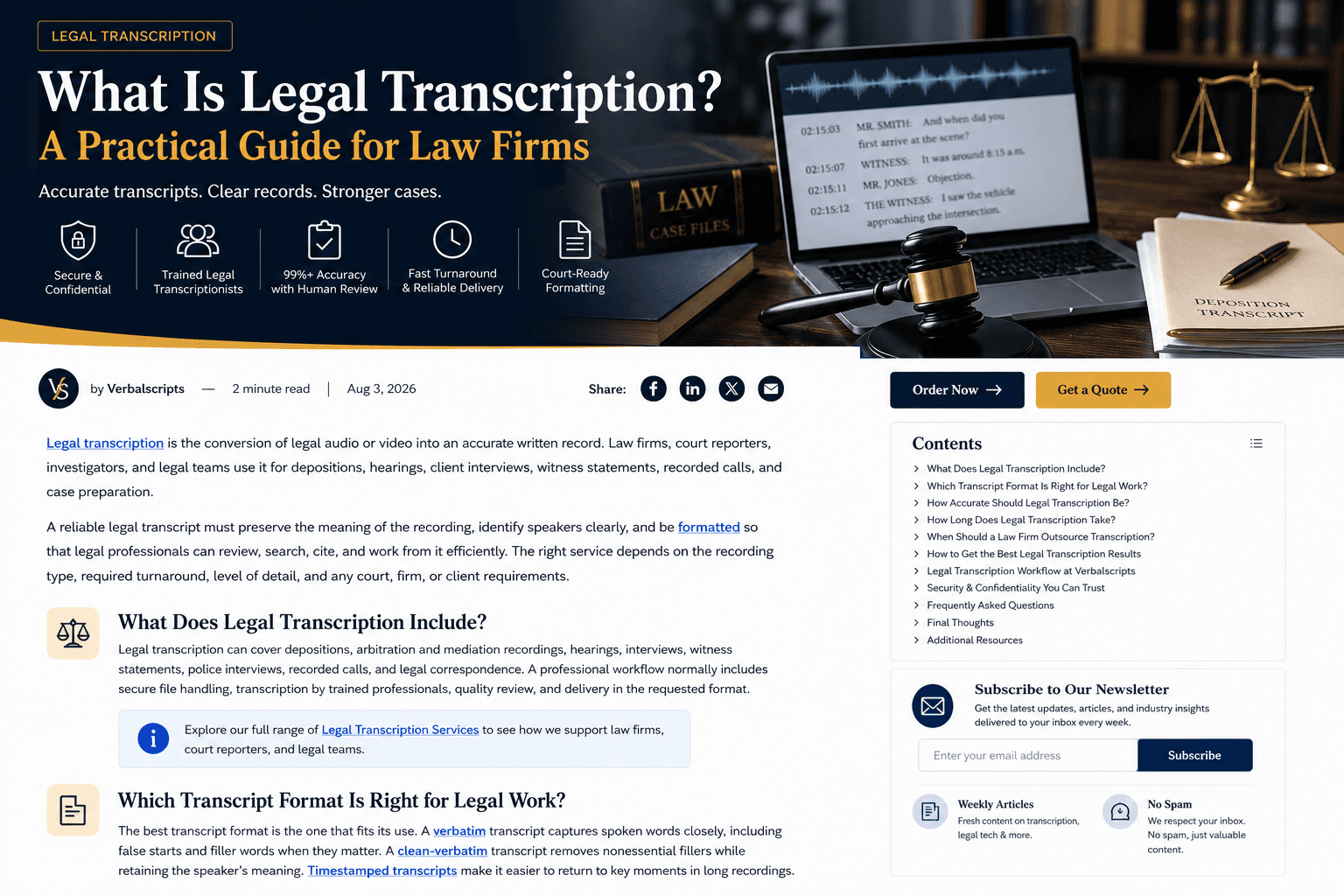
What Is Legal Transcription? A Practical Guide for Law Firms
Contents
Legal transcription is the process of converting recorded legal speech into a structured written document. Law firms use it for depositions, witness and client interviews, attorney dictation, recorded calls, arbitrations, mediations, and other case-related material. A dependable transcript preserves meaning, identifies speakers consistently, follows the requested format, and marks genuinely unclear audio instead of guessing.
The right workflow depends on the recording and its intended use. An internal interview summary does not carry the same formatting, review, or authorization requirements as an official court transcript. This guide explains what legal transcription includes, how it differs from court reporting, what affects quality and turnaround, and how a law firm can evaluate a provider.
Quick answer: What is legal transcription?
Legal transcription turns legal audio or video into searchable text for review, case preparation, recordkeeping, and client work. Professional service normally combines secure intake, careful speaker identification, legal-terminology review, formatting, quality assurance, and secure delivery.
What does legal transcription include?
Legal transcription can cover almost any authorized recording created or obtained during legal work. Common projects include depositions, examinations under oath, witness statements, client interviews, police or investigator interviews, arbitration and mediation sessions, recorded telephone calls, attorney correspondence, case notes, and digital recordings of proceedings.
The final document may be full verbatim, clean verbatim, timestamped, or formatted to a firm template. Requirements should be confirmed before transcription begins, including speaker labels, exhibit references, timecodes, page layout, file type, deadline, and whether uncertain speech must be marked in a particular way.
Legal transcription versus court reporting: what is the difference?
Legal transcription and court reporting overlap, but they are not interchangeable. A legal transcriptionist usually works from an existing recording. A court reporter or authorized court recorder creates or preserves the record of a proceeding under the rules that apply to that court or jurisdiction.
For U.S. federal proceedings, the U.S. Courts explains that designated proceedings are recorded under 28 U.S.C. § 753 and that written court transcripts are produced by official court reporters or authorized transcribers. A transcript created for a law firm's internal use is not automatically an official or certified court transcript.
Before outsourcing a hearing or courtroom recording, confirm that the firm is permitted to share it, who is authorized to prepare the transcript, and whether certification, filing, redaction, or jurisdiction-specific formatting is required. Court rules and orders control; a general transcription service should never imply that ordinary transcription automatically creates an official record.
What types of legal recordings are commonly transcribed?
Depositions and examinations
Recorded depositions and examinations may require precise speaker identification, question-and-answer structure, exhibit references, timestamps, and a format specified by counsel or the responsible reporter. Confirm who is authorized to produce any official or certified version.
Witness, client, and investigator interviews
Interview transcripts help legal teams search testimony, compare accounts, identify follow-up questions, and prepare chronologies. A participant list, matter-specific glossary, and consistent labels make these documents easier to use.
Hearings, arbitrations, and mediations
These recordings can involve many speakers, interruptions, remote participants, and specialist language. The request should identify whether the transcript is for internal review or an official process, because authorization and formatting obligations may differ.
Attorney dictation and recorded correspondence
Lawyers may dictate letters, memoranda, case notes, or instructions. Clean formatting and clear handling of names, citations, dates, and document structure are especially important for efficient review.
How does the legal transcription workflow work?
Secure intake and project scoping
The provider receives the recording through an approved channel and confirms the matter name, duration, number of speakers, audio condition, intended use, confidentiality needs, transcript style, formatting, deadline, and reference material.
Transcription and speaker identification
A transcriptionist creates the draft, applies the agreed labels and style, and marks passages that cannot be resolved reliably. Names, terminology, citations, figures, dates, and exhibit references receive targeted attention.
Review and quality assurance
The transcript is checked against the recording for completeness, meaning, speaker consistency, material details, punctuation, and formatting. Difficult sections may require repeated listening and comparison with supplied references.
Secure delivery and revisions
The completed file is delivered in the agreed format and through the approved method. The firm should know how long files are retained, who can access them, and how corrections or additional context will be handled.
Which transcript format should a law firm request?
Full verbatim
Full verbatim records speech closely, including fillers, repetitions, false starts, and interruptions when audible. It is useful when the manner of speaking or exact spoken sequence may matter.
Clean verbatim
Clean verbatim removes nonessential fillers and obvious verbal clutter without changing meaning. It often suits internal interviews, case review, correspondence, and material intended primarily for efficient reading.
Timestamped or timecoded transcripts
Timestamps connect text to the recording and help reviewers locate key moments. They may be inserted at fixed intervals, at speaker changes, or at selected passages, depending on the project.
Do not choose a format by habit. Ask who will use the transcript, whether exact speech patterns matter, whether it must be filed or certified, and which template or rule applies.
What affects legal transcript accuracy?
Audio quality and speaker overlap
Distant microphones, room echo, background noise, compressed calls, dropouts, and simultaneous speech can conceal words. When two people speak over each other, both the wording and speaker attribution may become uncertain.
Names, citations, terminology, and numbers
Case names, statutes, medical terms, addresses, dates, monetary amounts, exhibit numbers, and technical vocabulary deserve focused verification. A spelling list, pleading, agenda, exhibit index, or glossary can prevent avoidable errors.
Quality-control depth
A rapid first pass is different from a reviewed legal transcript. Ask which checks are included, who handles difficult passages, how uncertainty is marked, and whether the requested deadline allows the necessary level of review.
No responsible provider can guarantee one accuracy percentage for every recording. A useful quality discussion explains the audio conditions, review method, critical details, and limitations behind the result.
How should law firms assess confidentiality and security?
Legal recordings may contain client information, privileged communications, personal identifiers, medical details, financial information, or sealed material. Security questions should be answered before any file is transferred.
ABA Model Rule 1.6 states that lawyers must make reasonable efforts to prevent unauthorized disclosure of or access to information relating to a representation. Applicable professional rules, client commitments, protective orders, privacy laws, and firm policies may impose additional requirements.
Ask about secure upload and delivery, encryption where appropriate, access controls, worker confidentiality commitments, subcontractors, processing locations, retention and deletion, incident handling, and whether files are used to train automated systems. The law firm remains responsible for deciding whether disclosure to a provider is permitted and properly supervised.
How long does legal transcription take?
Turnaround depends on recording length, audio clarity, speaker count, terminology, transcript style, timestamps, formatting, and review depth. Clear attorney dictation may be simpler than a long multi-speaker hearing with interruptions and exhibits.
Request an estimate based on the actual recording rather than relying on a universal timeline. If a deadline is fixed, explain which portions are most urgent and ask whether phased delivery is available without weakening quality control.
How to choose a legal transcription provider
Evaluate the process, not only the advertised speed or price. A law firm should obtain clear answers to these questions:
What legal recordings and terminology does the team routinely handle? How are speakers, names, citations, figures, and exhibits checked? How is unclear audio marked? Can the provider follow a firm or jurisdiction-specific template? What security and retention controls apply? Are subcontractors or automated tools involved? How are revisions, urgent requests, and delivery formats handled?
For sensitive or court-related work, confirm the provider's role in writing. Legal transcription support does not replace counsel's responsibility to comply with court rules, filing requirements, certification rules, protective orders, or professional obligations.
How can a law firm prepare recordings for transcription?
Provide the clearest available source file rather than a re-recorded or highly compressed copy. Include participant names and roles, correct spellings, matter-specific terminology, key documents, the intended use, transcript style, timestamps, formatting instructions, and deadline.
Flag confidential or sealed material and identify passages where exact names, numbers, or quotations are especially important. For future recordings, place microphones near speakers, reduce room noise, ask participants to identify themselves, and encourage one person to speak at a time.
Frequently asked questions
Is legal transcription the same as a certified court transcript?
No. A general legal transcript is not automatically an official or certified court transcript. The applicable court, reporter, statute, rule, or order determines who may produce an official version and what certification or formatting it requires.
Can AI transcribe legal recordings?
Automated speech recognition can create a useful draft for suitable recordings, but names, citations, numbers, overlapping speakers, and unclear audio still require careful review. For consequential work, ask exactly where automation is used and what human quality control follows.
Should a legal transcript be full verbatim or clean verbatim?
Choose full verbatim when exact spoken delivery may matter. Choose clean verbatim when readability is the priority and removing nonessential fillers is permitted. Official proceedings may have their own rules, so confirm the required format first.
What should a law firm send with the recording?
Send participant names, a glossary, relevant case or exhibit references, the intended use, required format, timestamp rules, deadline, and any confidentiality or delivery instructions.
When should a law firm outsource legal transcription?
Outsourcing can help with long recordings, recurring interviews, overflow, specialist formatting, or urgent case preparation. The decision should account for authorization, confidentiality, supervision, quality requirements, and the provider's security controls.
The bottom line
Legal transcription gives law firms a searchable, reviewable record of authorized legal recordings. The strongest result comes from a clear scope, suitable transcript style, secure handling, accurate speaker and terminology work, transparent uncertainty labels, and quality assurance matched to the importance of the matter.
Need a legal transcript for a deposition, interview, arbitration, recorded call, or attorney dictation? Share the recording length, number of speakers, audio condition, required format, security needs, and deadline with Verbalscripts to receive a tailored transcription plan and quote.
Subscribe to our newsletter.
Get latest updates for our Articles & Blogs. We post fresh content every week.
- Weekly articles
- Stay updated with our weekly articles covering various topics.
- No spam
- We respect your inbox. No spam, just valuable content.

Sign up for our monthly newsletter