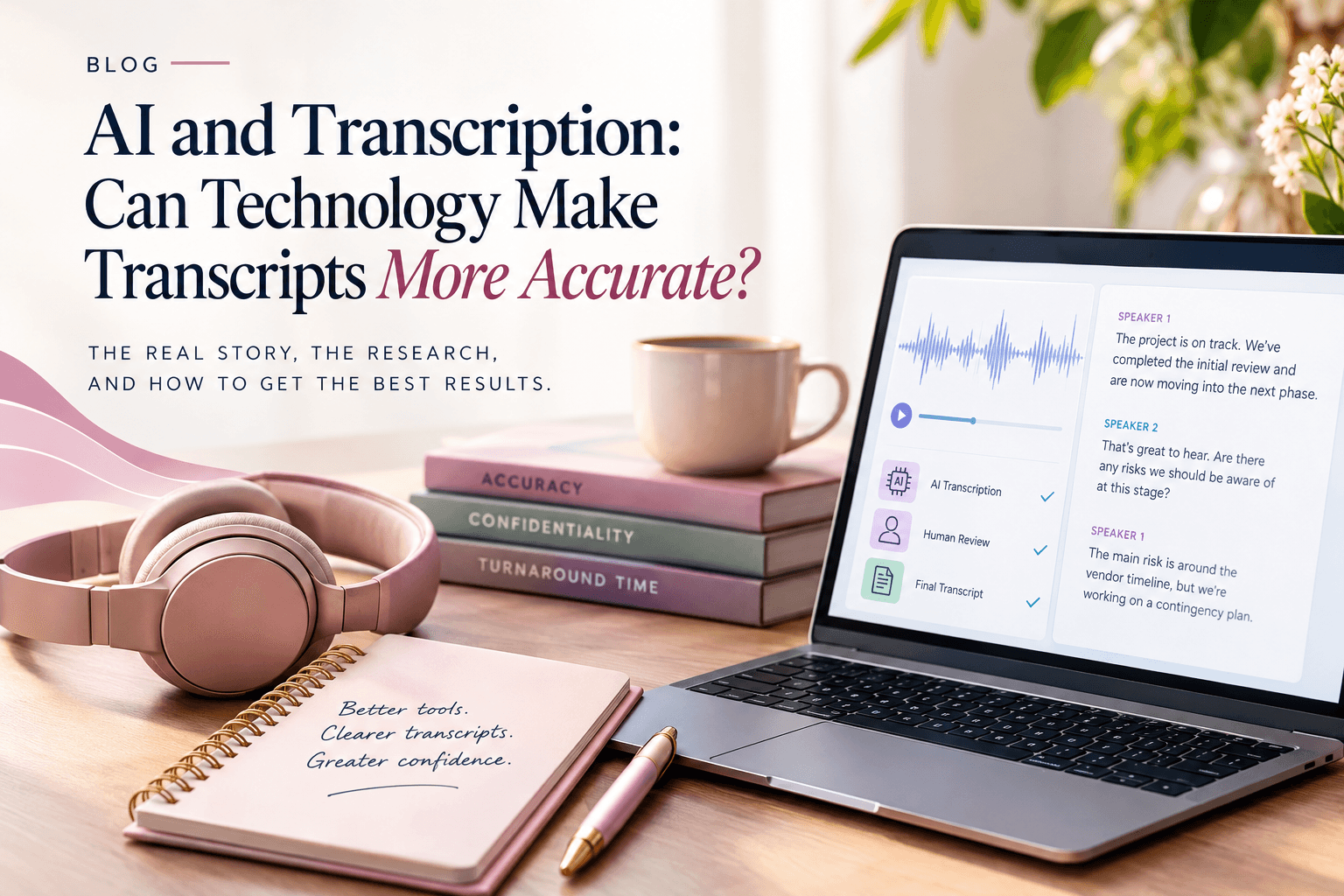
AI and Transcription: Can Technology Make Transcripts More Accurate?
Contents
For years, transcription has depended heavily on human listening, judgment and attention to detail. Today, artificial intelligence is changing how that work gets done.
AI-powered speech recognition can turn hours of audio into text in a fraction of the time it would take a person to type it manually. It can identify speakers, add punctuation, organize conversations and, increasingly, help clean up or structure transcripts.
But speed is not the same thing as accuracy.
A transcript can look polished while still containing a wrong name, missing phrase, incorrect speaker attribution or a subtle change in meaning. In legal, medical, academic, corporate and research settings, those errors can matter.
So the more useful question is not simply, “Is AI better than a human?”
It is:
How can AI and human expertise be used together to produce more accurate, reliable transcripts?
Recent research gives us a more nuanced answer.
AI transcription has come a long way
Modern automatic speech recognition (ASR) systems are considerably more capable than earlier speech-to-text technologies. They can process large volumes of audio quickly and perform well in many relatively clear recording conditions.
A 2025 systematic review of 29 studies examining AI-based speech recognition for clinical documentation found substantial variation in performance. Reported word error rates ranged from very low levels in controlled dictation settings to more than 50% in some conversational or multi-speaker scenarios. The review also found that AI transcription could reduce documentation time, while errors remained a concern, particularly with specialized terminology and accented speech.
That variation is important.
It means there is no single “AI transcription accuracy” figure that can describe every recording. Performance depends on factors such as audio quality, number of speakers, accents, vocabulary, speaking style and the environment in which the recording was made.
A clear, single-speaker recording with good audio may be relatively straightforward for an AI system.
A courtroom discussion involving several speakers, overlapping speech, unfamiliar names and specialist terminology is a different problem.
The same is true of a medical consultation, research interview, academic discussion or business meeting.
The quality of the input and the complexity of the conversation can change the quality of the output.
Accuracy is more complicated than a percentage
One of the most common ways to evaluate automatic speech recognition is Word Error Rate, or WER.
In simple terms, WER measures differences between a generated transcript and a reference transcript, including words that were substituted, inserted or omitted.
It is useful.
But recent research suggests it should not be treated as the complete definition of transcription quality.
A 2025 ACL study examining more than 20 speech recognition models found that low WER does not necessarily mean that a transcript is free from serious errors. The researchers examined a phenomenon known as hallucination, where an ASR system produces words or phrases that are not actually supported by the audio.
This matters because not every error has the same consequence.
Consider two transcripts.
In one, a system changes a minor filler word.
In another, it incorrectly inserts the word “not” into an important statement.
Both are technically transcription errors. But the second error could completely change the meaning of what was said.
That is why transcript quality needs to be considered at more than one level:
Did the system hear the words correctly?
Did it preserve the meaning?
Did it identify the correct speaker?
Did it handle names and specialist terminology correctly?
Did it introduce information that was never actually spoken?
For high-stakes transcription, these questions can be more important than a single accuracy percentage.
Where AI can genuinely improve transcription
Being cautious about AI does not mean overlooking what it does well.
AI can provide several practical advantages to transcription workflows.
1. Faster first-pass transcription
An AI system can process large amounts of audio rapidly. This makes it useful for producing an initial transcript that can then be reviewed, corrected and formatted.
Instead of beginning with a blank document, a human reviewer can begin with a working draft.
That can significantly change where human effort is spent.
2. Consistent processing
AI can apply the same basic transcription process repeatedly across large volumes of audio.
For organizations handling hundreds of recordings, this consistency can be valuable.
However, consistency should not be confused with correctness. An AI system can consistently make the same mistake, especially when the audio contains a word, name or phrase it does not recognize.
3. Identifying potential problem areas
AI does not have to be responsible for making every final decision.
It can also help identify parts of a transcript that deserve additional attention.
This is an especially interesting area of recent research.
A 2026 study published in Frontiers in Artificial Intelligence tested whether disagreement between multiple speech-recognition systems could be used to identify potentially error-prone sections. The researchers found that regions where the systems disagreed were more likely to contain verified transcription errors in their test dataset.
In one illustrative analysis, flagging approximately 28.6% of token positions captured 93.7% of the human-verified errors.
That does not mean that 93.7% of transcription errors can always be found this way. The study used 50 medical-education audio clips rather than real clinical encounters, and the authors explicitly noted that further validation is required.
But the underlying idea is powerful:
AI can potentially help decide where humans should look more closely.
Instead of asking a human to treat every word as equally uncertain, technology can help prioritize the areas most likely to require attention.
4. Improving terminology and formatting
AI can also assist with post-processing.
Depending on the workflow, it can help identify possible spelling inconsistencies, punctuation issues, repeated phrases, formatting problems and terminology that deserves verification.
Recent research has also explored using language models after the initial speech-recognition stage to improve transcription quality.
A 2026 study examining accented clinical speech found higher error rates for non-native English speakers when using Whisper and WhisperX. The researchers reported that a post-processing stage using GPT-4o recovered some of the lost accuracy.
This illustrates an important principle:
AI does not necessarily have to be a single-step transcription machine.
It can be part of a multi-stage quality process.
Where AI still needs careful oversight
AI transcription has limitations, and they become particularly important when the transcript will be used as an authoritative record.
Accents and speech variation
People do not all speak the same way.
Accent, pronunciation, pace, vocabulary and speech patterns can influence recognition accuracy.
The 2026 clinical speech study mentioned above found significantly higher error rates for non-native English speakers in its testing. That does not mean AI cannot transcribe accented speech. It means performance can vary between speakers and that quality assurance remains important.
For transcription providers serving international clients, this is especially relevant.
A system should not simply be judged on how it performs with one familiar accent or carefully controlled recording.
Multiple speakers
Conversations create another challenge.
When several people speak, a transcription system must do more than recognize words. It must determine who said what.
Speaker diarization—the process of separating speech according to speakers—has improved considerably, but it is not infallible.
A 2025 study examining LLM-based correction of speaker diarization found that automated speaker attribution remains an area where correction and post-processing can be useful.
For a transcript where speaker identity matters, getting the words right is only part of the job.
The words must also be assigned to the correct person.
Specialist terminology
A transcript can be grammatically perfect and still be wrong.
Names of medications, legal terminology, technical terms, company names, locations and industry-specific vocabulary can be difficult for automated systems.
This is one reason contextual knowledge matters.
A human reviewer who understands the subject matter—or has access to a glossary, reference material or client-provided terminology list—may recognize an error that appears perfectly plausible to an automated system.
Poor audio
Background noise, overlapping conversations, microphone problems, low volume and non-speech sounds can all make transcription harder.
Research into speech-recognition hallucinations has also found that distribution shifts and noise can affect hallucination rates.
In other words, the system does not simply become less accurate when the audio gets difficult. In some circumstances, it may produce text that sounds plausible but is not grounded in what was actually said.
That is precisely why difficult audio deserves greater scrutiny.
So, can AI make transcripts more accurate?
Yes—but the answer depends on how it is used.
AI can improve accuracy when it is used as part of a well-designed quality-control workflow.
It can create an initial transcript quickly.
It can help identify potential errors.
It can assist with terminology, punctuation and consistency.
Multiple AI systems can potentially be compared to locate areas of disagreement.
Language models can be used as a second processing layer.
And automated checks can help reviewers focus their attention.
But none of these capabilities removes the need to verify the final transcript when accuracy matters.
In fact, the most interesting direction emerging from recent research is not necessarily full automation.
It is augmentation.
A better approach: AI-assisted human quality control
Imagine a transcription workflow like this:
Step 1: Audio preparation
The audio is assessed for quality, number of speakers, background noise and other factors that could affect recognition.
Step 2: AI transcription
An ASR system produces the initial transcript.
Step 3: Automated quality checks
Technology checks for possible issues such as uncertain words, unusual terminology, speaker changes, inconsistent formatting or sections where different systems disagree.
Step 4: Risk-based review
Rather than treating every part of the transcript identically, higher-risk sections receive closer human attention.
These might include names, numbers, technical terms, unclear audio, speaker changes, important statements and sections flagged by automated checks.
Step 5: Human verification
A trained reviewer listens to the relevant audio and verifies the transcript against the source.
The human is not simply proofreading the AI's grammar.
The reviewer is checking whether the transcript actually reflects what was said.
Step 6: Final formatting and quality assurance
The transcript is checked for consistency, formatting requirements, speaker labels and client-specific instructions before delivery.
This approach changes the role of AI.
Instead of asking:
“Can AI replace the transcription process?”
we can ask:
“Where can AI reduce unnecessary work while helping humans concentrate on the parts where judgment matters most?”
That is a much more useful question.
What this means for transcription buyers
If you are choosing a transcription provider, asking whether they use AI is not enough.
A better set of questions is:
How is accuracy checked?
Is AI output reviewed by a human when required?
How are difficult audio files handled?
How are multiple speakers identified and verified?
How are names and specialist terminology checked?
What happens when the AI is uncertain?
How is confidential audio handled?
What quality-control process takes place before the final transcript reaches the client?
These questions tell you much more about the reliability of a transcription service than simply being told that it uses—or does not use—AI.
A provider using AI without adequate quality control may deliver a fast transcript that still requires substantial correction.
A provider using AI as one component of a carefully managed workflow may be able to combine speed with a more rigorous review process.
And a provider relying heavily on human transcription may also have strong quality outcomes, depending on its training, processes and quality assurance.
The technology alone does not determine the result.
The workflow does.
The future of transcription may be neither “AI” nor “human”
The conversation around AI often becomes unnecessarily binary.
One side asks whether machines will replace people.
The other argues that humans will always be better.
The evidence is more complicated.
AI is becoming increasingly capable of recognizing speech, processing large volumes of audio and assisting with quality checks. At the same time, recent research continues to identify challenges involving accents, multiple speakers, specialized terminology, hallucinations and meaningful errors that may not be fully captured by conventional accuracy metrics.
Human reviewers bring a different set of capabilities: contextual judgment, verification against the source audio, awareness of client requirements and the ability to recognize when something simply does not make sense.
Neither capability needs to be treated as an absolute replacement for the other.
The more promising approach may be to design workflows in which each does what it is best suited to do.
AI can help process more. Humans can help verify what matters.
And when the transcript is being used for a legal record, medical documentation, research project, business decision, interview archive or any other purpose where the words matter, that distinction is important.
The goal should not simply be the fastest transcript.
It should be a transcript that is accurate, carefully reviewed, appropriately formatted and dependable for its intended purpose.
Technology can help us get there.
But accuracy is ultimately a process—not a button.
Subscribe to our newsletter.
Get latest updates for our Articles & Blogs. We post fresh content every week.
- Weekly articles
- Stay updated with our weekly articles covering various topics.
- No spam
- We respect your inbox. No spam, just valuable content.

Sign up for our monthly newsletter