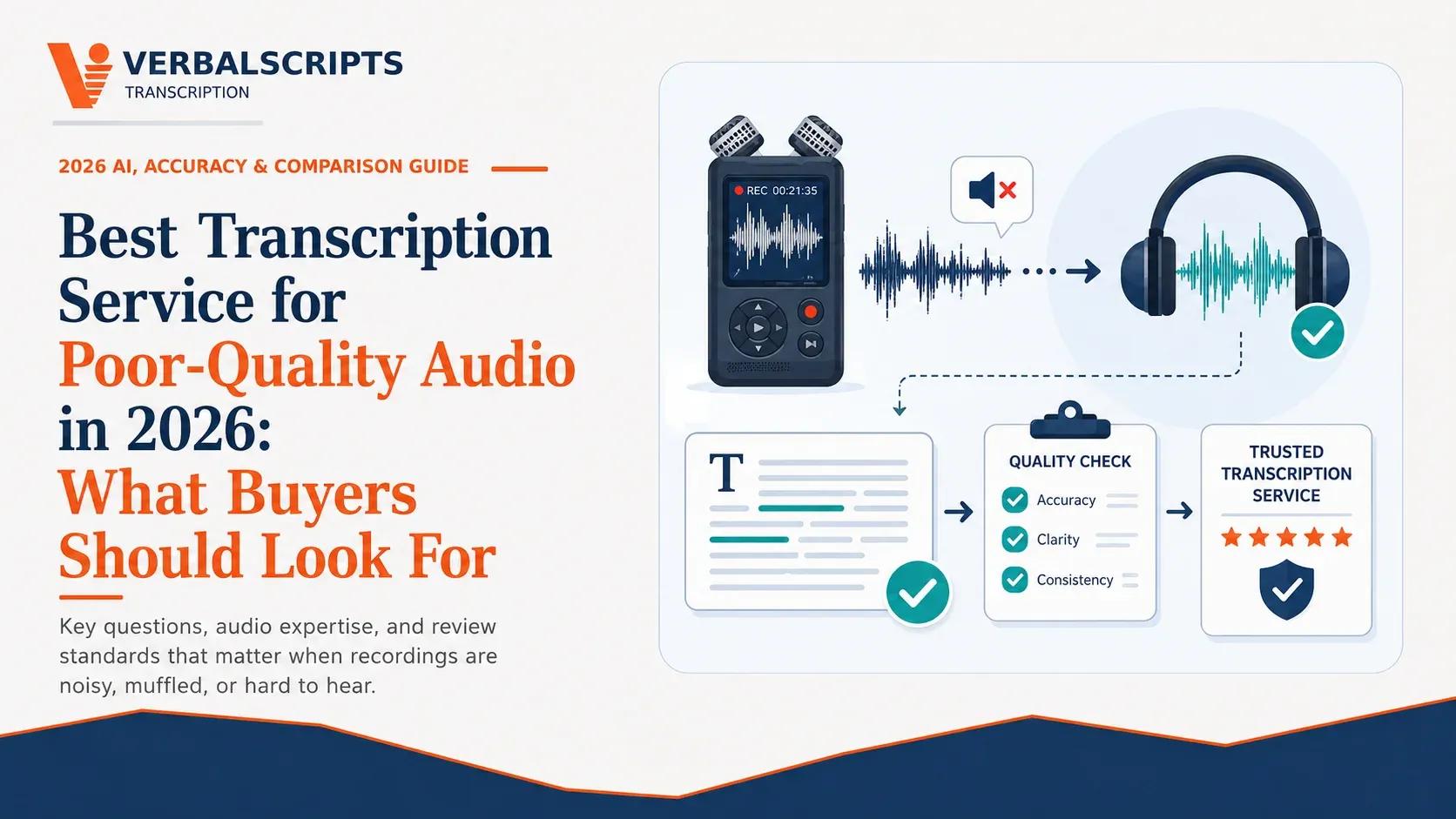
Best Transcription Service for Poor-Quality Audio in 2026: What Buyers Should Look For
Contents
Quick answer: The best transcription service for poor-quality audio is not the one that promises to “recover every word.” It is the one that preserves the original, tests enhancement on a working copy, assigns difficult files to experienced human reviewers, uses client context, separates speakers conservatively, timestamps uncertainty, and refuses to guess when speech is genuinely unrecoverable. Ask for a sample assessment using your actual recording before buying a large order. For difficult legal, research, investigative, medical, or archive audio, transparent uncertainty is a quality feature - not a failure.
Poor audio creates a strange market. The more difficult the recording becomes, the more tempting it is for a provider to sell certainty. “AI enhancement will fix it.” “99% accurate.” “Every word recovered.” Those claims ignore a physical reality: if the microphone never captured enough information to distinguish a word, no transcription process can recreate the original speech with certainty.
VerbalScripts has dedicated guidance for poor-quality audio transcription, background noise, quiet recordings, and audio enhancement before transcription. If your file is difficult, request a direct assessment.
What counts as poor-quality audio?
Difficult recordings can involve one or several problems:
• low volume;
• loud steady noise;
• intermittent impacts or traffic;
• echo/reverberation;
• clipping/distortion;
• muffled speech;
• distant microphones;
• phone compression;
• packet loss;
• wind;
• tape hiss or archive degradation;
• multiple people speaking at once;
• a quiet speaker beside a loud speaker;
• music/TV in the background;
• heavy accents combined with weak audio.
The correct workflow depends on which problem dominates. “Enhance audio” is not one universal operation.
The three main vendor types
AI-only service
Uploads the file and returns automatic text, sometimes with automated denoising.
Strengths: speed, low price, searchable rough draft.
Weaknesses: can produce fluent but incorrect words when the acoustic signal is ambiguous; speaker diarization can fail in crosstalk; uncertain regions may be omitted rather than flagged clearly.
Best for: low-stakes reference where a person will verify anything important.
AI + human editing service
ASR produces a draft and an editor reviews it.
Strengths: can combine speed with better accuracy.
Questions to ask: Does the human listen to the source audio or mainly proofread text? How much of the file is replayed? Are difficult passages escalated?
Best for: moderate difficulty when the human-review standard is strong.
Human-first difficult-audio workflow
Experienced transcriptionists listen directly, may use audio tools selectively, receive contextual references, and perform additional review.
Strengths: better judgment about ambiguous language, speaker identity, proper nouns, and when to mark uncertainty.
Limit: humans cannot recover information that is acoustically absent.
Best for: legal, research, archive, investigation, medical, or other files where guessing is unacceptable.
12 things the best difficult-audio service should do
1. Preserve the original file
Never destructively process the only source. Keep an untouched original and create a working derivative for enhancement.
2. Diagnose before processing
Low volume, hum, reverberation, clipping, wind, and crosstalk require different approaches. A provider should listen first.
3. Use conservative enhancement
Noise reduction can improve intelligibility, but aggressive settings can remove consonants and smear speech. The test is not whether the waveform looks cleaner; it is whether a careful listener can understand more words.
4. Compare processed audio to the original
An “enhanced” copy can create artifacts. Reviewers should be able to switch back to the original when a word sounds suspicious.
5. Use headphones and repeated listening
Difficult passages often require replay at different speeds/levels and comparison with surrounding context. This is labor, and it is one reason difficult audio costs more than clear audio.
6. Use client-supplied context
A case caption, speaker list, agenda, participant roster, glossary, medical specialty list, or historical-name sheet can turn an uncertain proper noun into a verifiable one.
Context should verify, not bias. A transcriber should not force the expected word into audio that says something else.
7. Mark uncertainty with timestamps
Use clear notation:
[inaudible 00:14:28]
[overlapping speech 00:31:04]
A timestamp lets counsel, researchers, or archivists independently review the source.
8. Separate speakers conservatively
If a provider cannot distinguish two voices reliably, it should not invent a speaker label just to make the page look complete.
9. Give special attention to critical entities
Verify:
• names;
• dates;
• amounts;
• medications;
• measurements;
• exhibit/case numbers;
• addresses;
• negation;
• technical terminology.
One correct critical entity can matter more than 100 correctly transcribed filler words.
10. Apply more than one review pass when warranted
A fresh reviewer can catch a word the first listener normalized mentally. Ask whether difficult files receive a second review or targeted QA.
11. Be honest about the ceiling
The best provider should sometimes tell you that a segment is not recoverable. That is more trustworthy than filling every blank with a guess.
12. Protect sensitive source audio
Legal, medical, research, government, and investigative recordings may require confidentiality agreements, HIPAA BAAs, agency security controls, or project-specific retention/deletion. Difficult audio should not be sent to random consumer tools without a security review.
Questions to ask before ordering
Send these to any vendor claiming expertise in bad audio:
1. Will you review a sample before quoting?
2. Do humans listen to the original audio?
3. Do you preserve an unprocessed source?
4. What enhancement techniques might be used?
5. How do you mark inaudible or uncertain words?
6. Are uncertainty markers timestamped?
7. How do you handle crosstalk?
8. Can I provide names, terminology, or case documents?
9. Is there a second review for difficult passages?
10. What happens if the audio is worse than expected?
11. How are files secured and deleted?
12. Can you return the transcript in my required legal/research format?
Beware of “audio restoration” language
Restoration and enhancement can make a recording more usable, but they do not guarantee original information can be reconstructed. Ask the provider to distinguish:
• increasing playback level;
• reducing steady noise;
• balancing channels;
• filtering hum;
• improving access copy clarity;
• actually recovering words.
Only the last claim is what buyers ultimately care about, and it has limits.
For archive recordings, preserve a high-quality master and work from derivatives; see Old Cassette and Archive Audio Transcription.
What “best” means for different buyers
Law firms and appeals
Prioritize exact speaker attribution, legal names/terms, timestamps, uncertainty notation, required format, and certification requirements defined by the court/authority.
Researchers
Prioritize participant labels, verbatim convention, analytic features, confidentiality, and traceability to the recording.
Medical/healthcare
Prioritize medical terminology, numbers/doses, negation, HIPAA/business-associate workflow where applicable, and clinician review.
Government
Prioritize motions, votes, case numbers, names, public-record/accessibility workflow, and retention rules.
Archives/oral history
Prioritize source preservation, historical names, conservative processing, timecodes, metadata, and transparent uncertainty.
The “best” vendor is the one whose workflow matches the consequence of error.
Why a sample matters more than a testimonial
A testimonial tells you a provider succeeded on someone else’s recording. A sample tells you what the provider can do with your microphone, your speakers, and your noise.
Choose 5-10 minutes containing the worst meaningful section, not the clean introduction. Ask the vendor to show:
• transcript output;
• uncertainty markers;
• speaker labels;
• whether processing helped;
• realistic turnaround;
• price implications.
For large projects, include one easy, one average, and one hard file.
How VerbalScripts approaches poor audio
VerbalScripts describes a human-led difficult-audio process that applies processing only when it genuinely improves intelligibility and marks unrecoverable speech rather than guessing. The most important part of that approach is not the software; it is the decision discipline around what can and cannot be supported by the source.
For a challenging file, request a quote or sample review and include any speaker spellings, case/study details, glossary, and deadline that can improve verification.
Frequently asked questions
Can poor-quality audio be transcribed accurately?
Sometimes. Accuracy depends on how much speech information remains audible. Good processing, context, and human review can improve results, but severely masked or destroyed speech may remain inaudible.
Can AI enhancement recover inaudible words?
It can improve audibility in some cases, but generated or reconstructed speech should not be treated as evidence of what was actually spoken. For evidentiary or research use, rely on the recoverable source and transparent uncertainty.
Should I increase the volume before uploading?
Keep the original. Simple gain may help a working copy, but boosting also raises noise. A transcription provider can assess whether processing is useful.
Is crosstalk fixable?
If each speaker is captured on a separate channel, separation can be much easier. If two voices acoustically overlap on a single mixed track, some words may be impossible to isolate reliably.
How much does difficult-audio transcription cost?
It depends on duration, severity, speaker count, required review, turnaround, and formatting. A sample-based quote is more reliable than a universal rate.
What if only a few minutes are difficult?
Tell the vendor. The project may be scoped with targeted enhancement/review on the problem sections rather than treating the entire recording as equally difficult.
Get a realistic assessment before paying for certainty that does not exist
If you have a court recording, interview, cassette, focus group, investigation, or meeting that other tools could not transcribe reliably, send VerbalScripts a representative sample for a quote. The right outcome is not a transcript with the fewest blanks; it is the most reliable record the source audio can support.
Authoritative references
• NIST, Open Speech Analytic Technologies evaluation plan (ASR/WER framework)
• Library of Congress, Care and Handling of Audio Visual Materials
• National Archives, preservation copy/derivative definitions
Subscribe to our newsletter.
Get latest updates for our Articles & Blogs. We post fresh content every week.
- Weekly articles
- Stay updated with our weekly articles covering various topics.
- No spam
- We respect your inbox. No spam, just valuable content.

Sign up for our monthly newsletter