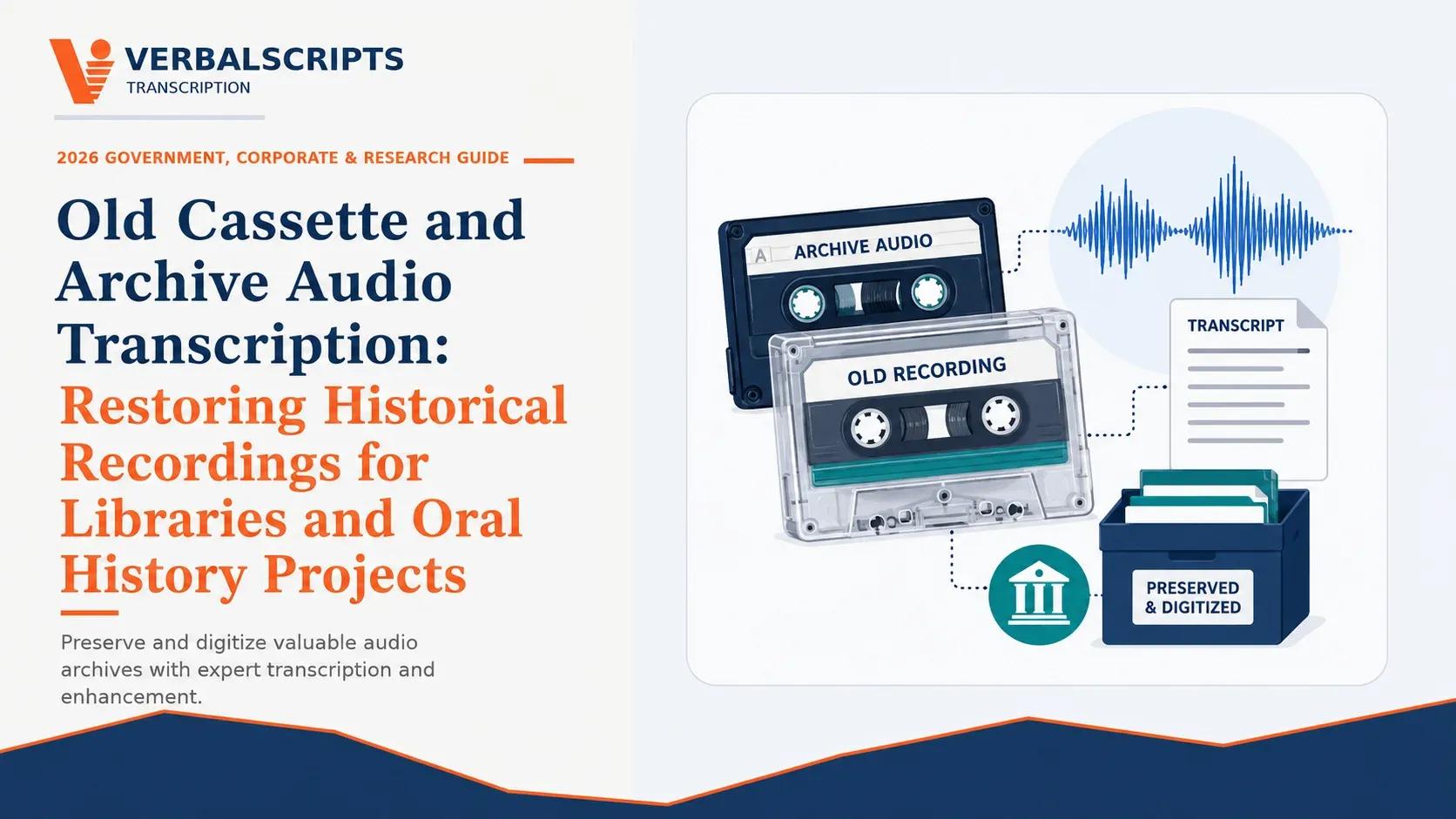
Old Cassette and Archive Audio Transcription: Restoring Historical Recordings for Libraries and Oral History Projects
Contents
Quick answer: For historical tapes, preserve first, enhance second, transcribe from a controlled working copy. Keep the original physical carrier and a high-quality preservation master unchanged; create a derivative for noise reduction or level adjustment; document what processing was applied; and retain timestamps so uncertain words can be traced back to audio. A transcript improves search and access, but it is not a replacement for the recording. Oral History Association guidance emphasizes preservation of audiovisual components together with transcripts, metadata, and documentation.
A 40-year-old cassette is not just “bad audio.” It is a physical object with an aging magnetic layer, a playback history, and possibly unique voices that cannot be re-recorded. Aggressive software can make speech seem cleaner while permanently hiding details in the working copy. Preservation-minded transcription treats the recording and the transcript as different archival objects.
VerbalScripts provides audio and video transcription and difficult-audio workflows. Libraries and oral-history projects can request a sample review and quote before committing a large collection.
Step 1: stabilize and digitize the source correctly
If the only copy is an analog cassette, reel, disc, or other fragile carrier, digitization is a preservation task. The Library of Congress advises careful handling of audiovisual media and notes that magnetic tape can have physical and chemical vulnerabilities. Collections with mold, sticky-shed symptoms, broken shells, or unknown condition should be handled by qualified preservation specialists.
Do not repeatedly play a fragile original simply to get a transcript.
A preservation workflow normally creates a high-quality digital capture that remains as faithful as practical to the source. NARA distinguishes preservation copies from derivatives created for access or reproduction. Oral History Association resources likewise emphasize high-quality, widely supported preservation formats and long-term planning.
Step 2: keep the preservation master untouched
Create a checksum/backup strategy and treat the high-quality master as read-only. Then create a working derivative for transcription.
This distinction is critical because audio enhancement is subjective. You may want to try:
• gentle broadband noise reduction;
• hum reduction;
• channel balancing;
• level normalization;
• targeted equalization;
• speed correction when objectively warranted;
• segmentation into interview sides/parts.
If processing makes speech worse, you can discard the derivative and return to the preservation master.
VerbalScripts’ guide on improving audio before transcription explains why aggressive cleanup can remove speech detail along with noise.
Step 3: never promise to “recover” words that are not there
Archive recordings may contain:
• tape hiss;
• print-through;
• wow/flutter;
• low recording level;
• microphone distance;
• room noise;
• clipped peaks;
• crosstalk;
• damaged sections;
• incomplete side changes.
Enhancement can improve audibility, but it cannot reconstruct information that was never captured or has been destroyed. A credible transcript uses markers such as:
[inaudible 00:22:17]
[unclear name 00:34:02]
Do not fill a historical gap with a contextually plausible sentence.
For difficult recordings, see How to Transcribe Audio with Background Noise and Best Transcription Service for Poor-Quality Audio in 2026.
Step 4: build a historical name and terminology sheet
A modern web search can easily “correct” an unfamiliar historical name to the wrong current person. Archives should supply whatever controlled information they have:
• narrator/interviewer names;
• dates and places;
• organizations;
• local surnames;
• historical events;
• religious or community institutions;
• musical works/performers;
• technical vocabulary;
• accession number;
• collection title.
The transcriber can use the list to verify spellings while preserving the words actually spoken.
Step 5: choose a transcript convention appropriate to oral history
Oral-history transcripts often benefit from a readable verbatim style that preserves the narrator’s voice without drowning it in every conversational filler. The project should decide how to handle:
• dialect;
• repeated words;
• false starts;
• laughter;
• emotional pauses;
• interviewer backchannels;
• editorial insertions;
• uncertain names;
• profanity;
• non-English passages.
Do not silently “standardize” a narrator’s grammar or change culturally specific wording. Any editorial intervention should be transparent.
Step 6: use timecodes as archival metadata
Timecodes let future researchers move between transcript and audio. For long interviews, place timestamps:
• every 30-60 seconds;
• at each speaker turn;
• at topical index points; or
• at every uncertain passage.
If the cassette was split into Side A/Side B files, specify whether time restarts at 00:00 for each file or remains continuous across the interview.
Step 7: keep transcript, audio, and metadata together
The Oral History Association’s archival guidance recommends preserving audiovisual components alongside transcripts, metadata, and documentation about restrictions and process. A collection package can include:
• preservation master;
• access/working audio derivative;
• final transcript;
• transcript version history;
• interview metadata;
• rights/restriction documentation;
• enhancement log;
• glossary/name authority file;
• optional topic index/time log.
A transcript without the recording loses tone and source verification. A recording without metadata is harder to discover. Preserve both.
Should AI be used for old cassette transcription?
AI can generate a rough draft for some clear passages, but archive audio often contains exactly the conditions that reduce automatic speech recognition reliability: noise, degraded bandwidth, accents, old microphone technique, code-switching, and unfamiliar names.
For a historical collection, the most efficient workflow may be AI-assisted where useful plus line-by-line human listening, but the delivered transcript should be judged by human verification and transparent uncertainty - not by whether software produced a fluent paragraph.
A library/archive procurement checklist
Source protection: Will you work from a supplied digital derivative rather than alter the only master?
Enhancement: Is processing conservative and documented?
Uncertainty: Are inaudible words timestamped instead of guessed?
Names: Can you use collection-specific authority lists?
Formatting: Can you follow the archive’s oral-history template?
Metadata: Can accession/interview IDs be preserved in filenames/headers?
Versions: Can corrected transcripts be versioned?
Delivery: Can you return DOCX/TXT/PDF as required?
Security/rights: Can access restrictions be reflected in the workflow?
Scale: Can a small pilot precede a multi-hundred-hour backlog?
What to send VerbalScripts
For an archive project, provide:
• digital audio files (preferably working derivatives, not the only preservation master);
• collection/interview IDs;
• narrator/interviewer spellings;
• historical glossary;
• transcript style guide;
• timestamp rule;
• known damaged sections;
• rights/confidentiality restrictions relevant to the vendor;
• required file naming and formats;
• project volume and delivery phases.
Request a difficult-audio sample assessment before pricing a large backlog because the effort can vary dramatically by cassette and recording era.
Frequently asked questions
Can an old cassette be made perfectly clear before transcription?
No. Noise reduction can improve some recordings, but information lost through poor recording or physical damage cannot always be recovered. Preserve an unprocessed master and be transparent about inaudible sections.
Should the original cassette be thrown away after digitization?
Archives normally make preservation decisions under their collection policy. Digitization does not automatically mean the physical original should be discarded.
What audio format should an oral-history archive use?
OHA resources commonly recommend standard high-resolution uncompressed formats such as WAV/Broadcast WAV for preservation. The repository should define its technical specification.
Should a transcript “correct” the narrator’s grammar?
Not silently. Preserve the narrator’s meaning and voice according to the project’s chosen convention. Editorial changes or clarifications should be transparent.
Can historical names be researched during transcription?
Yes when the project permits, but supplied collection metadata is often more reliable than open-web guessing. Mark unresolved names with a timestamp.
Turn fragile sound into searchable access without sacrificing the source
If your library, museum, university, oral-history program, or archive has cassettes or legacy digital recordings waiting to be made searchable, request a VerbalScripts archive transcription quote. Start with representative files from the best, average, and worst audio in the collection so the scope is realistic.
Authoritative references
• Library of Congress, Care and Handling of Audio Visual Materials
• National Archives, Archival Formats Glossary (preservation copy/derivative concepts)
• Oral History Association, Best Practices
• Oral History Association, Archiving Oral History
• OHA remote interviewing/preservation resource (WAV/Broadcast WAV)
Subscribe to our newsletter.
Get latest updates for our Articles & Blogs. We post fresh content every week.
- Weekly articles
- Stay updated with our weekly articles covering various topics.
- No spam
- We respect your inbox. No spam, just valuable content.

Sign up for our monthly newsletter