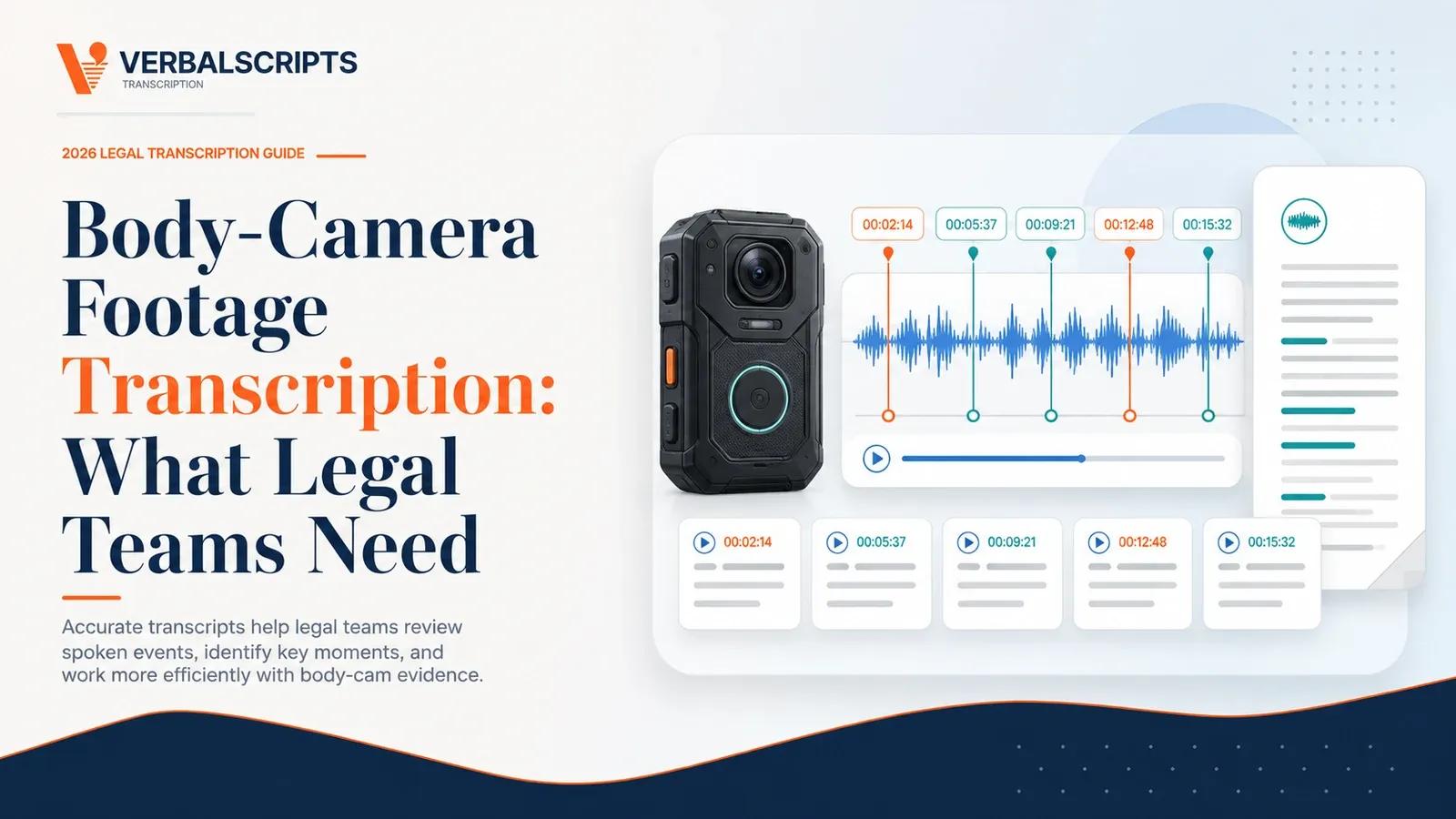
Body-Camera Footage Transcription: What Legal Teams Need
Contents
Quick answer: Body-camera footage transcription turns spoken content in body-worn-camera video into a searchable, time-aligned written record. Legal teams use it to locate statements, compare accounts, prepare witnesses, review disclosure, and organize evidence. The transcript should preserve the original media, identify uncertainty, use source-based timestamps, distinguish speakers cautiously, and never be treated as a substitute for watching the complete footage.
Why body-camera footage is different from ordinary audio
Body-worn-camera recordings are mobile, visual, multi-source evidence. The microphone moves with the officer, speech may come from behind the camera, and the recording can contain wind, sirens, radio traffic, clothing noise, crowds, and abrupt changes in distance. A transcript can make the footage much easier to search, but it cannot capture every visual fact, gesture, camera movement, or environmental condition.
The original video therefore remains the controlling source. The transcript is a derivative review aid that should identify the exact media file and the time reference it follows.
What legal teams use body-cam transcripts for
UseTranscript valueImportant limitation
Initial case assessment
Finds names, statements, commands, and disputed moments quickly
Counsel should still review the surrounding video
Discovery review
Makes large media collections searchable
Transcript versions must map to the correct source files
Motions and hearings
Helps cite rights advisements, consent, commands, or statements
The court may require the recording itself or an official transcript
Witness preparation
Lets counsel compare accounts and locate inconsistencies
Avoid presenting uncertain speaker attribution as established fact
Redaction planning
Identifies spoken PII and sensitive content
Visual redaction requires separate frame-by-frame review
Trial preparation
Supports clips, demonstratives, and examination outlines
Admissibility and authentication are legal questions
Preserve the native source before transcription
A defensible workflow starts before anyone presses play. Keep the original export, native filename, file size, duration, metadata, evidence identifier, and export history. Where the case protocol calls for it, preserve a cryptographic hash and maintain chain-of-custody records. Any enhancement, transcoding, clipping, synchronization, or channel extraction should be performed on a working copy and documented.
NIST's guidance on digital evidence preservation emphasizes maintaining integrity and documenting how digital evidence is acquired, stored, and transferred. DOJ guidance also treats body-worn-camera recordings created in covered federal operations as records subject to agency controls. See the Justice Manual.
Use timestamps that match the source video
The best timestamp is the one a reviewer can use to reach the same moment in the preserved source. Common options include:
elapsed time from the beginning of the file;
visible in-video timecode;
device date and time, where reliable;
segment time for exported clips; or
event timestamps supplied by the evidence-management platform.
The transcript should state which convention is being used. If the source has been clipped, concatenated, or stripped of silence, ordinary elapsed time may no longer match the native evidence. A file-level identifier and timestamp legend prevent confusion.
For long recordings, combine periodic timestamps with event markers for rights advisements, commands, arrests, searches, medical treatment, use-of-force moments, or other case-specific events. Learn more in When Should You Add Timestamps to a Transcript?.
Speaker identification requires restraint
Body-cam audio rarely provides studio-quality separation. The wearer may be obvious, but bystanders, officers, dispatch, witnesses, and subjects may speak off camera or overlap. Labels should be based on reliable support such as self-identification, video context, rosters, incident reports, or client confirmation.
Useful labels include Officer 1, Officer 2, Subject, Witness, Dispatcher, Unidentified Male Voice, and Unidentified Female Voice. A neutral label is better than a confident but unsupported name. If attribution changes after counsel's review, maintain a controlled correction log rather than silently replacing versions.
Record verbal and material nonverbal events
A legal body-cam transcript may include more than dialogue. Depending on the assignment, the style guide can capture:
radio traffic and dispatch transmissions;
alarms, sirens, gunshots, impacts, and breaking glass;
commands shouted from a distance;
crying, coughing, groaning, or laughter;
long pauses or periods with no intelligible speech;
overlapping speakers;
language changes and interpreter speech;
apparent reading of rights or forms; and
obvious recording interruptions.
Visual observations should be included only when the client requests a video log or audiovisual transcript. A transcriber should not infer intent, emotion, identity, intoxication, or physical condition from appearance. Use neutral descriptions such as [officer points toward doorway] rather than argumentative characterizations.
Handle poor audio without inventing words
Enhancement can improve audibility through channel isolation, moderate gain, filtering, and restrained noise reduction. It cannot reliably reconstruct speech that was masked, clipped, or never captured. The correct practice is to mark uncertainty using a client-approved notation such as [inaudible 00:14:22], [unclear], or [simultaneous speaking].
Critical passages should receive independent review and, when available, comparison across multiple cameras, vehicle audio, dispatch recordings, or interview-room recordings. Read How to Transcribe Poor-Quality Audio Accurately.
Plan for redaction and protective restrictions
Body-cam footage can expose faces, addresses, license plates, medical information, minors, victims, confidential informants, inside-the-home scenes, and privileged communications. A transcript may create a second searchable copy of that information.
Before outsourcing, define permitted personnel, secure transfer, storage location, retention, deletion, incident reporting, and whether subcontractors are allowed. Spoken PII should be handled under the same protective framework as the video. DOJ's video redaction best practices stress planning tools, staffing, and resources before a deadline forces rushed decisions.
Quality-control checklist for legal teams
Confirm every transcript identifies the source file and evidence number.
Verify timestamps against the preserved media.
Review rights advisements, consent, admissions, denials, and disputed phrases twice.
Confirm speaker labels against case materials where possible.
Check that no visual event has been overstated as a spoken fact.
Require honest inaudible and overlap notation.
Keep a version log for corrections and redactions.
Preserve the original footage independently of the transcript.
Confirm confidentiality, access, retention, and deletion requirements.
Ask counsel to determine whether a certified or official transcript is required.
FAQs
Is a body-camera transcript the official evidence?
Usually not. The video and its native audio remain the source evidence. A transcript is typically a derivative aid unless a court, agency, stipulation, or authorized reporter gives it a different status.
Can a transcript replace watching the footage?
No. Tone, distance, gestures, camera angle, lighting, movement, and events outside the microphone's range may matter. The transcript should accelerate review, not replace it.
Should every sound be transcribed?
Only material sounds required by the assignment should be noted. The scope should distinguish dialogue transcription from a detailed audiovisual log.
How are unidentified speakers handled?
Use neutral labels and record uncertainty. Do not identify a person from voice alone without reliable support.
Can multiple body cameras be combined into one transcript?
Yes, but the transcript must show which source is active and how time synchronization was established. Separate parallel transcripts may be safer when recordings overlap substantially.
Should body-cam transcripts include profanity and grammatical errors?
For legal verbatim work, generally yes. Spoken wording should not be sanitized unless the client orders a separate clean version.
How long does body-camera transcription take?
Turnaround depends on total duration, speaker count, noise, overlap, visual logging, timestamp density, and review requirements. A short clear clip may be completed quickly; multi-camera incidents need more time and coordination.
Work with Verbalscripts Transcription
Verbalscripts provides human transcription, editing, review, proofreading, and formatting for legal, medical, research, and professional recordings. Projects can be delivered in Word, PDF, RTF, TXT, or a client-supplied template, with timestamps, speaker labels, line numbering, and certification options where appropriate.
For sensitive material, project access can be limited to assigned personnel, and all transcribers are bound by confidentiality obligations. Share the recording length, intended use, required format, deadline, and any governing security requirements through our secure quote request or secure project dashboard.
This article provides general information and is not legal, medical, regulatory, or compliance advice. Requirements vary by jurisdiction, organization, contract, and intended use.
Subscribe to our newsletter.
Get latest updates for our Articles & Blogs. We post fresh content every week.
- Weekly articles
- Stay updated with our weekly articles covering various topics.
- No spam
- We respect your inbox. No spam, just valuable content.

Sign up for our monthly newsletter