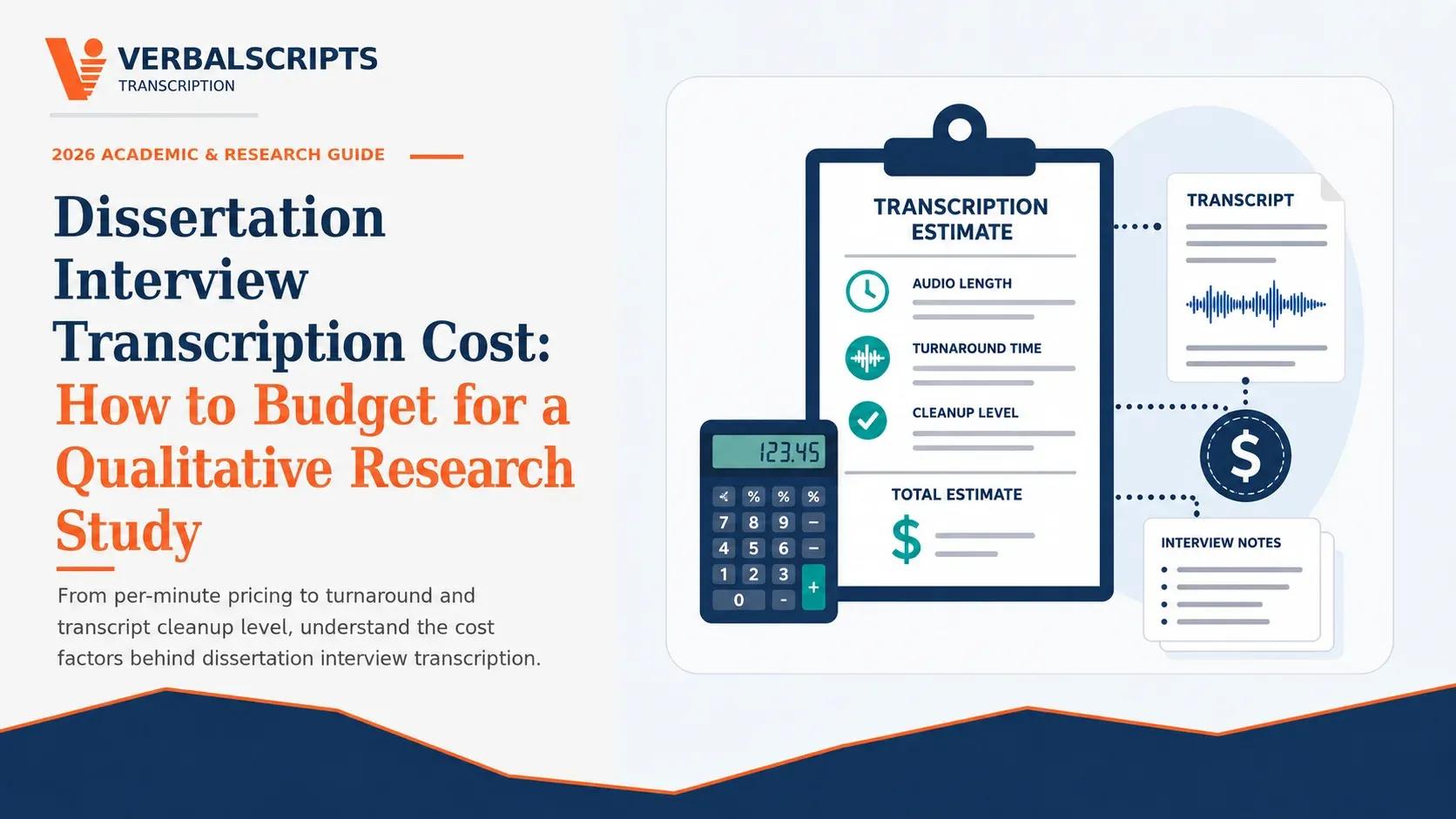
Dissertation Interview Transcription Cost: How to Budget for a Qualitative Research Study
Contents
Quick answer: Build your dissertation transcription budget from recorded minutes, not the number of interviews. Multiply expected audio minutes by the vendor’s applicable rate, then add contingency for longer interviews and any project-specific needs such as full-verbatim notation, difficult audio, rush turnaround, translation, or de-identification. For example, 20 one-hour interviews equal about 1,200 audio minutes. At a hypothetical $1.50 per audio minute, the base transcription budget would be $1,800 before optional extras or contingency.
A dissertation transcription budget is easy to underestimate because “20 interviews” sounds like a fixed quantity. In practice, interviews vary in length, participants join late, follow-up probes expand, and a one-hour slot may produce 73 minutes of recorded conversation. A defensible budget treats transcription as a measurable research cost rather than an afterthought.
VerbalScripts currently maintains a dedicated dissertation interview transcription workflow for doctoral candidates. Any website price should be confirmed at the time you order because rates and project requirements can change; request a current quote for the study you are actually conducting.
The simplest dissertation transcription cost formula
Use this planning equation:
Estimated transcription budget = expected audio minutes × applicable per-minute rate + project add-ons + contingency
If your university or vendor prices by audio hour instead, convert the same way: 60 recorded minutes = one audio hour. “Audio minute” means the duration of the recording, not the number of minutes a transcriptionist spends working. VerbalScripts explains this distinction in its guide to audio-minute transcription pricing.
Example: 20 qualitative interviews
Assume:
• 20 participants;
• planned interview length: 60 minutes;
• expected recorded minutes: 1,200;
• planning rate: $1.50/audio minute.
Base estimate: 1,200 × $1.50 = $1,800.
Now add a 10% to 15% planning cushion because interview lengths rarely land exactly on the protocol target:
• 10% contingency: $180, total planning budget $1,980;
• 15% contingency: $270, total planning budget $2,070.
The contingency is not a vendor fee; it is a project-management reserve so an unexpectedly talkative sample does not create a funding problem in the final month of data collection.
Budget scenarios for common dissertation designs
The figures below use $1.50/audio minute solely as an example planning rate. Confirm the rate applicable to your own VerbalScripts order before publishing it in a grant, reimbursement request, or procurement document.
10 interviews × 45 min — Recorded minutes: 450 | Example base cost at $1.50/min: $675
15 interviews × 60 min — Recorded minutes: 900 | Example base cost at $1.50/min: $1,350
20 interviews × 60 min — Recorded minutes: 1,200 | Example base cost at $1.50/min: $1,800
25 interviews × 75 min — Recorded minutes: 1,875 | Example base cost at $1.50/min: $2,812.50
30 interviews × 60 min — Recorded minutes: 1,800 | Example base cost at $1.50/min: $2,700
The more useful question is not “What does a dissertation cost?” but “What will my recorded dataset cost under the transcript convention my committee expects?”
Seven factors that can change the price
1. Full verbatim versus clean verbatim
A clean-verbatim transcript removes routine fillers and false starts when they add no analytic value. A fuller convention may retain “um,” “uh,” repetitions, abandoned phrases, laughter, long pauses, overlaps, and selected nonverbal events. Full detail can require more review and formatting. Decide this with your methodology before requesting quotes.
For studies centered on lived experience and the way meaning is expressed, see Phenomenological Research Transcription.
2. Audio quality
A quiet one-to-one Zoom interview with a headset is different from a participant speaking on a weak mobile connection in a noisy room. Background noise, low volume, echo, clipping, and simultaneous speech increase the effort required to produce a defensible transcript. If your pilot recording is difficult, send a sample before committing the whole budget. VerbalScripts has a practical guide to poor-quality audio transcription.
3. Speaker count
Most dissertation interviews involve one interviewer and one participant. Focus groups, dyadic interviews, committee discussions, and multi-party sessions require more speaker differentiation and can be priced differently.
4. Timestamps
Timestamping every change of speaker, at fixed intervals, or only at inaudible passages can require different amounts of work. For qualitative coding, timestamps are particularly valuable when you expect to return from a quotation in the transcript to the original recording.
5. Specialty terminology
Research in medicine, engineering, education policy, law, cybersecurity, theology, or another technical field can contain names, acronyms, specialized vocabulary, statutes, drugs, instruments, and organizations that require additional verification. A glossary reduces uncertainty and improves consistency across interviews.
6. Translation and bilingual work
If interviews are conducted in Spanish but the dissertation is written in English, decide whether you need Spanish transcription, English translation, or both. Translation is a separate intellectual task from transcription and should be budgeted separately. See Spanish-English Research Interview Transcription.
7. Rush turnaround
Planning early is cheaper than discovering that 25 interviews must be ready for coding by Monday. Align transcription delivery with the analysis schedule rather than waiting until all data collection is complete.
Should you transcribe the interviews yourself?
Self-transcription has a genuine methodological advantage: repeated listening can deepen familiarity with the data. But it also consumes research time that may be needed for recruitment, memoing, coding, committee revisions, and writing. The right choice depends on your methodology and budget.
A useful hybrid approach is to outsource a consistent first transcript and then have the researcher listen back to analytically important passages during coding. That preserves researcher immersion without turning every hour of data into a manual clerical project.
If your institution permits outsourcing, confirm the vendor arrangement in the IRB/data-management workflow first. The companion guide IRB-Compliant Research Transcription provides a procurement checklist.
How to write transcription into a dissertation or grant budget
Avoid a vague line such as “transcription - $2,000.” A stronger justification shows the underlying quantity:
Example budget narrative: “The study anticipates 20 semi-structured interviews of approximately 60 minutes each (1,200 recorded minutes). Funds are budgeted for human-reviewed transcription based on an estimated per-audio-minute rate, plus a modest contingency for interviews exceeding the planned duration.”
Then describe any required extras: bilingual transcription, identifiers removed from the final dataset, fixed-interval timestamps, or special formatting for a qualitative data analysis platform.
Grant rules differ by sponsor and institution, so verify allowability with the grant administrator. NIH-funded projects may also need to align data handling with the approved Data Management and Sharing Plan and participant-privacy protections.
How to reduce transcription cost without reducing research quality
1. Record clean audio. Use a headset or good microphone, reduce speaker distance, and avoid music, fans, traffic, or speakerphone whenever possible.
2. Keep files organized. Use participant codes and consistent filenames such as P014_2026-08-08.wav.
3. Provide a glossary once. A shared study glossary is more efficient than correcting the same technical term in 25 files.
4. Choose the right verbatim level. Do not pay to preserve every filler if your analysis does not use it; do not strip discourse features if your methodology needs them.
5. Batch logically. Sending interviews as they are completed allows transcription and analysis to overlap.
6. Avoid unnecessary rush fees. Build transcription into the collection timeline from the beginning.
7. Specify a template before work starts. Mid-project format changes can create avoidable revision work.
What to send a transcription vendor
For a dissertation interview project, provide:
• total files and approximate audio minutes;
• participant IDs and speaker-label rules;
• clean or full-verbatim preference;
• timestamp requirements;
• terminology/acronym list;
• de-identification instructions;
• target file format;
• target coding software if relevant;
• delivery schedule;
• IRB or institutional data-handling restrictions that affect the vendor.
VerbalScripts research interview transcription can be scoped around these requirements. If you already know the approximate minutes, get a written quote before finalizing your budget.
Frequently asked questions
How much does dissertation interview transcription cost?
The most accurate estimate is recorded minutes multiplied by the vendor’s current rate, plus any optional services and contingency. Because rates change and projects differ, request a current project quote rather than relying on an old blog price.
Is transcription charged by the interview or by the audio minute?
Many professional services use audio minutes because an 18-minute interview and a 92-minute interview require very different amounts of work. Ask how the vendor defines billable duration and whether silence is treated differently.
Should I budget for every planned interview?
Yes. Budget against the maximum realistic dataset, then add a modest contingency for interviews running long. Unused funds can be managed under your institution’s normal budget rules; an underfunded final dataset is harder to fix.
Is AI transcription cheaper?
Raw automated transcription is usually cheaper, but the relevant comparison is the cost of analysis-ready accuracy. If the researcher must spend substantial time correcting names, speaker labels, terminology, omissions, and misheard phrases, the apparent savings can shrink quickly.
Can I send interview files before data collection is finished?
Yes, if your protocol permits it. Rolling delivery can shorten the time between interviewing and coding and reveal transcript-format issues early.
Get a study-specific estimate
Your best dissertation transcription budget is a line item tied to the actual design: number of participants, estimated duration, transcript convention, language, audio conditions, and deadline. Request a VerbalScripts dissertation transcription quote and include those details so the estimate reflects the work rather than a generic average.
Authoritative references
• NIH Data Management and Sharing Policy
Subscribe to our newsletter.
Get latest updates for our Articles & Blogs. We post fresh content every week.
- Weekly articles
- Stay updated with our weekly articles covering various topics.
- No spam
- We respect your inbox. No spam, just valuable content.

Sign up for our monthly newsletter