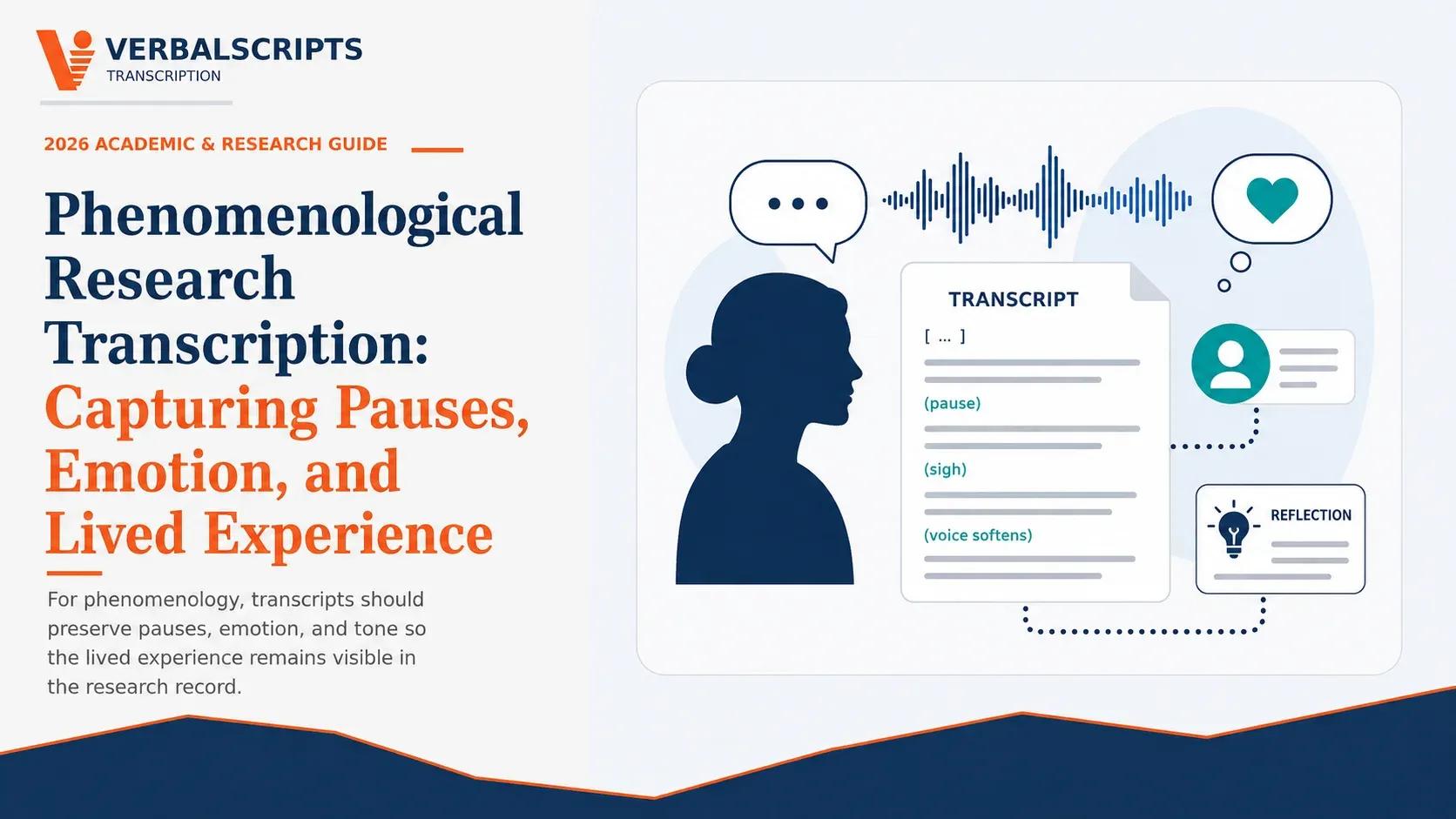
Phenomenological Research Transcription: Capturing Pauses, Emotion, and Lived Experience
Contents
Quick answer: Phenomenological transcription should preserve the features of speech that matter to the study without pretending that a transcript can reproduce the entire encounter. Before transcription begins, define a notation system for pauses, overlap, laughter, crying, emphasis, incomplete sentences, and inaudible speech. Record what can be heard; do not infer private emotions or intentions that the recording cannot establish. The best transcript is a transparent, consistent analytic representation of the interview - not a “cleaned up” substitute for the participant’s voice.
Phenomenological studies ask researchers to engage deeply with how people describe experience. That makes transcription unusually consequential. A transcript that converts every hesitant, emotionally difficult answer into polished prose may be easier to read, but it can also erase how the participant expressed the experience. At the other extreme, a transcript overloaded with micro-second pause measurements and conversation-analysis symbols can create detail the research design never uses.
The goal is methodological fit.
VerbalScripts offers academic and conference transcription and qualitative interview transcription for research teams that define the convention they need. The guide below can be used to brief a vendor or standardize an in-house team.
A transcript is an interpretation layer, not the lived experience itself
The recording preserves sound. The transcript converts selected features of that sound into text. Decisions about punctuation, paragraph breaks, fillers, pauses, laughter, overlap, and incomplete grammar all influence how a later reader encounters the participant’s account.
That is why phenomenological projects should make transcription decisions explicit. The study’s methods section should be able to explain whether transcripts were verbatim, what nonverbal cues were retained, how uncertainty was marked, and whether researchers checked recordings against transcripts during analysis.
No transcriptionist - human or automated - should silently “improve” a participant’s syntax to make the person sound more articulate. Likewise, a researcher should avoid treating notation such as [long pause] as evidence of a specific emotional state unless that interpretation is supported by the broader data.
What should phenomenological transcripts preserve?
Pauses
Pauses can matter when a participant is searching for words, considering a sensitive question, or shifting the way an experience is framed. Decide in advance whether you need:
• only meaningful pauses, e.g. [pause];
• rough duration, e.g. [pause 4 sec];
• precise timed pauses; or
• no pause notation unless the silence affects intelligibility.
Consistency matters more than theatrical detail. If every half-second breath is tagged in one interview but ignored in another, cross-participant analysis becomes uneven.
False starts and repetitions
A participant may say: “I thought I was - I mean, I knew I was ready.” The false start can reveal a self-correction that is analytically meaningful. In a full-verbatim convention, preserve it. In a cleaner convention, define which routine repetitions can be removed and which meaning-changing revisions must remain.
Emphasis and vocal intensity
If emphasis is relevant, use a simple convention such as italics or [emphasis]. Avoid writing interpretations such as [angrily] unless the study deliberately includes paralinguistic coding and the criterion is defined. “Louder voice” is an observable feature; “angry” is an interpretation.
Laughter, crying, sighing, and other audible events
Use neutral labels: [laughs], [crying], [sighs]. If the event belongs to an interviewer rather than the participant, attribute it. Do not insert nonverbal descriptions that were not audible or visible in the source provided to the transcriber.
Overlapping speech
Overlap often occurs when an interviewer encourages a participant with “mm-hmm” or when both people speak during a difficult story. Decide whether short backchannels should be retained. For more substantial overlap, timestamps help analysts revisit the original audio.
Inaudible or uncertain speech
A transcript should never hide uncertainty. Use a defined marker such as [inaudible 00:32:17] for unintelligible content. For a probable but uncertain term, the research team can adopt a convention such as [unclear: cardiology? 00:32:17] if it wants possibilities documented. Guessing creates false data.
Full verbatim, intelligent verbatim, or a custom research convention?
There is no single “phenomenological transcript format” that fits every phenomenological school or project.
Full verbatim can preserve fillers, repetitions, false starts, grammatical irregularities, and selected nonverbal features. It is useful when the manner of expression is part of interpretation.
Clean/intelligent verbatim removes routine speech disfluencies while retaining the participant’s meaning and wording. It can be appropriate when the analysis is primarily thematic and the team does not interpret speech mechanics.
Custom research verbatim is often the strongest option: preserve the specific features your study needs and remove noise the analytic framework does not use. Put those decisions in a one-page transcription protocol.
A practical notation legend
A simple research legend might look like this:
[pause]: noticeable pause relevant to the utterance
[pause 5 sec]: longer pause with approximate duration
[laughs]: audible laughter by current speaker
[overlap]: simultaneous speech obscures clean separation
[inaudible 00:18:42]: words cannot be recovered reliably
em dash -: abandoned phrase or self-interruption
[name removed]: identifier intentionally redacted under study rule
Do not copy this legend automatically. Adapt it to the methodology, then apply it to every interview.
Preserve participant language - including dialect and grammar
Researchers should be cautious about “correcting” dialect, nonstandard grammar, or second-language speech. Normalizing a participant’s language can remove identity-relevant or meaning-relevant features. On the other hand, exaggerated phonetic spelling can stigmatize a speaker and may not serve the analysis.
A sound default is to transcribe the words accurately in ordinary orthography, preserve syntactic structure, and avoid caricature. If dialect itself is a research object, build a more detailed convention with an appropriate methodological rationale.
Speaker labels and participant confidentiality
Use stable labels such as INTERVIEWER and P07, or participant pseudonyms defined by the research team. If the recording contains names, decide whether the transcriptionist should preserve them in a restricted master, replace them in the transcript, or produce both identifiable and de-identified versions.
That decision should follow the approved protocol. For vendor selection and third-party access, use the checklist in IRB-Compliant Research Transcription.
Make transcripts easy to code and easy to audit
Phenomenological analysis often involves repeated movement between whole interviews, meaning units, memos, themes, and selected quotations. Formatting should help rather than hinder that movement.
Useful choices include:
• one stable participant ID per file;
• one speaker turn per paragraph;
• timestamps at meaningful intervals or speaker turns;
• no decorative headers inserted between every answer;
• consistent notation across interviews;
• unchanged source filename recorded in the transcript metadata;
• page/line numbering only if the committee or citation workflow requires it.
For software-focused preparation, see Thematic Analysis Transcription: Preparing Interview Data for Coding and Quote Retrieval.
Quality control for phenomenological interviews
A strong workflow should include more than spellcheck. Reviewers need to listen to ambiguous passages, verify participant and place names against the project glossary where permitted, check speaker switches, and make sure the transcript convention is applied consistently.
After delivery, the researcher should still return to the audio for crucial quotations and analytically sensitive moments. Transcription reduces the burden of searching the recording; it does not eliminate the researcher’s responsibility to interpret in context.
What to send VerbalScripts
When requesting research interview transcription, provide:
• a one-page transcript convention;
• participant-code and speaker-label rules;
• whether pauses and nonverbal events matter;
• a glossary of study-specific terms;
• identifier/redaction instructions;
• timestamp preference;
• target analysis software if relevant;
• deadline and batching plan.
If you are budgeting a dissertation, pair this workflow with the Dissertation Interview Transcription Cost guide.
Frequently asked questions
Should every pause be transcribed in phenomenological research?
Not necessarily. Preserve pauses at the level your analytic framework can actually use. A consistent meaningful-pause convention is often more useful than measuring every brief silence.
Should a transcriptionist label emotions such as “sad” or “angry”?
Usually not unless the research protocol explicitly defines that annotation. Prefer observable descriptions such as [crying], [laughs], or [voice becomes quieter] rather than inferring internal states.
Is clean verbatim acceptable for phenomenology?
It can be, depending on the phenomenological approach and research question. If fillers and speech production are not analytic data, a custom clean convention may be defensible. Document the decision.
Can AI capture pauses and emotion accurately?
Automated tools can detect some timing and acoustic features, but they can mis-segment speakers, miss overlap, and infer punctuation or emotion incorrectly. Human review is particularly important when these features influence interpretation.
Should I correct participant grammar in quotations?
Do not silently rewrite participant language in the source transcript. Publication conventions for quotations are a separate editorial decision and should be handled transparently by the researcher.
Get transcripts built for the methodology
A phenomenological transcript should help the researcher encounter the participant’s account repeatedly without disguising the limits of written text. If you need a consistent custom convention across a dissertation or multi-interviewer project, request a VerbalScripts quote and include a sample recording plus your notation rules.
Authoritative references
• HHS Office for Human Research Protections, 45 CFR part 46
• NIH, Principles and Best Practices for Protecting Participant Privacy
Subscribe to our newsletter.
Get latest updates for our Articles & Blogs. We post fresh content every week.
- Weekly articles
- Stay updated with our weekly articles covering various topics.
- No spam
- We respect your inbox. No spam, just valuable content.

Sign up for our monthly newsletter