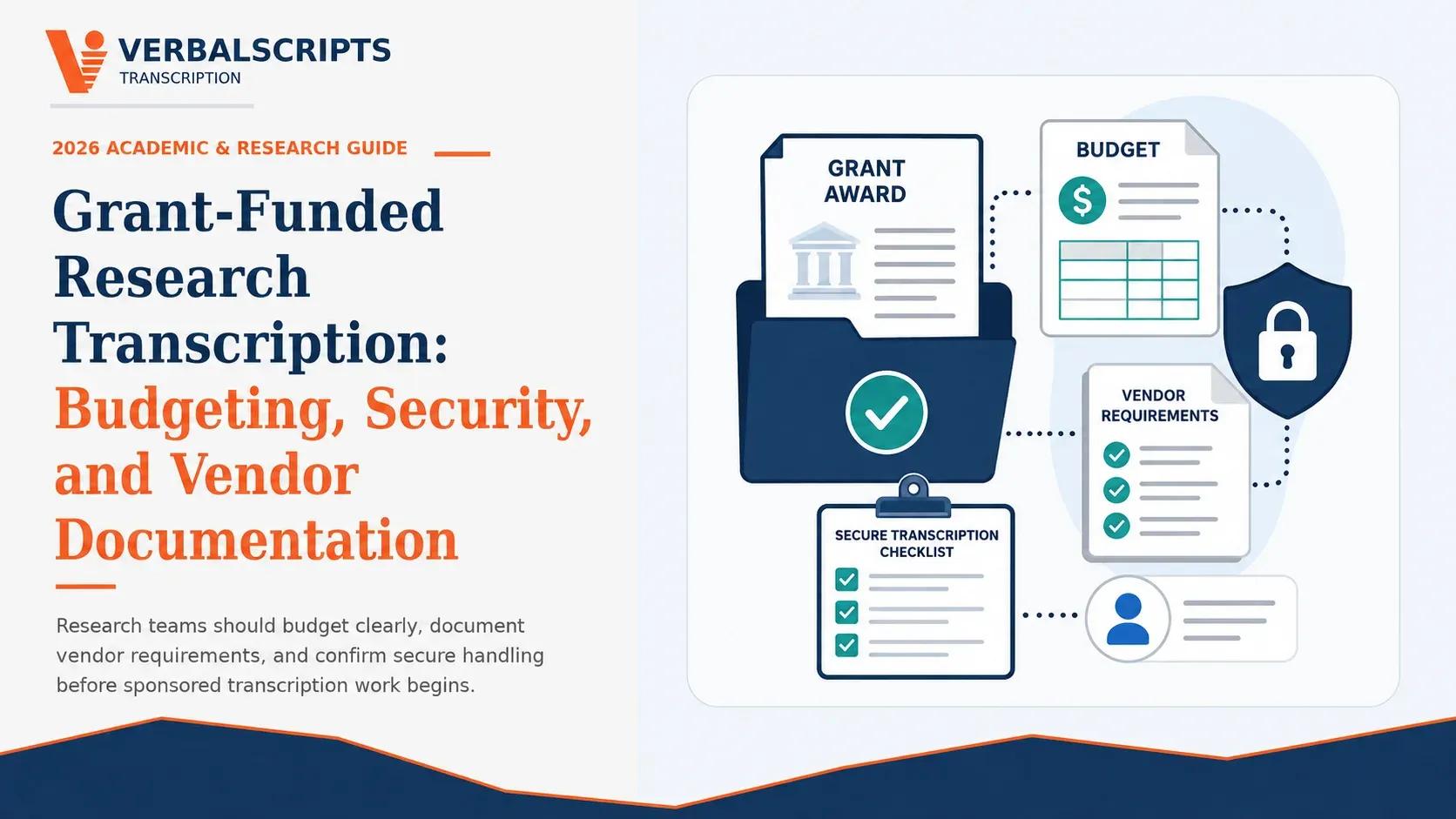
Grant-Funded Research Transcription: Budgeting, Security, and Vendor Documentation
Contents
Quick answer: Treat transcription as a planned research service with three parallel requirements: a defensible budget, a data-handling workflow, and procurement documentation. Estimate cost from total audio minutes and project complexity; make sure the vendor workflow matches the approved protocol and any Data Management and Sharing Plan; and collect the agreements your institution requires before restricted files are sent. For NIH-funded work, current DMS policy emphasizes responsible management and sharing while protecting participant privacy - so transcription should be designed into the data lifecycle, not bolted on at the end.
Grant-funded projects often have enough money for transcription but not enough time for an unexpected procurement problem. The team finishes interviewing, discovers that the vendor must complete a security review, realizes the consent form restricts third-party access, and then loses weeks during the analysis phase.
A better approach is to select and document the workflow while the study is being set up.
VerbalScripts supports academic and conference transcription, qualitative interview transcription, and research-focused workflows. Use the checklist below before requesting a project quote.
1. Build the budget from the dataset you plan to create
Do not budget “25 interviews” without duration. Calculate:
planned participants × expected minutes per session = expected audio minutes
Then apply the current vendor rate and add the specific services your protocol requires.
Example:
• 30 interviews × 60 minutes = 1,800 audio minutes;
• 4 focus groups × 90 minutes = 360 audio minutes;
• total expected dataset = 2,160 audio minutes.
Budget factors can include:
• full or clean verbatim;
• number of speakers;
• difficult audio;
• timestamps;
• multilingual transcription/translation;
• de-identification;
• specialty terminology;
• rush delivery;
• special templates or file formats.
For a detailed formula and scenarios, see Dissertation Interview Transcription Cost. The same audio-minute logic applies to many funded studies even when the overall procurement structure differs.
2. Confirm whether the cost is allowable under the award
Whether a transcription charge is allowable depends on the award terms, sponsor rules, institutional policy, budget category, and the purpose of the cost. Do not assume a general article can determine allowability for your grant.
During proposal or award setup, ask the research administrator:
• Is third-party transcription an allowable direct cost for this project?
• Was it included in the approved budget or justification?
• Does a rebudgeting threshold or prior approval apply?
• Is competitive procurement required above a dollar threshold?
• Which account/object code should be used?
• Can rush charges or translation be charged if scientifically necessary?
Document the answer in the project file.
3. Connect transcription to the Data Management and Sharing Plan
NIH’s Data Management and Sharing (DMS) Policy requires applicable researchers to submit and comply with an approved DMS Plan. NIH also emphasizes protecting privacy, rights, and confidentiality when human participant data are shared.
Transcription affects that plan because it creates a new research artifact. Ask:
• Is the transcript itself “scientific data” under the plan or a working intermediate product?
• Which version will be retained: identifiable master, coded copy, de-identified copy, or all three?
• Will transcript data be shared in a repository?
• What transformations are needed before sharing?
• Which access controls apply?
• When can recordings and vendor working files be destroyed?
A vendor should not decide these questions for the PI. The vendor should be able to implement the decisions the research team makes.
4. Review participant privacy before outsourcing
If recordings contain direct or indirect identifiers, third-party transcription changes who can access the raw data. Confirm that the approved protocol and consent language permit that access.
If the project is covered by HIPAA and the vendor acts as a business associate by creating, receiving, maintaining, or transmitting PHI on behalf of a covered entity or business associate, a BAA may be required. HHS guidance also extends business-associate obligations to relevant downstream subcontractors.
For a full vendor checklist, see IRB-Compliant Research Transcription.
5. Ask for the procurement documents early
A university purchasing office may request some combination of:
• vendor onboarding form;
• W-9 or tax documentation;
• certificate of insurance;
• NDA/confidentiality agreement;
• data-processing or security addendum;
• Business Associate Agreement, when applicable;
• accessibility documentation for a platform;
• information-security questionnaire;
• subcontractor disclosure;
• conflict-of-interest documentation;
• quote, statement of work, or purchase-order terms.
Not every institution asks for every item. The key is to identify the required package before the first deadline.
6. Define a statement of work that protects the science
A transcription SOW should cover more than price. Include:
Scope: file count, approximate audio minutes, languages, speaker count.
Transcript convention: verbatim level, pause/overlap treatment, timestamps, inaudible markers.
Data handling: transfer method, authorized access, retention, deletion, subcontractor constraints.
Deliverables: formats, naming convention, participant codes, QDAS-ready structure if needed.
Quality: review stages, glossary use, correction process.
Schedule: rolling batches, final due date, rush conditions.
Acceptance: how long the research team has to report corrections and what counts as a revision.
This turns “transcribe our interviews” into a reproducible service.
7. Use rolling transcription to reduce project risk
For a multi-month study, do not wait until the last participant is interviewed. Transcribe a pilot and a small early batch. This lets the team detect:
• recording problems;
• confusing participant-code rules;
• terminology errors;
• transcript convention issues;
• de-identification problems;
• QDAS import quirks.
Fixing a template after three interviews is manageable. Fixing it after 80 is expensive and can threaten the analysis timeline.
8. Plan for Certificates of Confidentiality when applicable
Many NIH-funded studies involving identifiable, sensitive information receive Certificates of Confidentiality automatically under NIH policy. A Certificate has specific protections and responsibilities; it is not simply a general confidentiality promise.
If the project is covered, the PI and institution should determine how those obligations affect disclosure, vendor access, and contract language. The transcription company should receive only the operational instructions it needs to comply with the research team’s requirements.
9. Control the transcript versions
Funded projects can generate several variants:
1. original audio;
2. first transcription draft;
3. quality-reviewed transcript;
4. researcher-corrected transcript;
5. coded/annotated copy;
6. de-identified sharing copy.
Use version identifiers and decide which artifacts are official. A simple version log prevents an analyst from coding an outdated transcript after a correction was made.
10. Budget for the end of the project, not just data collection
The final quarter can create extra needs: quote verification, publication-related de-identification, reformatting for an archive, or transcription of follow-up interviews. Keep a small reserve when sponsor rules allow, and schedule vendor closeout before the account end date.
Vendor evaluation table
Can you follow our approved data-handling restrictions?: Protocol alignment
Who will access the files?: Confidentiality and least-necessary access
Do you use subcontractors?: Downstream risk and contractual obligations
Can you execute required agreements?: Procurement/HIPAA readiness
What are retention and deletion terms?: DMS/IRB lifecycle control
How do you mark uncertainty?: Scientific integrity
Can you use our participant codes and glossary?: Dataset consistency
Can you deliver in rolling batches?: Analysis schedule
What is the revision process?: Quality and version control
Frequently asked questions
Can grant funds pay for transcription?
Often they can when transcription is necessary for the approved research, but allowability depends on the specific award and institutional rules. Ask the grant administrator rather than relying on a generic pricing page.
Does NIH require a particular transcription vendor?
There is no general NIH rule naming a particular commercial transcription provider. The project must meet the award, DMS, human-subjects, privacy, security, and institutional requirements that apply to it.
Should transcription be included in the DMS Plan?
The plan should accurately describe the management and sharing of applicable scientific data. Whether intermediate transcripts are specifically addressed depends on the project. Align the transcription workflow with the approved plan and institutional interpretation.
What if the vendor changes subcontractors mid-project?
If subcontractor identity or processing location is material to your protocol, BAA, data-use agreement, or security approval, the contract should require notification or approval before the change.
Can VerbalScripts provide a project quote before files are uploaded?
Yes. A useful quote can be based on estimated minutes, speaker count, language, transcript convention, security/contract needs, and schedule. Request a quote before transferring sensitive source files.
Scope the research workflow before the award clock is running
A well-planned transcription vendor should disappear into the research operations: predictable cost, controlled access, consistent output, and no surprise at the coding deadline. If you are preparing a grant-funded qualitative, clinical, policy, or mixed-methods study, send the project parameters to VerbalScripts and ask for a written transcription scope that your research and procurement teams can evaluate.
Compliance note: Sponsor rules, IRB determinations, HIPAA status, and institutional procurement requirements are project-specific. This article is not legal or grants-management advice.
Authoritative references
• NIH Data Management and Sharing Policy
• NIH, Writing a Data Management and Sharing Plan
• NIH, participant privacy best practices
Subscribe to our newsletter.
Get latest updates for our Articles & Blogs. We post fresh content every week.
- Weekly articles
- Stay updated with our weekly articles covering various topics.
- No spam
- We respect your inbox. No spam, just valuable content.

Sign up for our monthly newsletter