How Background Noise Affects Medical Dictation Accuracy
Contents
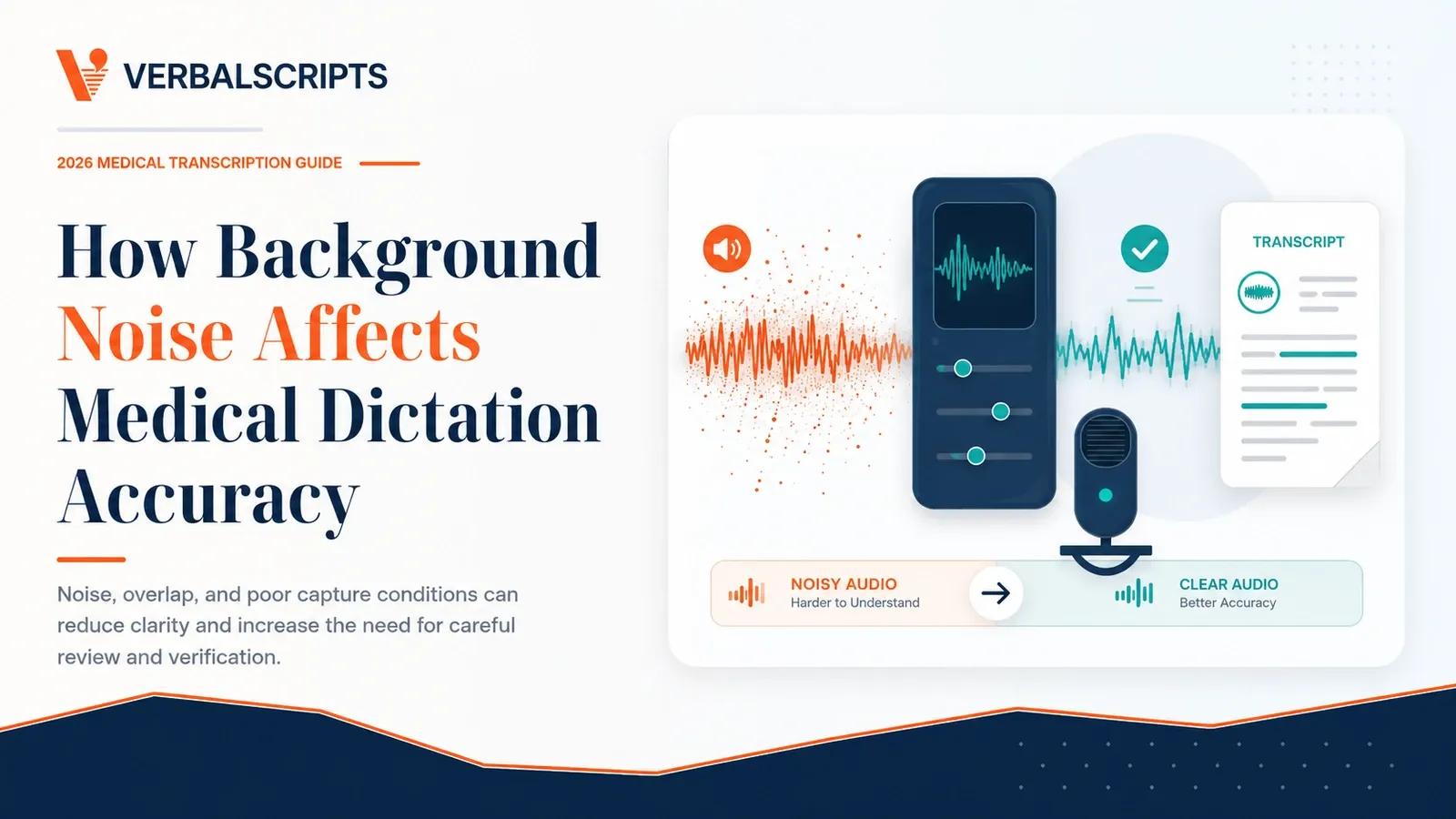
Quick answer: Background noise reduces medical dictation accuracy by masking consonants, drug names, numbers, negations, and word boundaries. Echo, clipping, low volume, movement, and overlapping voices can be as damaging as steady noise. Prevention—quiet location, close microphone, stable device, and immediate sound check—is more reliable than later enhancement. Unrecoverable words should be flagged, not guessed.
Noise does not affect every word equally
Consonants, short function words, and unstressed syllables are often masked first. In medical speech, this can change meaning: “with” versus “without,” “hyper” versus “hypo,” or a decimal and unit can disappear in noise.
Common audio problems
ProblemEffectBest prevention
HVAC or fan hum
Masks low speech and creates fatigue
Move away or use a close microphone
Paper and keyboard noise
Covers nearby words
Place device on stable surface and pause handling
Room echo
Smears syllables
Use a smaller furnished room
Clipping
Permanently distorts peaks
Lower input level and avoid speaking too close
Low volume
Raises noise when amplified
Keep a consistent microphone distance
Overlap
Two voices compete
One speaker at a time
Bluetooth dropouts
Removes audio segments
Test connection or use wired/approved device
Why enhancement has limits
Noise reduction can lower steady background sound, but aggressive processing may remove speech detail or create artifacts. Clipped or missing audio cannot be reliably reconstructed. Enhancement should be performed on a working copy while preserving the original.
A professional transcriber may use repeated listening, channel separation, moderate filtering, and context. If the word remains uncertain, the transcript should mark [inaudible] or raise a query.
High-risk content needs extra attention
Review medications, dosages, allergies, laterality, measurements, dates, diagnoses, procedure names, and negative statements twice. A single masked syllable can produce a plausible but wrong term.
Improve capture at the source
Dictate in a quiet private room.
Keep the microphone close and consistent.
Do not hold the device against clothing.
Avoid speakerphone.
Pause paper handling and keyboarding.
Run a short test recording.
Correct errors in full.
Repeat critical numbers and unusual terms when needed.
See How to Prepare Medical Dictation for Accurate Transcription.
When to request re-dictation
If a critical report is extensively clipped, incomplete, or inaudible, re-dictation may be safer than extended guesswork. The organization should define when transcriptionists escalate and who decides whether a report can proceed.
Document uncertainty
Use consistent notation and, where useful, timestamps. Do not insert a probable word without marking uncertainty. A query can include the surrounding phrase and timestamp without proposing a diagnosis or treatment choice.
Different noise patterns require different responses
Steady noise such as a fan may be partially reduced because its pattern is predictable. Irregular noise—doors, alarms, paper movement, coughs, or another conversation—is harder because it overlaps speech unpredictably. Reverberation is also difficult: the room creates delayed copies of the speaker's voice, blurring consonants and word boundaries.
Clipping is especially serious. When the input level is too high, the waveform is cut off and speech detail is permanently distorted. Turning down the volume after recording does not restore the lost information. A short test recording is the most effective way to catch this problem.
Use a controlled audio-enhancement process
Keep the untouched original, create a working copy, and document material processing. Apply the least aggressive enhancement that improves intelligibility. Overprocessing can make a waveform look cleaner while removing quiet consonants or creating metallic artifacts. The final transcript should still disclose unresolved uncertainty.
For critical reports, a second reviewer can listen to both the original and enhanced versions. Context documents may help confirm spelling, but they should never be used to force an unclear word into a predetermined answer.
Measure audio quality before assigning a deadline
A provider should sample the actual file rather than relying only on the client's description. Ten minutes of severe overlap may take longer than an hour of clear dictation. Early assessment allows the provider to quote realistic turnaround, identify sections that may remain inaudible, and request re-dictation while the encounter is still recent.
Organizations with recurring problems should audit recording locations, device settings, and clinician habits. Small changes in microphone placement and room selection often improve quality more than expensive post-production software.
FAQs
Can software remove all background noise?
No. It can reduce some noise, but cannot restore speech that was masked, clipped, or never recorded.
Is low volume better than clipping?
Low volume may sometimes be amplified, but it also raises noise. Proper level is best; clipping is often irreversible.
Why are medication names especially vulnerable?
Many sound alike, and a small masked syllable can change the drug or dose.
Should transcribers guess from context?
No. Context can guide review, but unresolved words should be flagged or queried.
Does a better microphone solve everything?
It helps, but room acoustics, placement, speaking habits, network quality, and device settings also matter.
Can multiple recordings help?
Yes. Separate channels or a second source may clarify overlap, but the sources must be synchronized and documented.
Should noisy files take longer?
Usually. They require repeated listening, possible enhancement, and additional review.
Work with Verbalscripts Transcription
Verbalscripts provides human transcription, editing, review, proofreading, and formatting for legal, medical, research, and professional recordings. Projects can be delivered in Word, PDF, RTF, TXT, or a client-supplied template, with timestamps, speaker labels, line numbering, and certification options where appropriate.
For sensitive material, project access can be limited to assigned personnel, and all transcribers are bound by confidentiality obligations. Share the recording length, intended use, required format, deadline, and any governing security requirements through our secure quote request or secure project dashboard.
This article provides general information and is not legal, medical, regulatory, or compliance advice. Requirements vary by jurisdiction, organization, contract, and intended use.
Subscribe to our newsletter.
Get latest updates for our Articles & Blogs. We post fresh content every week.
- Weekly articles
- Stay updated with our weekly articles covering various topics.
- No spam
- We respect your inbox. No spam, just valuable content.

Sign up for our monthly newsletter