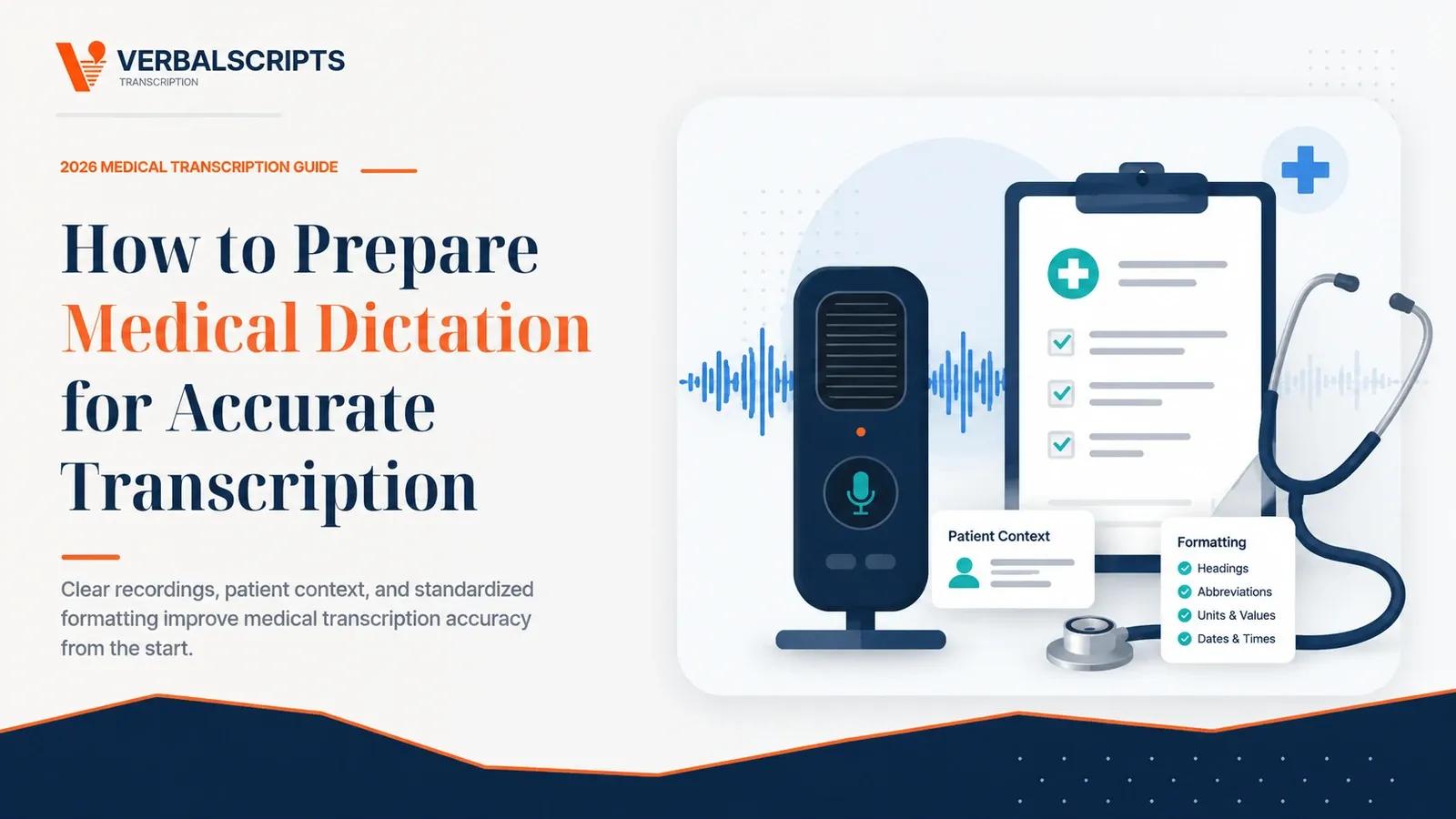
How to Prepare Medical Dictation for Accurate Transcription
Contents
Quick answer: Accurate medical transcription begins with clear dictation. Identify the patient and report type according to policy, dictate in a quiet setting, follow a consistent section order, speak punctuation and formatting instructions clearly, spell unusual names and terms, state units and medication details carefully, and correct errors immediately. Send the audio through an approved secure workflow with the required template and context.
Why dictation quality matters
Medical transcription accuracy depends on both the transcriber and the source recording. A highly trained editor cannot reliably recover a drug name, decimal, laterality, or diagnosis that was clipped, masked by noise, or never spoken. Good preparation reduces queries, turnaround delays, and downstream correction risk.
A practical medical dictation checklist
Before dictatingDuring dictationBefore submission
Confirm patient and encounter under organizational policy
Speak at a steady, natural pace
Verify the recording saved and is complete
Select the correct report type and template
Use a consistent clinical sequence
Add required priority or turnaround status
Move to a quiet, private location
Spell unusual names and terms
Send through an approved secure channel
Check microphone position and battery
State medication, dose, route, frequency, and units clearly
Attach templates, reference lists, or prior notes if permitted
Start with the required identifiers
Follow the facility's policy for patient identifiers. Common fields include medical-record number, encounter date, clinician, location, report type, and referring provider. Avoid speaking unnecessary identifiers into a recording if the workflow does not require them.
Clearly announce when one report ends and the next begins. Batch dictation should use a stable convention such as “End report” followed by the next patient identifier. This prevents text from being attached to the wrong chart.
Use a consistent report structure
A predictable sequence helps the transcriber recognize omissions and ambiguous transitions. Depending on the document, this may include:
chief complaint;
history of present illness;
relevant history;
medications and allergies;
review of systems;
examination;
results;
assessment;
plan;
procedure details; and
follow-up instructions.
Use the organization's approved template. Do not assume the transcriptionist should invent headings or populate missing clinical content.
Dictate medications, numbers, and units deliberately
High-risk details deserve slower, explicit delivery. State the complete medication name, concentration, dose, route, frequency, and duration. Distinguish sound-alike names by spelling when needed. Say “zero point five milligrams” rather than rushing “point five,” and follow organizational rules concerning leading and trailing zeros.
For laboratory values, dates, times, measurements, and laterality, pause briefly between items. Correct mistakes in full: “Correction: left knee, not right knee.” Do not rely on the transcriber to infer the intended side from context.
Handle names and specialized terminology
Spell patient surnames only when policy permits and the workflow needs it. Spell unfamiliar physician names, rare diagnoses, devices, procedures, research terms, and proprietary products. A current terminology list can improve consistency across recurring work.
The transcriber should flag uncertain terms rather than silently substituting a familiar word. Medical transcription editing is a quality process, not a license to make clinical decisions.
Improve the recording environment
Use a quiet, private room and keep the microphone at a consistent distance. Avoid dictating while walking through corridors, driving, eating, handling papers, or speaking over alarms and conversations. Turn off unnecessary notifications and place the recorder on a stable surface.
Record a short test when using a new device. Check for clipping, low volume, Bluetooth dropouts, and room echo. Background noise effects are discussed in How Background Noise Affects Medical Dictation Accuracy.
Speak naturally, not unnaturally slowly
A steady conversational pace is easier to follow than exaggerated word-by-word speech. Pause at section boundaries, before long numeric strings, and when changing topics. Avoid trailing away from the microphone at the end of sentences.
If punctuation is required, use consistent commands such as “comma,” “new paragraph,” and “heading.” The transcription provider should know whether spoken punctuation is to be followed literally or interpreted under the template.
Correct errors immediately
When a mistake occurs, identify the correction clearly and restate the complete phrase. For example: “Patient takes 25 milligrams—correction—50 milligrams once daily.” This is safer than saying “No, make that 50” after several intervening words.
If the recording contains a material mistake discovered later, send a documented correction linked to the file and report rather than creating an ambiguous second recording.
Protect privacy and security
Medical dictation can contain protected health information. Use only approved devices, applications, storage, and transfer methods. If an outside transcription service receives PHI on behalf of a covered entity, determine whether a business associate agreement is required. HHS explains the obligations of business associates and the Security Rule's administrative, physical, and technical safeguards on its Security Rule page.
Specify the expected output
Provide the exact template, heading order, date format, abbreviation policy, units style, signature block, carbon-copy list, and delivery format. State whether the file is a draft for clinician review or a final document requiring additional quality control.
Transcription does not replace clinician authentication. The responsible healthcare professional should review and sign documentation according to organizational policy.
FAQs
What is the best microphone distance for dictation?
Use the device manufacturer's guidance and keep the distance consistent. Too close causes breath noise and clipping; too far captures room noise.
Should clinicians spell every medical term?
No. Spell unusual, ambiguous, proprietary, or case-specific terms and any term that could be confused with a sound-alike.
Can a transcriber correct a clinical mistake?
A transcriber can flag an apparent inconsistency and follow an approved query process, but should not independently change clinical meaning.
Is medical dictation always part of the designated record set?
That depends on how the recording and transcript are maintained and used. HHS notes that covered entities are not required to record oral communications, but retained recordings used to make decisions may have different implications.
How should rushed or urgent dictation be handled?
Mark the priority clearly, provide the deadline and report type, and still include complete identifiers and context. Urgency should not remove quality controls.
What supporting documents help most?
An approved template, current provider list, terminology list, medication list, prior relevant report, and clear formatting instructions, subject to privacy policy.
Who should perform final review?
The responsible clinician or authorized reviewer should confirm clinical accuracy, completeness, and authentication before the document is relied upon.
Work with Verbalscripts Transcription
Verbalscripts provides human transcription, editing, review, proofreading, and formatting for legal, medical, research, and professional recordings. Projects can be delivered in Word, PDF, RTF, TXT, or a client-supplied template, with timestamps, speaker labels, line numbering, and certification options where appropriate.
For sensitive material, project access can be limited to assigned personnel, and all transcribers are bound by confidentiality obligations. Share the recording length, intended use, required format, deadline, and any governing security requirements through our secure quote request or secure project dashboard.
This article provides general information and is not legal, medical, regulatory, or compliance advice. Requirements vary by jurisdiction, organization, contract, and intended use.
Subscribe to our newsletter.
Get latest updates for our Articles & Blogs. We post fresh content every week.
- Weekly articles
- Stay updated with our weekly articles covering various topics.
- No spam
- We respect your inbox. No spam, just valuable content.

Sign up for our monthly newsletter