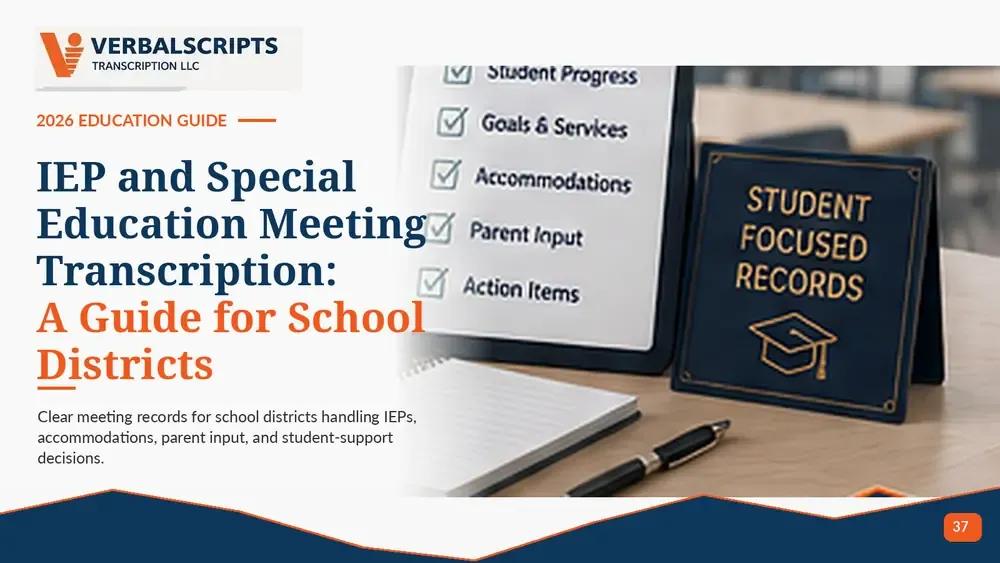
IEP and Special Education Meeting Transcription: A Guide for School Districts
Contents
Quick answer: IEP and special-education meeting transcription can give districts and families a searchable record of complex discussions, but recording and transcript use should follow state law, district policy, FERPA requirements and the IEP process. The transcript is not a substitute for the official IEP, prior written notice, meeting notes or required special-education documentation unless the district has formally defined that role.
This article provides general operational information, not legal, medical, compliance, educational or regulatory advice. Requirements can change by jurisdiction, contract, institution and facts. Confirm current rules with qualified counsel or the responsible authority before relying on a recording or transcript for a high-stakes purpose.
Quick answer
IEP and special-education meeting transcription can give districts and families a searchable record of complex discussions, but recording and transcript use should follow state law, district policy, FERPA requirements and the IEP process. The transcript is not a substitute for the official IEP, prior written notice, meeting notes or required special-education documentation unless the district has formally defined that role.
The value of a transcript comes from a controlled chain between the recording, the written record and the business decision that follows. For high-stakes projects, the transcript should be treated as a governed record: purpose defined, access limited, formatting specified, quality reviewed and retention intentional.
Why this workflow is different from ordinary meeting transcription
IEP meetings combine educational performance, evaluations, services, accommodations, behavior, health-related information, parental concerns and legal rights. Multiple participants may speak rapidly or use acronyms such as FAPE, LRE, BIP, ESY and related-service terms. The transcript needs accurate speaker attribution and should preserve the distinction between proposals, questions, decisions and unresolved issues.
A general-purpose transcript can fail even when most words are correct. Specialized work depends on correct proper nouns, role labels, dates, numbers, technical terms and the relationship between what a speaker says and the documents being discussed. The project brief should therefore include reference material and explicit conventions instead of relying on the transcriber to guess.
Recordings commonly included in scope
The exact scope should be agreed in writing. Typical recordings include IEP team meetings when recording is permitted, eligibility and reevaluation meetings, manifestation or behavior-related meetings where authorized, parent conferences linked to special-education planning, and remote IEP calls and interpreter-assisted meetings.
Not every recording should be transcribed just because it exists. Prioritize files that support decisions, audit trails, legal review, research analysis, accessibility, publication, training or another defined purpose. Reducing unnecessary transcription can lower cost and reduce the amount of sensitive text that must be governed.
Choose the transcript format around the use case
IEP team meeting — Recommended controls: Names/roles, accurate acronyms, decision language, timestamps if requested | Typical purpose: Reference and dispute prevention
Parent conference — Recommended controls: Clear parent/teacher labels; action items separated from verbatim record | Typical purpose: Follow-up and communication
Interpreter-assisted meeting — Recommended controls: Identify original speaker and interpreter consistently | Typical purpose: Access and accurate attribution
Evaluation review — Recommended controls: Preserve test names, dates and service frequencies exactly | Typical purpose: Educational planning
A seven-step production workflow
1. Confirm authority to record, share and transcribe the source material, including any required participant consent.
2. Classify the information and select a transfer/storage workflow appropriate to its sensitivity.
3. Define transcript style, speakers, timestamps, redaction, formatting and delivery specifications.
4. Supply a controlled glossary, roster and reference documents that improve names and technical terminology.
5. Transcribe against the source audio with explicit uncertain-audio and cross-talk conventions.
6. Perform an independent quality review focused on names, numbers, speaker identity, terminology and formatting.
7. Deliver to authorized recipients, resolve corrections, and apply the agreed retention/deletion schedule to source and output files.
Accuracy controls that matter more than a headline percentage
Quality should be judged against the errors that could change meaning. Names, dates, monetary amounts, measurements, negation, speaker identity and technical terminology deserve a separate review pass. A transcript with perfect ordinary grammar can still be unusable if it assigns the wrong statement to the wrong person or changes a critical number.
For difficult recordings, the provider should flag uncertainty rather than invent certainty. Time-stamped inaudible markers, alternate-hearing notes when allowed, reference requests and client clarification are signs of a controlled process. Quiet guessing is not quality assurance.
Privacy, compliance, and records management
FERPA can apply when the recording or transcript is maintained by an educational agency or party acting for it and contains personally identifiable information from education records. A contractor operating under the school-official exception must meet the institution’s criteria, perform an institutional function, be under the school’s direct control regarding use and maintenance, and observe limits on use and redisclosure. State recording laws and district policy separately determine whether the conversation may be recorded.
Data minimization is practical as well as legal. Share only the recordings and reference material required for the assignment; restrict access to the project team; avoid unnecessary identifiers in filenames; and decide how long audio, working files and final transcripts will remain available. A vendor’s default retention setting should never override the client’s documented legal or policy requirement.
What procurement should require from a transcription vendor
Districts should provide a speaker/role roster, acronym glossary, redaction instructions, secure-transfer method and explicit retention/deletion requirements. Decide whether the output should be verbatim, clean verbatim or a meeting-support transcript. If the record may be used in due process, counsel should define formatting and certification needs before transcription begins.
Beyond those subject-specific questions, evaluate secure transfer, authentication, reviewer accountability, subcontractors, corrections, service levels, incident response, deletion, backup retention and contract terms. Ask for a realistic sample using the same type of audio and formatting the production project will use.
Human review versus automated first drafts
Automated speech recognition can be useful for low-risk discovery, indexing or creating a starting draft. The risk appears when a draft is treated as final without enough review. Specialized recordings contain precisely the elements that speech recognition handles inconsistently: unfamiliar names, abbreviations, cross-talk, distant microphones, technical terminology and rapid changes of speaker.
A practical hybrid strategy is to use technology where it improves speed while keeping a human accountable for the accepted text. The buyer should care less about whether software was used at any step and more about whether the final transcript was checked against the source and meets the written specification.
How to scope a project with Verbalscripts
Start with the minimum information needed for an accurate quote: number of recordings, total minutes, approximate speakers, language, audio quality, deadline, transcript style, timestamps, formatting, certification needs and security requirements. For sensitive matters, agree on the transfer method and contract terms before sending source files.
For multi-file programs, a small pilot can establish the glossary and style guide. Once the first accepted transcript is approved, use it as the reference for the remaining batch. This improves consistency and reduces corrective work when several transcribers or reviewers are involved.
How to write a transcription specification that vendors can actually quote
A useful specification separates mandatory requirements from preferences. Mandatory items might include verbatim level, speaker naming, confidentiality, a page-line template, timestamp intervals, output file type, certification language, data-location restrictions or a fixed filing deadline. Preferences might include paragraph style, whether filler words are retained, or whether a second convenience format is delivered.
Include acceptance criteria. For example: all named speakers must match the supplied roster; every inaudible segment must carry a timestamp; numbers and dates receive a targeted review; headings must match the template; and corrections caused by vendor error are returned within an agreed period. Acceptance criteria turn “high quality” into something both parties can test.
Price the accepted transcript, not the cheapest first pass
A low per-minute quote can be expensive if it excludes human review, difficult audio, speaker identification, timestamps, formatting, rush service or project management. Normalize quotes into the same scope. If one vendor sends a raw draft and another sends a reviewed, client-ready file, the two prices are not measuring the same product.
Internal labor belongs in the calculation. Track how long attorneys, coordinators, researchers, editors or HR staff spend correcting names, speakers and formatting. A service that costs more per audio minute can have a lower total cost when it removes hours of skilled employee cleanup and reduces the chance of a consequential error reaching the final user.
Quality assurance questions for the vendor demo
Ask who performs the final review, whether the reviewer listens to the audio or only proofreads text, how low-confidence audio is escalated, whether client corrections are fed back into the project glossary, and how consistency is maintained across multiple transcribers. For recurring work, request one named style guide that follows the project rather than living in email threads.
Test edge cases deliberately. Include a name that sounds like a common word, a rapid number sequence, overlapping speakers, a quoted document and a weak-audio segment. The goal is not to make the vendor fail; it is to learn whether the workflow exposes uncertainty honestly and resolves it before delivery.
What to do after the first transcript is delivered
Review the first file promptly and return consolidated feedback. Correct participant names, preferred punctuation, role labels and template choices once, then turn those decisions into the project style sheet. Repeated piecemeal changes create inconsistency and unnecessary revision cycles.
For ongoing matters, establish version control. The file name or cover page should make clear whether a transcript is draft, reviewed, corrected or final. If a later client correction changes substantive wording, preserve the earlier version according to the organization’s records policy so users can understand what changed and why.
Frequently asked questions
Should every recording be transcribed verbatim?
No. Strict or full verbatim is appropriate when disfluencies, interruptions and exact utterances matter. Clean verbatim can be better for readable training, research or business material. Choose the style based on intended use.
Can we send a glossary or reference documents?
Yes, and doing so usually improves names, acronyms and technical terms. Send only materials necessary for the project and classify them under the same security workflow as the audio.
When should timestamps be included?
Use timestamps when reviewers need to verify quotations, navigate long files, synchronize media, find exhibits or return to disputed audio. They can be periodic or event-based depending on the workflow.
What happens when a word cannot be heard?
A quality transcript should mark the uncertainty using an agreed convention, often with a timestamp, rather than silently guessing. A reviewer can then return to the exact audio location.
Can automated transcription be used for this type of project?
Often as a draft or indexing tool, depending on the data and contract. High-consequence deliverables should receive review proportionate to the risk, especially for names, numbers, speakers, technical terms and confidential records.
What should be included in the quote request?
Provide total minutes, number of files and speakers, transcript style, deadline, timestamps, special formatting, terminology, certification needs, and the security or contractual requirements that affect the workflow.
Related Verbalscripts resources
Related resources: academic and conference transcription, general transcription services, focus group and interview transcription, professional transcription accuracy guide and Get a transcription quote.
Authoritative sources and further reading
• 34 C.F.R. § 300.322 - Parent Participation - IDEA regulation addressing parent participation in IEP meetings.
• U.S. Department of Education - FERPA - Official FERPA guidance and resources.
• 34 C.F.R. § 99.31 - FERPA exceptions permitting certain disclosures, including school-official arrangements.
Plan the transcript before the deadline is close
For a reliable scope, send Verbalscripts the project parameters before the source files: total minutes, file count, speakers, terminology, transcript style, timestamps, turnaround, format and security/contract requirements. Once the workflow is agreed, use the approved secure transfer method and start with a pilot when the project is large or sensitive.
Next step: request a written transcription quote with the exact workflow and deadline you need.
Subscribe to our newsletter.
Get latest updates for our Articles & Blogs. We post fresh content every week.
- Weekly articles
- Stay updated with our weekly articles covering various topics.
- No spam
- We respect your inbox. No spam, just valuable content.

Sign up for our monthly newsletter