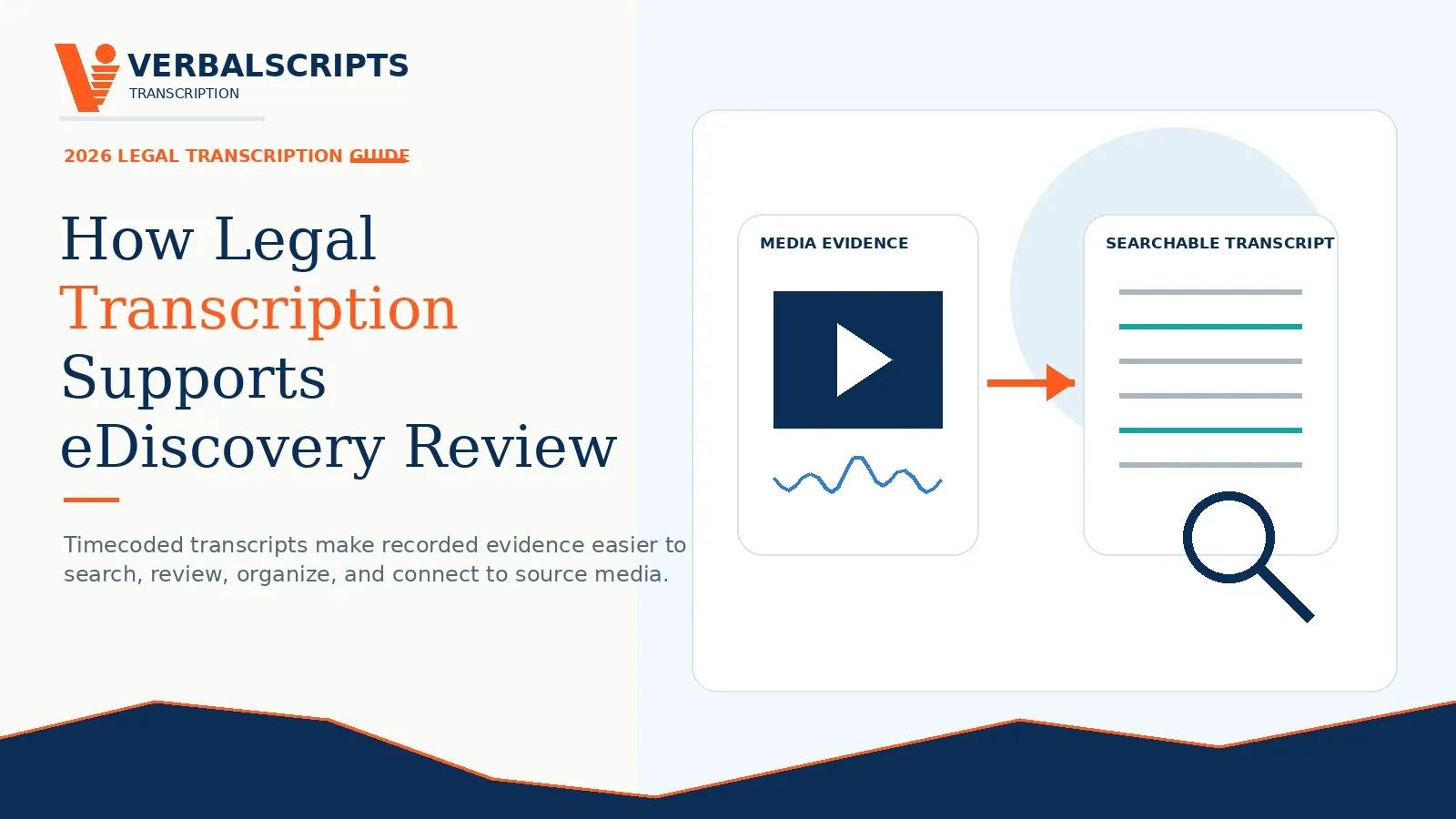
How Legal Transcription Supports eDiscovery Review
Contents
Quick answer: Legal transcription makes recorded evidence searchable, quotable, reviewable, and easier to code during eDiscovery. A synchronized transcript can help teams locate names, issues, dates, admissions, and privileged content across calls, interviews, meetings, voicemails, body-camera footage, and video. The transcript is a derivative review aid—not a replacement for the original media—so it should remain linked to source IDs, metadata, hashes, timecodes, and chain-of-custody information.
Where transcription fits in an eDiscovery workflow
eDiscovery activityHow transcription helpsControl that should remain in place
Identification
Reveals topics and speakers in otherwise opaque media
Preserve custodian, collection source, and original metadata
Processing
Creates searchable text and time-aligned segments
Keep the native audio/video unchanged and link derivatives by ID
Review
Supports keyword search, issue coding, privilege review, and notes
Verify important passages against the media
Analysis
Enables chronologies, communication maps, and testimony comparison
Distinguish transcript inference from source fact
Production
Provides readable or accessibility versions when agreed or ordered
Follow format, redaction, metadata, and load-file specifications
Presentation
Speeds clip selection and quotation
Use accurate source timecode and preserve context
Audio and video are electronically stored information. They are often harder and more expensive to review than email or ordinary documents because the content cannot be scanned quickly. Transcription reduces that friction by creating a text layer that points reviewers back to exact moments in the media.
Why audio and video create eDiscovery challenges
A litigation collection may contain:
customer-service calls;
recorded sales conversations;
voicemail;
conference and videoconference recordings;
mobile-phone videos;
surveillance files;
police interviews;
body-worn-camera footage;
recorded board or committee meetings;
podcasts or public statements;
call-center archives;
internal training recordings; and
multilingual interviews.
These files can be large, duplicated, inconsistently named, encoded in proprietary formats, and spread across custodians or systems. A reviewer may need 30 minutes to listen to a 30-minute call even when only one minute is relevant. Overlapping speech, accents, noise, playback speed, and visual context make the task more difficult.
A searchable transcript allows the review team to triage and navigate media, but it must be integrated into a defensible process. The Electronic Discovery Reference Model organizes eDiscovery into connected stages such as identification, preservation, collection, processing, review, analysis, production, and presentation. Transcription can support several stages, but it does not replace preservation or legal review.
The transcript is a derivative, not the evidence itself
This distinction should appear in the workflow documentation.
The original media may contain information that text cannot fully reproduce, including:
tone, pace, hesitation, volume, and emotion;
simultaneous speech;
environmental sounds;
gestures and visual conduct;
screen-shared exhibits;
camera movement and perspective;
silence and pauses;
edits, discontinuities, or technical artifacts; and
metadata concerning creation, export, device, codec, and duration.
A transcript represents what a transcription process concluded was said. Even a highly accurate human-reviewed transcript may contain an uncertainty notation or a disputed attribution. Reviewers should verify legally significant quotations against the original audio or video before relying on them in a filing, witness examination, expert report, or presentation.
Seven ways transcription improves eDiscovery review
1. Keyword and concept search
Once speech is converted to text, reviewers can search names, project codes, products, locations, dates, allegations, and legal concepts. Search results should link to the relevant media timecode so the reviewer can hear or see the surrounding context.
Searchability is particularly valuable when counsel does not know which of hundreds of calls contains a relevant statement. Transcription turns each file from a black box into a reviewable record.
2. Early case assessment
A targeted transcript set can help counsel understand the substance of key recordings before committing to full-scale processing. For example, the team may transcribe the longest calls, recordings involving senior custodians, or files that overlap with critical dates.
3. Issue coding and chronology building
Reviewers can tag transcript passages for liability, damages, notice, intent, compliance, causation, or privilege. Timestamps and source identifiers allow those passages to populate an event chronology without losing the connection to the recording.
4. Privilege and confidentiality review
Recorded communications may include attorney advice, medical information, trade secrets, personnel matters, or regulated data. A transcript can help identify potentially protected portions for attorney review and redaction. Automated search alone should not make final privilege decisions; context and participants matter.
5. Witness and statement comparison
A legal team can compare recorded interviews, depositions, declarations, emails, and hearing testimony. Consistent speaker labels and citations make contradictions or corroborating statements easier to locate.
6. Translation and multilingual review
A two-stage workflow—source-language transcription followed by human translation—creates a more auditable record than translating directly from unclear audio without preserving the source text. The team should maintain links among the original media, source transcript, translation, and reviewer notes.
7. Clip selection and presentation
Synchronized text helps trial teams select clips, build designations, and prepare demonstratives. Timecodes must be based on the preserved source or a documented review copy. A timestamp from a player that resets after conversion can produce the wrong citation.
A defensible audio-and-video transcription workflow
Step 1: Preserve native and original files
Do not overwrite, trim, enhance, transcode, or rename the only copy. Preserve native metadata and record how the file was collected. Where the matter's protocol requires it, calculate and retain cryptographic hashes.
Step 2: Assign stable identifiers
Every recording should have a unique media ID. Derivative transcripts, enhanced listening copies, redacted versions, translations, and clips should inherit or reference that ID.
Example:
MEDIA000184_original.mp4
MEDIA000184_review.wav
MEDIA000184_transcript_en.docx
MEDIA000184_transcript_es_source.docx
MEDIA000184_translation_en.docx
MEDIA000184_redacted.mp4
Step 3: Create a manifest
Record at least:
media ID;
original filename;
custodian or source;
collection date;
recording date if known;
duration;
format and codec;
hash where used;
language;
likely participants;
confidentiality designation;
review status; and
relationship to other files.
Step 4: Define transcription scope
Not every file needs full transcription. Possible tiers include:
machine-generated triage text followed by no reliance;
human correction of prioritized files;
full human transcription of key evidence;
timestamped event logs for visually important footage;
targeted excerpts around identified events; and
translated transcripts for selected foreign-language recordings.
The protocol should state which output is suitable for search only and which has received human quality review.
Step 5: Choose timestamp and speaker conventions
Common options include timestamps every 30 or 60 seconds, at each speaker change, at each event, or according to embedded source timecode. Speaker labels may use names, roles, participant codes, or neutral labels pending verification.
For detailed guidance, see When Should You Add Timestamps to a Transcript? and How Does Speaker Identification Work in Transcription?.
Step 6: Transcribe, review, and document uncertainty
A human transcriptionist should mark genuinely unclear speech rather than invent wording. A second reviewer should check key passages, speaker attribution, names, numbers, and source alignment. Important uncertainties can be escalated to counsel with timecodes.
Step 7: Load and link the transcript
The transcript may be loaded as extracted text, a related document, a fielded text file, or a synchronized viewer asset. Coordinate with the review platform vendor so that:
the media and transcript remain parent-child or otherwise linked;
timecodes are searchable and clickable where supported;
redactions propagate correctly;
translated and source-language versions remain distinct; and
production exports include the agreed metadata.
Step 8: Validate before production or use
Check that the transcript matches the correct file, duration, timecode, language, speaker list, and version. Verify selected quotations against the source. Maintain a change log if the transcript is corrected after review begins.
Human transcription versus automated speech recognition in eDiscovery
Automated speech recognition can be useful for triage, especially when the dataset is large. It can identify files that may contain a keyword or help prioritize review. However, error rates can rise with:
crosstalk;
low-volume speakers;
poor microphones;
noise and reverberation;
names and legal terminology;
accented or multilingual speech;
radio traffic;
emotionally charged dialogue; and
short, context-dependent words such as “did,” “didn't,” “can,” and “can't.”
The risk is not merely cosmetic. A missing negation, wrong amount, or incorrect speaker can alter legal meaning. Use human-reviewed transcription for testimony, important admissions, quoted passages, privilege decisions, production exhibits, and other high-consequence material.
Read How to Transcribe Poor-Quality Audio Accurately for a careful enhancement and uncertainty workflow.
Transcript redaction and production considerations
A transcript can expose sensitive speech more readily than the original recording because search makes it easy to find. Plan for:
personal identifiers;
protected health information;
financial-account information;
minors' names;
confidential informants;
trade secrets;
privileged advice;
sealed information;
sexual or graphic content; and
information restricted by protective order.
Redacting the transcript without redacting the source media may be insufficient. Conversely, redacting the media but producing an unredacted transcript defeats the purpose. The production protocol should define whether the native recording, transcript, redacted media, text load file, and metadata are produced together.
Common eDiscovery transcription mistakes
Losing the link to the source
A standalone transcript named Call Transcript Final.docx is difficult to authenticate or trace. Use stable IDs.
Changing the timebase
Removing silence or joining clips can shift timestamps. Preserve source timecode or document every transformation.
Treating ASR output as verified testimony
Label machine-generated text clearly and require human review before consequential use.
Ignoring nonverbal and visual context
A transcript of body-camera footage may not reveal who held an object, where a speaker stood, or what happened silently.
Over-identifying speakers
When a voice cannot be attributed reliably, use a neutral label and escalate rather than guess.
Producing inconsistent versions
Maintain version control, correction logs, and clear distinctions among draft, reviewed, translated, redacted, and final transcripts.
How Verbalscripts supports litigation review teams
Verbalscripts provides human transcription for legal audio and video, including interviews, calls, meetings, hearings, law-enforcement recordings, and selected evidence collections. All assigned transcribers are certified and vetted, sign nondisclosure agreements, and follow our transcriber agreement and code of conduct.
Our four-step quality process includes:
Transcription and editing with matter-specific terminology and style;
Independent source review for speaker attribution, names, numbers, and difficult passages;
Proofreading for completeness and consistency; and
Formatting and delivery in Word, PDF, RTF, TXT, timestamped, platform-ready, or client-defined formats.
We can follow media IDs, confidentiality labels, participant codes, file manifests, source-timecode rules, rolling batches, and retention instructions. Learn more about legal transcription, review our privacy policy, or request a scoped quote.
Frequently asked questions
Is an audio recording discoverable ESI?
It can be. Discoverability depends on relevance, proportionality, possession or control, preservation duties, privileges, and applicable rules. Audio and video should be considered during identification and collection rather than treated as an afterthought.
Does a transcript replace the native recording?
No. The transcript is a derivative review and navigation aid. Preserve the original media and verify important wording, tone, and context against it.
Can transcripts be searched in a review platform?
Yes, if they are loaded as searchable text or linked documents. The implementation depends on the platform and processing vendor. Stable media IDs and synchronized timecodes improve usability.
Should every recording be transcribed?
Not necessarily. A tiered approach can use metadata and preliminary review to prioritize likely relevant files, followed by full human transcription of high-value evidence.
How should unclear speech be handled?
Use an agreed notation such as [inaudible 00:12:41] or [unclear], preserve the source, and escalate important passages. Do not guess simply to create a complete sentence.
Can a transcript be redacted for production?
Yes, but the team should coordinate redaction across the transcript and source media. The production specification should identify which versions and metadata will be produced.
How are eDiscovery transcription costs calculated?
Pricing may be based on audio minutes, difficulty, speaker count, timestamps, translation, volume, turnaround, and formatting. See What Is an Audio Minute in Transcription Pricing?.
Final takeaway
Legal transcription can transform an audio-and-video collection from a slow, opaque review problem into searchable, coded, time-linked evidence. The defensible approach preserves originals, uses stable identifiers, documents derivatives, verifies key passages, controls access, and treats the transcript as a guide back to the source—not a substitute for it.
To scope an eDiscovery project, send Verbalscripts the file count, total duration, languages, media types, desired review tier, timecode requirements, platform or load-file needs, security restrictions, and deadline through our quote request page.
Authoritative references
Electronic Discovery Reference Model
Federal Rules of Civil Procedure — U.S. Courts
NIST Digital Evidence Preservation: Considerations for Evidence Handlers
ABA Model Rule 1.6: Confidentiality of Information
This article provides general information, not legal advice or a complete eDiscovery protocol. Preservation, collection, processing, privilege, production, and admissibility requirements vary by matter, court, jurisdiction, agreement, and order.
Subscribe to our newsletter.
Get latest updates for our Articles & Blogs. We post fresh content every week.
- Weekly articles
- Stay updated with our weekly articles covering various topics.
- No spam
- We respect your inbox. No spam, just valuable content.

Sign up for our monthly newsletter