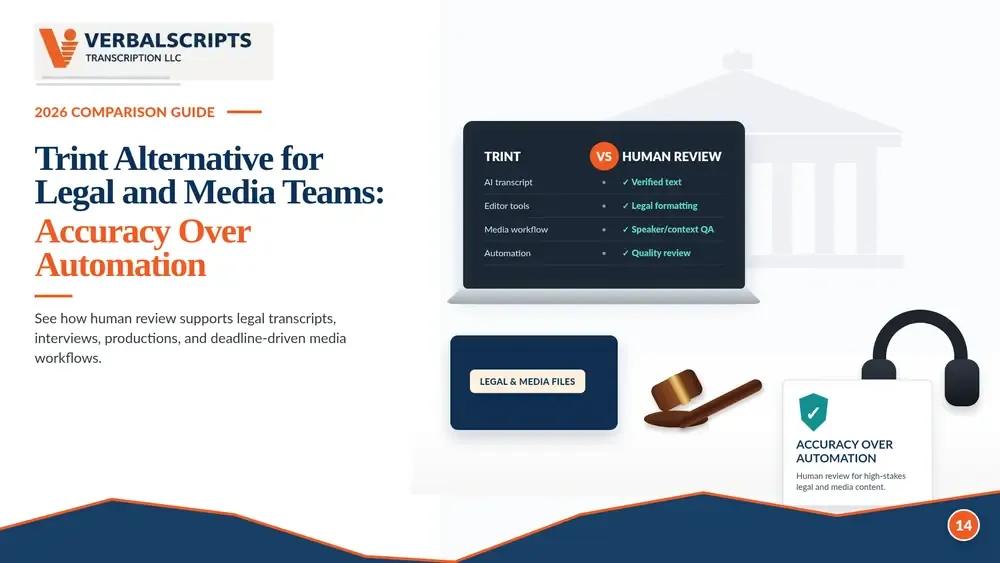
Trint Alternative for Legal and Media Teams: Accuracy Over Automation
Contents
Quick answer: This guide explains Trint alternative for professional buyers.
Quick answer: when a human-verified alternative makes sense
Trint can be a strong choice for the workflows it is designed to serve. A Verbalscripts-style human-verified service is most compelling when the buyer wants a finished transcript rather than a draft that staff must edit, or when legal, research, medical, investigative, media or executive content makes speaker attribution and wording unusually important.
The useful comparison is not “AI bad, humans good.” Modern transcription workflows often use software for upload, audio handling, playback, search or quality assistance. What matters is who is accountable for the final text, what happens when audio is difficult, whether the deliverable follows the buyer’s format, and how security and exceptions are managed.
What Trint does well in 2026
Trint is an AI transcription and content-workflow platform with strong collaborative editing, translation and story-building tools. It is particularly relevant to newsrooms, producers and teams that want to move from recorded material into searchable content quickly. A human-verified alternative becomes more attractive when the transcript itself is the deliverable and accuracy, speaker attribution or formatting cannot be delegated to the end user.
For teams that value its particular feature set, those capabilities can be more important than a traditional service model. Buyers should give the incumbent credit for those strengths rather than compare a specialist transcript service against software features they do not actually need.
Where the buying decision changes
Legal teams often need more than a searchable draft: objections, question-and-answer structure, verbatim conventions, exhibits, timestamps, confidential handling and consistent names must survive review. Media buyers may similarly need quote accuracy and clean speaker attribution before a script or publication deadline. Human review is most valuable where an error is expensive to discover after publication or filing.
A transcript has different consequences depending on use. A podcast producer can often correct a minor name error before publication. A litigation team may discover the error only when the transcript is cited against an exhibit. A research team can propagate a misheard technical term into coding. A compliance team can misunderstand who made a statement if speaker labels are wrong. Higher consequence justifies more review.
Feature comparison: platform workflow versus managed human verification
Primary operating model — Trint: Trint platform/service mix | Human-verified service: Managed human-reviewed service
Best fit — Trint: Teams valuing vendor-specific software/platform features | Human-verified service: Buyers wanting a finished reviewed transcript
Human accountability — Trint: Varies by product/service tier | Human-verified service: Human review is central to accepted deliverable
Formatting — Trint: Platform exports plus available services | Human-verified service: Client-specific legal/professional formatting
Difficult audio — Trint: Depends on workflow and review tier | Human-verified service: Human escalation and uncertainty notation
Procurement question — Trint: Which plan/service combination meets the use case? | Human-verified service: Does the project team meet the exact spec?
This table describes decision dimensions, not a universal winner. Confirm current product features and service terms directly with each vendor before procurement.
Accuracy: measure the cost of review, not a marketing percentage
Accuracy percentages are difficult to compare unless vendors use the same audio, error definition and scoring method. A claim of “up to 99%” does not mean every file reaches that level, and even 99% on a 10,000-word transcript can imply about 100 word errors before considering whether those errors fall on names, numbers or legally material phrases.
Procurement teams should run a blinded pilot using representative audio: good and bad microphones, overlapping speakers, accents, jargon and the file types that actually create risk. Score names, numbers, speaker identification and formatting separately from ordinary words. Also record how much employee time is spent correcting each output; labor is part of total cost.
Security and confidentiality: compare evidence, not logos
Ask every provider for current documentation appropriate to the risk: security architecture, encryption, identity and access controls, data retention, subprocessors, incident response, audit reports or certifications where relevant, HIPAA/BAA capability for applicable health data, and data-location restrictions if procurement requires them. A certification can be valuable evidence, but it does not answer every workflow question.
Human access is not automatically a security defect, and automation is not automatically private. The correct question is whether access is necessary, controlled, logged, contractually governed and limited to authorized people. Sensitive projects may justify a smaller reviewed workforce, matter-based permissions and explicit deletion after acceptance.
Formatting and specialization: the hidden source of rework
Generic transcript output may be perfectly acceptable for search and notes. Specialized users often require legal Q-and-A structure, page-and-line conventions, timestamps, exhibit references, research speaker IDs, redactions, medical terminology, verbatim conventions or client templates. If those requirements are added manually after transcription, the apparent software savings can disappear.
Ask the vendor to produce the exact intended deliverable during the pilot, not a simplified sample. A procurement test should include the hardest formatting rule, the trickiest proper nouns and at least one poor-audio segment. That reveals whether the workflow is truly ready for production.
Seven-step vendor evaluation process
1. Define the use case and consequence of error rather than starting with price.
2. Select three to five representative recordings, including one deliberately difficult file.
3. Give every vendor the same glossary, speaker roster and formatting brief.
4. Measure text accuracy, names/numbers, speaker attribution, formatting and reviewer labor separately.
5. Review security, privacy, contract terms, subprocessors and data-retention settings.
6. Price the complete workflow: base transcription, human review, rush, captions, exports, corrections and employee editing time.
7. Run a small paid production pilot before migrating a high-volume or high-risk program.
When Verbalscripts is the better fit
Verbalscripts is worth evaluating when the buyer wants human-reviewed output, direct handling of project instructions, legal or specialized formatting, difficult-audio judgment, confidential file handling and a clear delivery rather than an editing queue. The strongest fit is not every file; low-risk internal notes may be served efficiently by automation.
That selective approach can also reduce cost. Organizations can use AI tools for low-consequence search and reserve human verification for depositions, investigations, research interviews, executive material, publishable quotes and regulated workflows. The procurement goal is not to replace software everywhere; it is to put review where error has a meaningful cost.
How to write a transcription specification that vendors can actually quote
A useful specification separates mandatory requirements from preferences. Mandatory items might include verbatim level, speaker naming, confidentiality, a page-line template, timestamp intervals, output file type, certification language, data-location restrictions or a fixed filing deadline. Preferences might include paragraph style, whether filler words are retained, or whether a second convenience format is delivered.
Include acceptance criteria. For example: all named speakers must match the supplied roster; every inaudible segment must carry a timestamp; numbers and dates receive a targeted review; headings must match the template; and corrections caused by vendor error are returned within an agreed period. Acceptance criteria turn “high quality” into something both parties can test.
Price the accepted transcript, not the cheapest first pass
A low per-minute quote can be expensive if it excludes human review, difficult audio, speaker identification, timestamps, formatting, rush service or project management. Normalize quotes into the same scope. If one vendor sends a raw draft and another sends a reviewed, client-ready file, the two prices are not measuring the same product.
Internal labor belongs in the calculation. Track how long attorneys, coordinators, researchers, editors or HR staff spend correcting names, speakers and formatting. A service that costs more per audio minute can have a lower total cost when it removes hours of skilled employee cleanup and reduces the chance of a consequential error reaching the final user.
Quality assurance questions for the vendor demo
Ask who performs the final review, whether the reviewer listens to the audio or only proofreads text, how low-confidence audio is escalated, whether client corrections are fed back into the project glossary, and how consistency is maintained across multiple transcribers. For recurring work, request one named style guide that follows the project rather than living in email threads.
Test edge cases deliberately. Include a name that sounds like a common word, a rapid number sequence, overlapping speakers, a quoted document and a weak-audio segment. The goal is not to make the vendor fail; it is to learn whether the workflow exposes uncertainty honestly and resolves it before delivery.
What to do after the first transcript is delivered
Review the first file promptly and return consolidated feedback. Correct participant names, preferred punctuation, role labels and template choices once, then turn those decisions into the project style sheet. Repeated piecemeal changes create inconsistency and unnecessary revision cycles.
For ongoing matters, establish version control. The file name or cover page should make clear whether a transcript is draft, reviewed, corrected or final. If a later client correction changes substantive wording, preserve the earlier version according to the organization’s records policy so users can understand what changed and why.
Frequently asked questions
Is Trint inaccurate?
That would be too broad. Vendor performance varies by audio, language, speaker conditions and service tier. The right comparison is a representative pilot scored against your own requirements.
Is human transcription always more accurate than AI?
Not automatically. Human quality depends on training, review and source audio. The advantage of a managed human-verified workflow is accountability and the ability to resolve context, names, speakers and formatting before delivery.
Should we compare only per-minute price?
No. Include editing labor, rush fees, human-review add-ons, integrations, minimums, project management, security review and the cost of correcting mistakes after delivery.
Can we use both an AI platform and Verbalscripts?
Yes. Many organizations can use automation for low-risk discovery or internal notes and human-verified transcription for high-consequence files.
What should a pilot include?
Use real representative recordings, the exact output template, proper-name lists, at least one difficult file and a scoring rubric for text, speakers, names, numbers, formatting and turnaround.
How do we switch vendors without disrupting a live project?
Move in stages. Freeze the style guide, test a small batch, compare corrections, establish secure access, then migrate volume only after the new workflow passes acceptance criteria.
Related Verbalscripts resources
Related resources: professional transcription accuracy guide, legal transcription services, audio and video transcription, general transcription services and Get a transcription quote.
Authoritative sources and further reading
• Trint product - Vendor product and feature information.
• Trint security - Vendor-published security and privacy information.
• NIST Cybersecurity Framework - Framework for evaluating security and governance beyond marketing labels.
Plan the transcript before the deadline is close
If you are comparing Trint with a managed service, send Verbalscripts a representative file and the actual acceptance criteria: transcript style, speaker rules, names, timestamps, turnaround, security requirements and final format. Ask for a written quote and a production-ready sample rather than choosing from feature pages alone.
Next step: request a written transcription quote with the exact workflow and deadline you need.
Subscribe to our newsletter.
Get latest updates for our Articles & Blogs. We post fresh content every week.
- Weekly articles
- Stay updated with our weekly articles covering various topics.
- No spam
- We respect your inbox. No spam, just valuable content.

Sign up for our monthly newsletter