
Learn how to transcribe interviews accurately with this step-by-step guide and discover why Verbalscripts is your best partner.
Sep 1, 2026
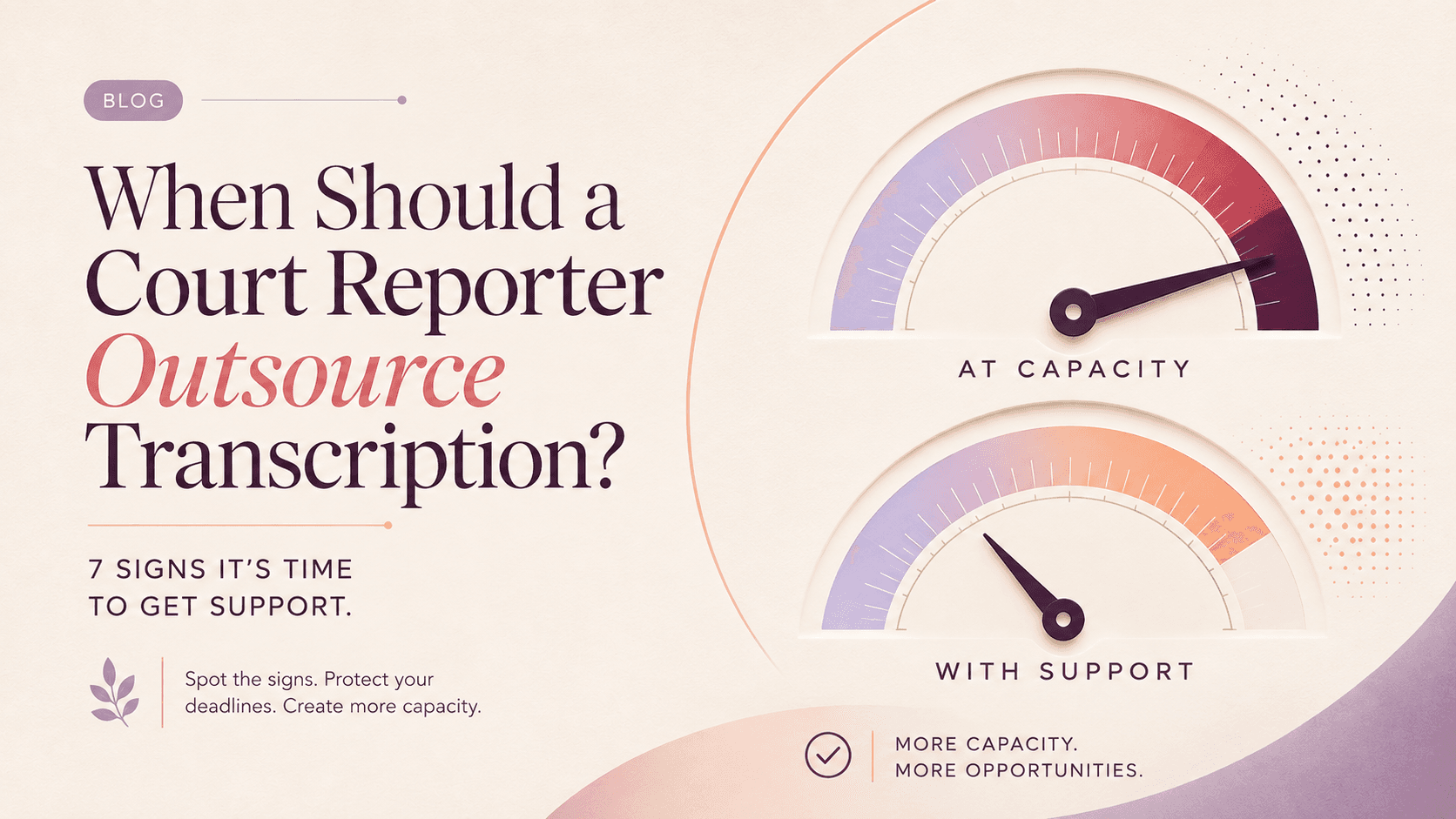
When Should a Court Reporter Outsource Transcription? 7 Signs It’s Time to Get Support
by Content Manager—6 min read
Contents
Being busy is usually a good problem to have.
More hearings. More depositions. More clients. More opportunities.
But there comes a point when the work happening after the proceeding starts affecting the work that got you there in the first place.
The hearing ends, but the transcript still needs to be produced. Then another proceeding appears on the calendar. A deadline moves closer. Another client calls.
Suddenly, the question isn't:
“Do I have enough work?”
It's:
“How am I going to get all of this done?”
For court reporters, transcription support can be a practical way to handle periods of high demand without automatically turning away work.
Here are seven signs it may be time to consider it.
1. Your transcript queue keeps growing
One unfinished transcript isn't necessarily a problem.
Neither is a particularly busy week.
The warning sign is when completed proceedings consistently turn into an expanding queue of transcripts waiting for production.
You finish one assignment and another takes its place. Before long, you are spending more time thinking about what is waiting in the queue than focusing on what's coming next.
A growing queue can also make deadlines harder to manage because every new assignment competes with work that is already outstanding.
If the queue is becoming a permanent part of your workload, it may be time to add capacity.
2. You're working on transcripts after everyone else has gone home
There is a difference between occasionally finishing a transcript late and regularly giving your evenings to transcript production.
If your normal workday ends but your transcript workload continues into the evening, the issue may not be that you need to work harder.
You may simply have more production work than your available hours can reasonably accommodate.
That matters because court reporting already requires concentration, preparation, travel, client communication and time in proceedings.
Your remaining hours are limited.
Using transcription support during particularly busy periods can give you those hours back.
3. A new assignment makes you think about your transcript queue first
This is one of the clearest signs.
A client contacts you about a new proceeding.
Instead of immediately thinking:
“Can I take this assignment?”
you think:
“When would I even have time to transcribe it?”
That's a capacity problem.
And it can become expensive.
If transcript production prevents you from accepting work that you otherwise have the skills and availability to handle, the workload isn't just consuming time—it may be limiting your earning opportunities.
The goal of outsourcing isn't necessarily to hand over everything.
It can simply give you additional capacity when your own production workload reaches its limit.
4. Multiple transcript deadlines are starting to overlap
One deadline can be manageable.
Several deadlines landing within the same week are different.
This is particularly challenging when recordings vary significantly in length or complexity.
You may have a short urgent transcript, a long deposition, another hearing coming up and a client who has already requested a specific formatting template.
At that point, prioritizing becomes difficult because everything feels urgent.
A transcription partner can help absorb selected assignments during these periods so that your entire queue doesn't depend on the number of hours you personally have available.
5. You are turning down work because you don't have time to produce the transcripts
This is probably the most commercially important sign.
You have the opportunity.
You have the experience.
You could take the proceeding.
But then you calculate the transcription workload and decide:
“I don't have the time.”
That decision may protect your immediate workload, but repeated often, it can mean leaving opportunities on the table.
This is where outsourcing can be viewed differently.
It isn't necessarily about reducing the amount of work you do.
It's about increasing the amount of work your current capacity can support.
6. A vacation, illness or unexpected schedule change creates a transcript crisis
Transcripts don't necessarily stop being due because you are away.
A planned vacation can therefore create a difficult choice:
Enjoy your time away—or spend part of it catching up on transcripts.
The same applies when illness, family commitments or unexpected schedule changes reduce the hours available for production.
Having a trusted transcription partner available for overflow work gives you another option.
Instead of building your entire schedule around the transcript queue, you can arrange support when circumstances require it.
7. You are spending more time producing transcripts than doing the work only you can do
This may be the biggest question to ask yourself:
What work can only I do?
Reporting the proceeding.
Managing client relationships.
Preparing for upcoming assignments.
Building your business.
Being present in court.
Taking on the next opportunity.
If too much of your time is being consumed by transcript production, you may be using your most valuable hours on a task that could be supported by someone else.
That doesn't mean accuracy becomes less important.
Quite the opposite.
It means the transcription partner needs to fit your quality expectations, formatting requirements, confidentiality needs and workflow.
Outsourcing Doesn't Have to Mean Outsourcing Everything
One common misconception is that getting transcription support means handing over every transcript.
It doesn't have to.
You can use support selectively.
For example:
During a busy week: outsource overflow.
For a particularly long recording: send the large assignment out.
For an urgent deadline: request rush turnaround.
During vacation: arrange temporary production support.
When several proceedings overlap: divide the workload.
When you want to accept another assignment: use additional transcription capacity.
The right arrangement depends on your workload and how much control you want to retain.
What Should Court Reporters Look For in a Transcription Partner?
Once you decide that support could help, the next question is just as important:
Who can you trust with the work?
For court reporters, price should not be the only consideration.
Look for a provider that can demonstrate:
Strong legal transcription experience
Human review and proofreading
Confidentiality procedures and NDAs where required
Clear turnaround commitments
Rush or same-day options when available
Ability to follow your templates
Formatting according to your requirements
Compatibility with the systems and file formats you use
Reliable communication
Willingness to work as an extension of your workflow rather than forcing you into theirs
Different court and transcript workflows can also have specific procedural requirements. For example, U.S. federal courts note that transcripts from electronically recorded proceedings may be produced by private transcription services designated by the court, while individual courts can establish their own ordering and certification procedures.
That is why the intended use of a transcript should always be clear before production begins.
Where Verbalscripts Fits In
Verbalscripts provides transcription support for court reporters and legal professionals who need additional production capacity.
For court reporters, the focus is not simply on converting audio into text.
The workflow includes understanding the client's requirements, reviewing the material provided, transcription, formatting, proofreading and review before delivery.
Court reporter support can include overflow work, long recordings, urgent assignments and periods when your normal production capacity is stretched. Verbalscripts also states that its court reporter service provides human review, confidentiality protections and rush options, with transcripts returned in the client's preferred style and format.
The important point is simple:
You don't have to wait until the backlog becomes unmanageable before asking for help.
The Bottom Line
You probably don't need transcription support because you're incapable of keeping up.
You may need it because your workload has grown beyond the hours available to you.
If your queue keeps growing, your evenings are disappearing, deadlines are overlapping or you're turning down opportunities because of transcript production, it may be worth considering additional capacity.
The right transcription support should give you something valuable:
more room to do the work only you can do.
Need transcription support? Tell us what you're working with, your deadline and your formatting requirements, and we'll help you determine the best turnaround option.

Discover how to start and succeed as a courtroom transcriptionist with expert tips, training paths, and job opportunities.
Subscribe to our newsletter.
Get latest updates for our Articles & Blogs. We post fresh content every week.
- Weekly articles
- Stay updated with our weekly articles covering various topics.
- No spam
- We respect your inbox. No spam, just valuable content.

Legal TranscriptionAudio and Video Transcription servicesGeneral TranscriptionFocus groups and InterviewsMedical TranscriptionAcademic & Conference Transcription
Court reporting & LegalCorporate & general businessMedia productionDigital & online learningGovernmentHealthcare
About UsBlogsTranscription solutionsLocationsFrequently Asked QuestionsPrivacy PolicyTerms of Service
Sign up for our monthly newsletter
© Verbalscripts 2026. All rights reserved.